

Lebanese Independence Day brought a large gathering to Halifax's Pier 21, where dignitaries, community members, clergy, scouts and performers celebrated a heritage that continues to unite two countries. Amid the festivities, one question stood out: Where can Lebanon find hope?
HALIFAX | November 23, 2026
The invitation was simple: come together, bring your families and show your pride in Lebanon.
On Sunday, November 22, the Lebanese community of Nova Scotia answered that invitation with an impressive gathering at the Canadian Museum of Immigration at Pier 21, celebrating Lebanon's 83rd Independence Day and Lebanese Heritage Month in Canada.
Organized by the Honorary Consulate of Lebanon in Halifax, the celebration brought together Lebanese Canadians of different generations, Canadian friends, political representatives, religious leaders and community organizations.
The Lebanese flag was raised at 4 p.m., followed by an official ceremony and reception. But the afternoon was about much more than raising a flag. It was an occasion for friendship, remembrance, cultural pride and, perhaps most importantly, hope.
A Celebration That Reached Beyond the Community
Among the distinguished guests was Nova Scotia's Lieutenant Governor, the Honourable Mike Savage, whose longstanding friendship with the Lebanese community was evident in his warm and occasionally humorous remarks.
Savage emphasized that the Lebanese presence in Nova Scotia extends far beyond its most prominent personalities. Its influence can be found throughout the province, among families, businesses, professionals and ordinary citizens who have made Canada their home.
With characteristic humour, he suggested that he might have heard of a Lebanese developer or two.
He also alluded affectionately to a friend who had come from modest beginnings and achieved considerable success, a reference to Wadih Fares, the Honorary Consul of Lebanon.
The humour carried a larger message: the Lebanese story in Nova Scotia is not simply about individual success. It is about generations of people who have become part of the province's everyday life.
Tim Halman, MLA for Dartmouth East and Nova Scotia's Minister of Environment and Climate Change, attended on behalf of Premier Tim Houston, offering similar recognition of the community's place in the province.
Halifax Mayor Andy Fillmore also addressed the gathering, reinforcing the city's longstanding relationship with its Lebanese residents. He introduced Halifax's newly selected Deputy Mayor, Councillor Jean St-Amand, who assumed the position earlier this month.
The presence of members of Parliament, provincial legislators and other dignitaries reflected the strong ties between the Lebanese community and Nova Scotia's public institutions.
Lebanese clergy, including priests and nuns, were also among those gathered, adding a spiritual dimension to an occasion that brought together people from different backgrounds.
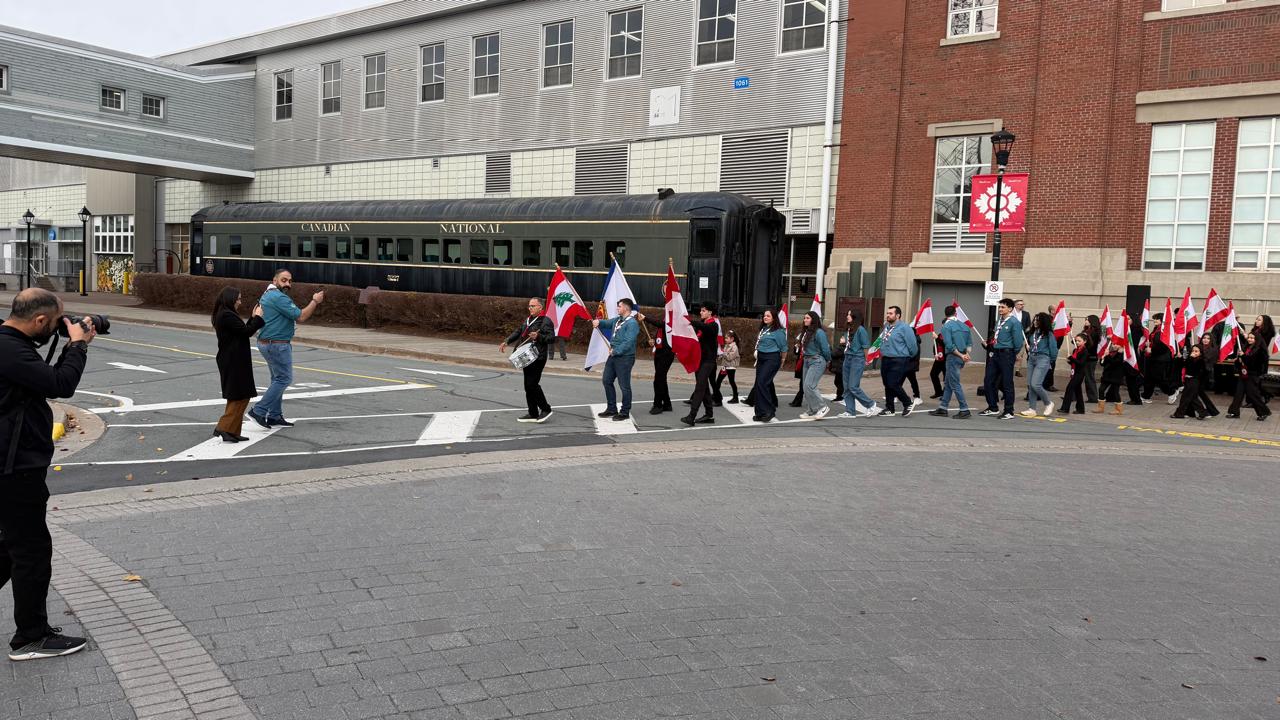
The Scout Libanais deserve special recognition for their assistance throughout the celebration. Their participation brought youthful energy to the event and demonstrated the importance of involving younger generations in community traditions.
Their procession, accompanied by Lebanese and Canadian flags, offered one of the afternoon's most meaningful images: young people proudly carrying the symbols of a heritage they have inherited and a country they now call home.
A Grandchild, ChatGPT and a Difficult Question
One of the afternoon's most memorable moments came during the heartfelt address delivered by Honorary Consul Wadih Fares.
Rather than offering only the familiar words of celebration and national pride, Fares shared a personal story involving his grandchild and an unusual search for optimism.
He recounted how his grandchild turned to ChatGPT in search of something positive about Lebanon, hoping to find an encouraging development or a reason for optimism amid the country's continuing difficulties.
The search, however, failed to produce the hopeful answer he had been looking for.
The disappointment brought to mind a familiar appeal Fares has repeatedly made: “Give us some hope, General.”
It was a revealing moment. When even a search designed to uncover something encouraging about Lebanon struggles to offer reassurance, the country's predicament becomes painfully clear.
It was a striking anecdote, particularly on a day dedicated to celebrating a country's independence.
For many Lebanese, whether living in Lebanon or abroad, the difficulties facing their homeland are painfully familiar. Political instability, economic hardship and uncertainty about the future have made optimism increasingly difficult.
Yet Fares refused to let that discouraging answer become the conclusion of his speech.
Instead, he reminded the gathering that Lebanon remains in our hearts and that hope must survive, even when circumstances offer little reason for optimism.
His message was not that Lebanon's problems should be ignored. It was that belief in the country and its people must not disappear because of them.
His grandchild's unsuccessful search raised a question far larger than the anecdote itself: What kind of Lebanon, and what sense of hope, are we passing on to the next generation?
The answer cannot come from technology alone, nor can it be found simply by searching for better headlines. It must also come from the determination of Lebanese people, at home and abroad, to preserve what is good in their country and work toward what it could become.
Perhaps hope is not something we can always find in the news or retrieve from a computer. Sometimes, it is something we must choose to keep alive.
Music, Dance and the Lebanon We Love
The celebration also offered moments of colour, joy and cultural expression.
The Diman Association Club presented two traditional dance performances, both warmly received by the audience.
The dancers brought a lively reminder of Lebanon's cultural richness, demonstrating how music and movement can connect generations and preserve traditions far from their place of origin.
Another highlight was the screening of a tourism film showcasing Lebanon's landscapes, heritage, hospitality and cultural attractions.
The film, My Lebanon, presented as part of Lebanon's tourism promotion, drew enthusiastic applause.
For a few minutes, the audience was transported from Halifax to the country we still call home, whether through personal memories, family connections or an enduring emotional attachment.
The images offered a welcome contrast to the troubling headlines that so often dominate discussions about Lebanon.
They reminded everyone that, beyond its difficulties, Lebanon remains a country of extraordinary natural beauty, creativity, hospitality and cultural vitality.
In a way, the film offered a visual answer to the question raised during Fares's speech. Lebanon's troubles are real, but so is the beauty, resilience and human spirit that continue to define it.
Watch the film: My Lebanon — Official Tourism Campaign 2026
Two Flags, One Sense of Belonging
The choice of Pier 21 for this celebration was especially appropriate.
The museum represents Canada's immigration experience and the countless journeys that have helped shape the country.
It also holds a personal connection to Wadih Fares, who previously chaired the Pier 21 Society and helped advance the institution's development into a national museum.
For Lebanese Canadians, celebrating independence at this location brings together two important parts of their identity.
Lebanon represents their origins, family memories and inherited traditions. Canada represents the country where many have built their lives, raised their children and found opportunities.
The presence of Canadian political leaders alongside Lebanese families, religious representatives, scouts and cultural performers offered a living illustration of that relationship.
There is no contradiction in loving two countries. One can be grateful to Canada for the opportunities and security it provides while remaining deeply attached to Lebanon, its people and its future.
For many Lebanese Canadians, the two flags represent not divided loyalties, but two parts of the same life.
The Flag Was Raised. The Message Remains.
In its earlier coverage, Cedar Whispers encouraged the Lebanese community to attend the ceremony, bring children and grandchildren, and invite Canadian friends.
Sunday's strong turnout showed that the invitation had been heard.
The celebration succeeded not simply because dignitaries attended or because the program included memorable speeches and performances.
Its greatest strength was the presence of the people themselves.
There was something particularly moving about seeing children carrying Lebanese flags, young scouts marching proudly, and older generations watching traditions they had brought across the Atlantic continue to flourish.
For a community that has built so much in Nova Scotia while remaining emotionally connected to Lebanon, the celebration was both a tribute to the past and a promise to the future.
And perhaps that is where the answer to Wadih Fares's question begins.
Hope is not the denial of Lebanon's problems. It is the refusal to let those problems become the country's entire story.
Lebanon's future cannot be secured by nostalgia alone. But neither can it be built by people who have stopped believing in it.
On Sunday, beneath the Lebanese flag in Halifax, that belief was still very much alive.
Photo and Video Album
View the Lebanese Independence and Heritage Celebration photo and video album.