

by Simon Yammine
There are evenings that entertain.
There are evenings that celebrate.
And then there are evenings that reveal something deeper about a people, a city, and the invisible threads that slowly bind immigrants to the country they eventually help shape.
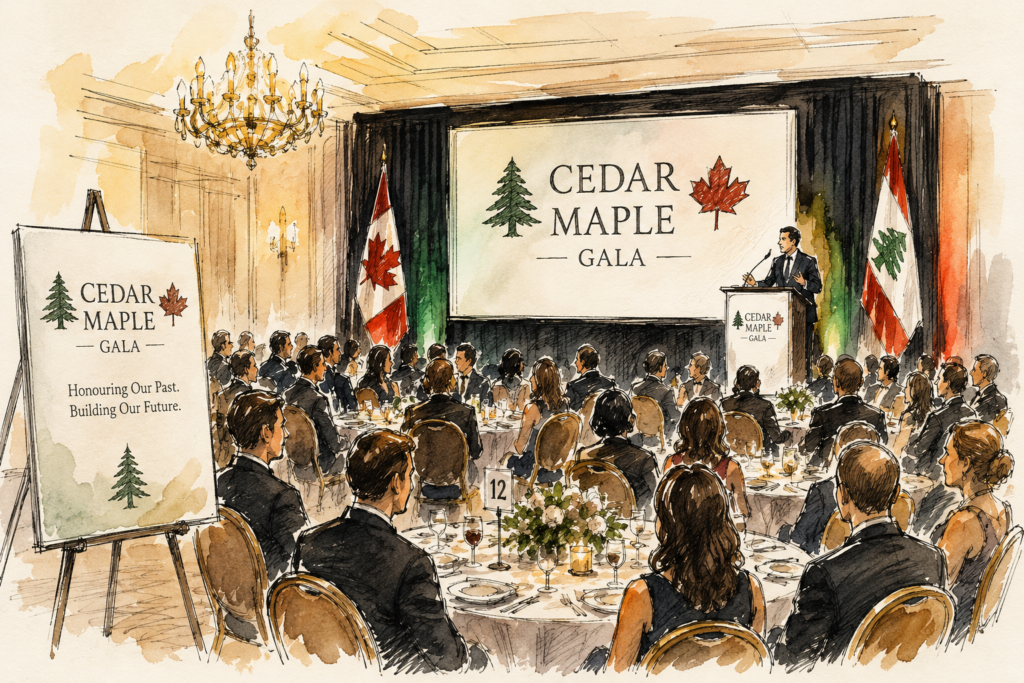
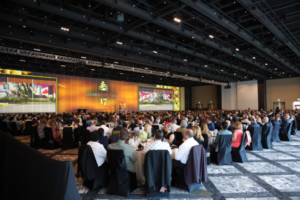
The 17th Cedar & Maple Gala, held on May 7, 2026, at the Halifax Convention Centre, was one of those evenings.
For a few hours in downtown Halifax, the Lebanese story in Nova Scotia stopped being merely an immigrant story. It became visible as a civic story, a cultural story, a business story, and perhaps most importantly, a Canadian story.
Maybe the clearest sign of that transformation was that the majority of the attendees were not Lebanese Canadians.
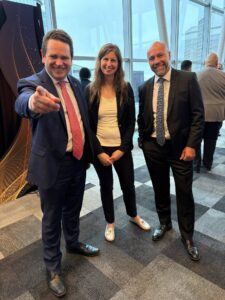
Among the distinguished attendees were former Mayor Mike Savage, Andy Fillmore, alongside politicians, bankers, developers, academics, business executives, municipal leaders, professionals, students, entrepreneurs, and community figures from across Nova Scotia, all gathered alongside Lebanese Canadians for what has quietly become one of the province’s most respected and anticipated business and cultural events.
That detail mattered.
Because the evening was not built around nostalgia alone.
It was built around contribution.

Few venues could have represented the evening more symbolically than the Halifax Convention Centre, one of the architectural symbols of Nova Scotia’s transformation over the last two decades.
Yet for many in the Lebanese community, the building represented something even more personal. The project itself was closely tied to the Ramia family and their role in major construction and development execution in Atlantic Canada.
A Lebanese Chamber of Commerce gala.
Celebrating Lebanese contribution.
Held inside one of Halifax’s most important modern landmarks shaped through Lebanese entrepreneurship.
It reinforced a runnibg joke in the city:
“What is Nova Scotia’s official provincial bird?”
The Osprey?
No…The Lebanese crane.
Lebanese entrepreneurs did not simply participate in Halifax’s growth. They helped redefine it.
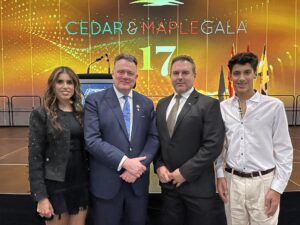
Lieutenant Governor of Nova Scotia, and former Halifax Mayor, Mike Savage once reportedly stood near the windows of City Hall, pointed toward the growing skyline, and remarked: “All that pointing to the sky is Lebanese. They reshaped the city skyline.”
The Lebanese Chamber of Commerce in Nova Scotia has spent seventeen years transforming the Cedar & Maple Gala into something larger than a community dinner.
The structure itself has become ceremonial.
Like previous editions of the gala, this year continued the Chamber’s evolution from networking organization into civic institution.
Yet what distinguished the 2026 edition was its maturity. Everything felt intentional.
The pacing.
The speakers.
The emotional sequencing.
The symbolism.
Unlike many diaspora events dominated by one central corporate sponsor, the Cedar & Maple Gala carried broad support across multiple financial institutions and businesses. Banks and major organizations competed for visibility and presence, reflecting the growing influence and prestige of the Chamber itself.
Organizations were not attending out of obligation. They wanted to be there.
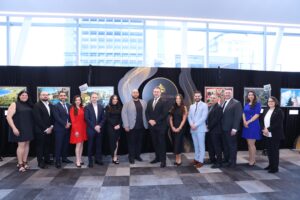
Much of that transformation reflects the leadership of Norman Nahas.
Nahas has helped shape the Chamber into something increasingly focused not simply on preserving identity, but on translating heritage into opportunity. Entrepreneurship, Professional networking, Youth support and Cultural diplomacy are the modus operandi. Programs associated with the Chamber increasingly reflect a long-term vision centered around intergenerational continuity.
The Lebanese story in Nova Scotia is no longer simply about surviving immigration.
It is about shaping the future.
Nahas captured that philosophy beautifully during his remarks: “Canada offers opportunity, but it’s up to each of us to turn it into something meaningful.”
That sentence lingered throughout the ballroom because it summarized something essential about the Lebanese immigrant experience.
The first Lebanese immigrants who arrived in the Maritimes in the late nineteenth century did not arrive with institutions, wealth, or influence. Many came with little more than cloth bags and merchandise samples. They became peddlers. Travelling town to town across isolated communities throughout Nova Scotia and the Maritimes, they built relationships before they built businesses.
They survived first.
Then they built.
Then they contributed.
Generations later, their descendants are funding scholarships, building towers, reshaping skylines, leading companies, transforming industries, and actively contributing to the identity and future of the province itself.
Those scholarships remain an important part of that legacy. Like every year, the evening celebrated scholarship and bursary recipients, something Nahas proudly emphasized in his remarks: “We’re also proud to highlight our scholarship and bursary recipients. Students who are already making an impact, and who represent the future of this community.”
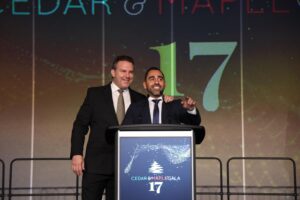
Every great evening depends on rhythm.
Amir Toulany,master of ceremonies, carried that balance with remarkable elegance. The evening flowed with coherence rarely achieved at large community events. Perhaps that balance comes from somewhere deeper than public speaking itself, maybe the dabkeh he excelled at.
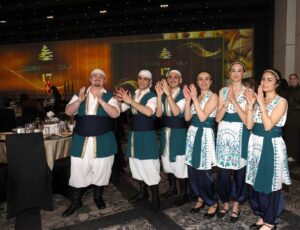
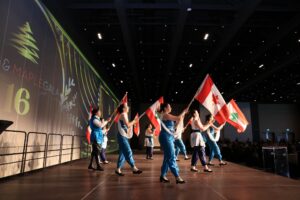
Throughout the evening, Toulany guided the gala almost like a dabkeh line itself: controlled, collective, emotional, and deeply Levantine in spirit. The atmosphere was further elevated by the excellent performance of Saint Antonios Dabkeh Group, whose presence brought rhythm, energy, and cultural authenticity to the evening.
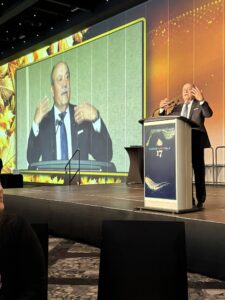
Among the evening’s most memorable remarks were those delivered by Lebanese Honorary Consul Wadih Fares.
Few figures embody the Lebanese-Canadian story in Nova Scotia more visibly than Fares. Through decades of work in development, business leadership, and civic engagement, he became one of the province’s most recognizable Lebanese figures. Through the W.M. Fares Group, his influence became physically embedded into the growth of Halifax itself.
Yet despite his stature, his remarks remained deeply human. “It is the cedar and the Maple together. Both have a strong symbol on their own.
The cedar, with its deep roots and enduring resilience… and the Maple, a symbol of openness,
opportunity, and unity.
Together, they create something stronger, more resilient, and more enduring than either could alone.”
The symbolism resonated immediately. Because the speech rejected the false choice many immigrants are often asked to make between heritage and belonging.
The Cedar and the Maple were never competing identities.
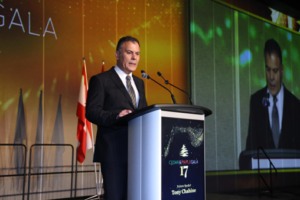
If the gala had a gravitational center, it was keynote speaker Tony Chahine.
The founder and CEO of Myant represents a uniquely modern Lebanese success story.
Not merely a businessman.
A futurist.
A man attempting to redefine the relationship between humanity, textiles, artificial intelligence, healthcare, and technology itself.
Myant’s work in textile computing, embedding intelligent sensors and health-monitoring systems directly into fabric, sits at the intersection of advanced materials, engineering, AI, and medicine.
Its vision sounds almost science fiction:
Garments capable of continuously monitoring health conditions.
Textiles communicating with machines.
Human-centered AI ecosystems.
Preventive healthcare woven directly into everyday life.
Yet what moved the audience most that evening was not innovation.
It was suffering.
During his reflections, Chahine spoke openly about one of the defining traumas of his life during the Lebanese Civil War. He recounted being kidnapped for ransom during the conflict. Recognizing one of the perpetrators, Tony was eventually shot and left to die.
The experience redefined him both physically and psychologically. He described spending nearly two years in what felt like a coma-like state.
Inside the ballroom, the atmosphere shifted instantly.
Because suddenly the innovator on stage became recognizable not as a distant success story, but as something profoundly Lebanese: A survivor and perhaps that is the hidden thread connecting so many Lebanese immigrant stories.
Like countless Lebanese immigrants who arrived in Canada carrying invisible scars from war, instability, exile, and uncertainty, Chahine transformed trauma into relentless creation. He arrived in Canada in 1990 and rebuilt his life through innovation: Battery technologies, Retail transformation, Advanced manufacturing, Deep-tech systems, Textile computing and Artificial intelligence.
But beyond technology itself, his message carried something philosophical. He argued that Canada must become a true “making economy.” That innovation only matters when nations can prototype, manufacture, commercialize, and scale together rather than simply consume ideas developed elsewhere.
For younger Lebanese Canadians in the audience, his presence represented something deeply important. Proof that suffering does not eliminate possibility.
One of the evening’s most emotional moments came through the speech and documentary presentation presented by Dr. Anthony Rahayel.
Known globally through NoGarlicNoOnions, Rahayel has spent years documenting Lebanese culture, food, memory, and identity through digital storytelling. What began as food content gradually evolved into something much deeper: cultural preservation.
His journey from dentist to storyteller became one of the most recognizable Lebanese media success stories in the Arab world.
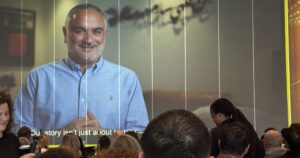
Anthony captured more than 50 hours of footage across Nova Scotia throughout three separate visits within a single year, spending a total of nearly 20 days exploring and documenting the Lebanese story across the province. Deeply captivated by the community’s history and evolution, he became genuinely passionate about telling its story. Multiple episodes featuring the people, places, and stories encountered throughout the province are expected to be released in the coming months.
But what touched the audience in Halifax most deeply was not celebrity. It was sincerity.
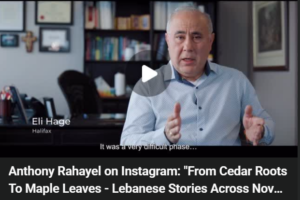
The short film transformed the atmosphere of the entire evening. (Anthony Rahayel’s Nova Scotia Documentary Preview)
The Lebanese story in Nova Scotia does not belong only to Halifax.
It belongs to roadside diners.
To grocery stores.
To church basements.
To forgotten family businesses.
To small towns where Lebanese immigrants quietly built lives generations ago.
The documentary carried enormous emotional weight precisely because it focused not on fame, but on memory.
Not on success alone. But on sacrifice.
 Every gala has awards.
Few have moments of collective silence.
This one did.
Among the evening’s most unforgettable moments were the stories of Jasmine Ghosn and Bassima Jurdak.
Recipient of the Lebanese Professional of the Year award, Jasmine Ghosn represented a different dimension of the Lebanese-Canadian experience.
Born in Canada, her story reflected the second-generation transition from survival to institutional participation. She spoke about watching her family struggle to preserve their business during difficult conflict involving municipal systems and economic pressures.
This experience changed her life. They pushed her toward law. Not out of prestige. But out of necessity. Her story reflected something deeply familiar within immigrant communities: The child who grows up watching instability too closely and decides they must learn how systems work so their family never becomes powerless again.
The room listened quietly. Because almost every immigrant family recognizes some version of that story.
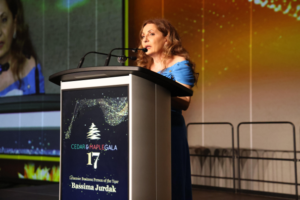
Then came Bassima Jurdak and the atmosphere changed completely.
Recipient of Lebanese Business Person of the Year, Jurdak spoke about growing up within a poor family where education itself required sacrifice and endurance from a widowed mother and scarifying siblings.
Yet what made her reflections extraordinary was how deeply they connected personal struggle to intellectual heritage. She spoke about her home, in Marjaayoun now besieged by a war her inhabitants did not choose, surrounded by books. Those were the heritage of her uncle, the legendary Lebanese writer George Jurdak.
George occupied a remarkable place in modern Arabic literature and philosophy. He represented something uniquely Lebanese: A Christian Arab intellectual capable of writing about Islamic figures with profound admiration, humanism, and literary brilliance. He also wrote poetry, criticism, journalism, historical novels, theatrical works, and philosophical literature that influenced generations across the Arab world.
Now his legacy lives in Access Language Services’ network, of more than 600 interpreters across the globe, tending to the newcomer, the poor, the helpless…
Yet perhaps that too reflects the Lebanese story itself: A small nation producing disproportionate influence in literature, commerce, philosophy, journalism, medicine, engineering, and entrepreneurship across continents.

Another powerful moment of the evening came through the recognition of Roma Engineering, led by Roland Hage, recipient of the Lebanese Business of the Year award. The company’s recognition symbolized the broader Lebanese contribution to Nova Scotia’s engineering, construction, and infrastructure sectors, industries where Lebanese professionals have helped shape not only businesses, but the physical growth of the province itself.

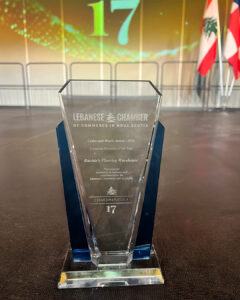
The evening also honored Ritchie’s, represented by Trevor Ritchie, recipient of the Canadian Business of the Year award. The inclusion of a non-Lebanese business among the night’s highest recognitions remains one of the Cedar & Maple Gala’s most important traditions. It reflects the philosophy repeatedly echoed throughout the evening: that the Lebanese story in Nova Scotia was never built in isolation, but through partnership, collaboration, and mutual respect with the broader Canadian community. In many ways, recognizing Ritchie’s was not simply about business excellence. It was about acknowledging the relationships and alliances that helped transform immigrant communities from newcomers into co-builders of Nova Scotia’s future.
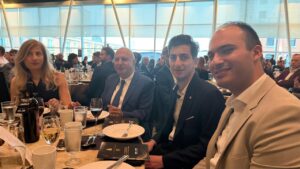
Among the distinguished attendees was Charles Khabouth, the Lebanese-Canadian entrepreneur and visionary behind some of Toronto’s most iconic restaurant and hospitality concepts. His presence reflected another reality increasingly visible at the Cedar & Maple Gala: Halifax’s Lebanese community is becoming nationally connected. His attendance reflected the growing national recognition of the gala itself within Lebanese-Canadian circles stretching from Montreal to Toronto and beyond.
He joined a legacy of Lebanese restaurat owners from Nahas to Kaadou to Hage, alongside gourmet caterer Bassam Karam all under one roof degustating a superb Lebanese fusion dineer fueled by kefraya Lebanese wine and ended by Lebanese Unica treat.
Perhaps the most remarkable aspect of the evening was this: The gala never felt exclusionary.
Despite its strong Lebanese identity, the atmosphere remained profoundly Canadian.
It celebrated identity without isolation.
Heritage without hostility.
Success without arrogance.
And contribution without victimhood.
That balance is rare.
It may also explain why the Cedar & Maple Gala has quietly become one of Nova Scotia’s most respected business and cultural events.
Because ultimately, the evening was not merely about Lebanese success.
It was about civic participation.
About what happens when immigrants stop seeing themselves as temporary guests and begin acting as co-builders of the society around them.
The Lebanese story in Nova Scotia is no longer peripheral.
It is part of the province’s identity itself.