
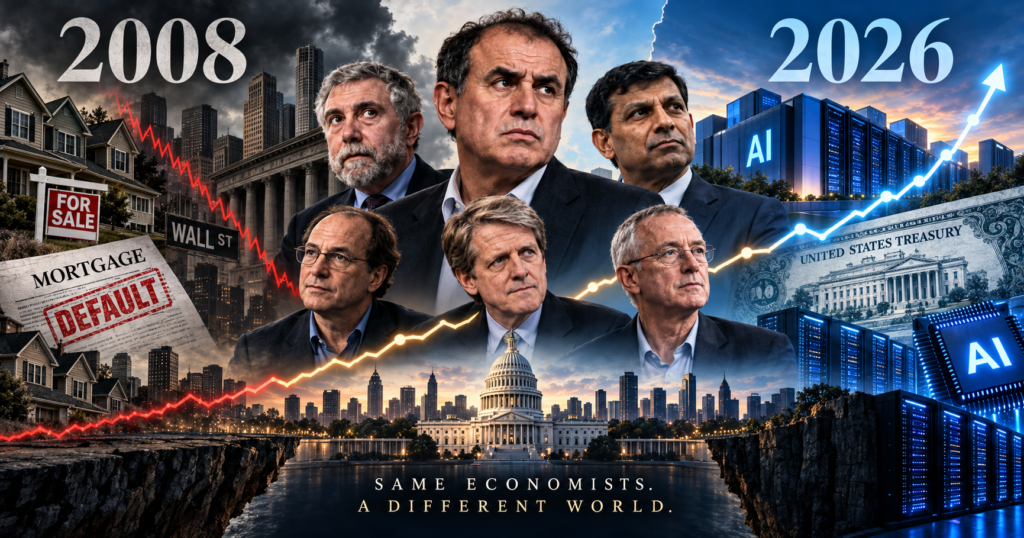


In an August 24, 2026 article for Project Syndicate, Nouriel Roubini examines the sharp rise in government bond yields across the United States, Japan, Germany, Britain and France. His central argument is that higher bond yields do not necessarily mean an approaching financial crisis.
Roubini identifies three possible explanations. The first is negative. Supply shocks, protectionism and higher oil prices can raise inflation and bond yields while weakening growth. This is the classic stagflationary scenario. The second is fiscal. Large government deficits can push yields higher if investors fear inflation, monetary financing or sovereign-debt problems. This can crowd out private investment and eventually hurt equities.
But Roubini gives considerable weight to a third explanation, especially in the United States. Higher yields may reflect stronger demand for capital caused by the enormous investment boom in artificial intelligence, data centers and technology infrastructure. In that case, higher real interest rates are not necessarily evidence of economic weakness. They can instead signal expectations of stronger productivity and future growth.
Roubini notes that American bond yields have risen dramatically since the pandemic while US equities have also risen. He argues that this is not contradictory. Strong economies often produce both rising stock prices and rising interest rates. His concern is greater for Europe and Japan, where growth and innovation are weaker while public debt remains high. For the United States, however, he sees the possibility that technological investment could raise potential growth enough to make both higher rates and large fiscal obligations more manageable.
That is a surprisingly optimistic argument from the economist once nicknamed “Dr. Doom.”
It also raises an interesting question. What do the economists who warned about the vulnerabilities that produced the 2008 crisis think about the risks accumulating today?
First, a qualification is necessary. “Predicted the 2008 crisis” is often used too loosely.
Roubini came closest to describing a specific chain of events. In September 2006, he warned an IMF audience that a housing bust could produce defaults, falling mortgage-backed securities prices, financial instability, recession and a global hard landing.
Dean Baker and Robert Shiller identified the housing bubble earlier. Raghuram Rajan warned in 2005 that financial innovation, incentives and interconnected markets had created the possibility of a catastrophic financial breakdown. Steve Keen emphasized excessive private debt and leverage. Paul Krugman clearly warned that the housing-driven American economy was unsustainable, although he did not forecast the precise financial chain that later ran from subprime mortgages through securitization and eventually into a banking panic.
Their views today make Roubini’s article more interesting because they are not all reaching the same conclusion.
Paul Krugman comes remarkably close to Roubini.
In an August 19 essay titled What Are Bond Markets Telling Us?, Krugman argues that two enormous borrowers are competing for capital. One is the US government. The other is the AI industry.
The hyperscalers building data centers are investing so heavily that companies which previously financed expansion from their own cash flows are increasingly turning to bond markets. At the same time, federal deficits remain extremely large. Together, these forces increase demand for credit and push interest rates higher.
Krugman nevertheless rejects the claim that America is approaching a sovereign-debt crisis. Long-term inflation expectations have not risen enough to suggest investors expect the government to inflate its debt away. Measures of default risk have also not indicated panic. His message is simple: interest rates are high, but this is not Greece and it is not 2008.
Dean Baker is less comfortable with the benign interpretation.
Baker notes that the 10-year Treasury yield rose from roughly 4% in February to around 4.7% by mid-August. He emphasizes the practical consequences. Mortgages become more expensive. Infrastructure becomes more expensive. Corporate borrowing becomes more expensive. The AI companies undertaking the massive investment boom cited by Roubini must themselves pay those higher financing costs.
Baker also questions whether increased AI investment alone can explain the recent jump. Investors already knew six months earlier that enormous data-center investment was coming. He places more emphasis on war, fiscal expansion and expectations that monetary policy will remain tighter for longer.
This does not amount to a prediction of another 2008. But Baker’s argument challenges an important part of Roubini’s optimism. Higher real rates may reflect investment demand, but they can eventually become a constraint on that same investment.
Raghuram Rajan raises another objection.
Rajan’s 2005 warning before the financial crisis was fundamentally about a system that appeared safer than it really was. Financial innovation had distributed risk, but it had also created new forms of hidden fragility.
His current concern about AI has a familiar tone. In May, Rajan warned that the enthusiasm surrounding artificial intelligence may be excessive and specifically noted that AI companies are increasingly relying on debt financing. He does not argue that another 2008 crisis is approaching. But he warns that investors should consider what happens if expectations about AI adoption, profitability or technological progress prove too optimistic.
That question goes directly to the weakest point in Roubini’s thesis.
Higher yields caused by productive investment are benign only if the investment ultimately proves productive.
Steve Keen goes much further.
Keen, another economist who warned about excessive private debt before 2008, believes the AI investment boom has “less than a year to go.” He argues that sustainable AI revenues may be far below the enormous amounts now being invested. His estimate is controversial and difficult to verify independently, so it should be treated as a forecast rather than fact.
Yet Keen makes an important distinction. He is not predicting another 2008-style banking collapse. Private credit creation is far lower relative to GDP than it was before the housing crash. His feared mechanism is different. An AI investment bust could damage corporate cash flows, produce bankruptcies and cause recession without necessarily triggering the same systemic banking panic experienced in 2008.
The most revealing conclusion is that the economists associated with the warnings before 2008 are not collectively predicting another crash.
Roubini and Krugman see much of the rise in yields as the consequence of intense demand for capital. Baker sees more economic damage from those rates. Rajan questions whether debt-funded AI optimism is justified. Keen goes further and predicts that the AI investment bubble itself will break.
The disagreement turns on one central question.
In 2006, the dangerous assumption was that rising house prices reflected strong fundamentals and that financial innovation had made the system safer.
In 2026, the assumption being tested is different. It is that enormous AI investment will generate enough productivity, profits and economic growth to justify both the borrowing behind it and the increasingly expensive capital used to finance it.
If Roubini is right, today’s higher bond yields may partly be the price of a stronger economy.
If Rajan or Keen is closer to the truth, those same yields may eventually expose how much of the AI boom was built on expectations that could never be fulfilled.
The bond market is not announcing another 2008. But it may be asking the same question markets failed to ask loudly enough before 2008: are the investments being financed today really worth what investors believe they will become?