
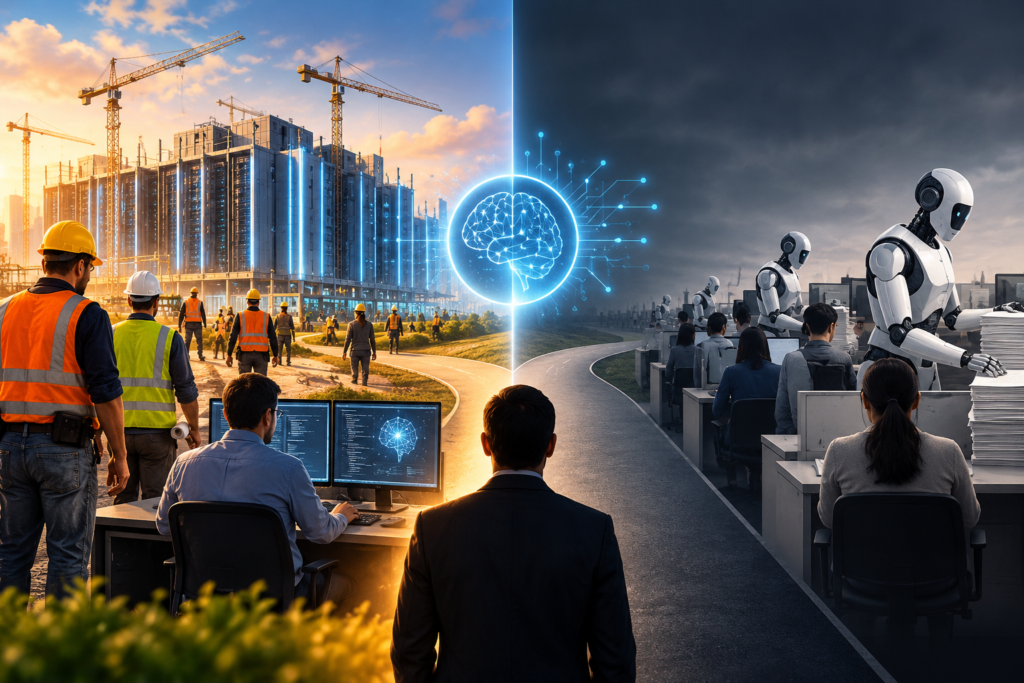


For several years, one of the dominant fears surrounding artificial intelligence has been that it would rapidly eliminate white-collar jobs. The Economist in its article “The jobs apocalypse is postponed. An AI jobs boom is here” argues that the evidence from the United States now points in almost the opposite direction. AI is destroying some jobs, but the investment boom surrounding the technology appears to be creating substantially more.
The American labour market remains relatively strong. In August, employers added 162,000 jobs and unemployment stood at 4.1%. Even younger workers, often assumed to be the first victims of generative AI, have not yet suffered the employment collapse many forecasts anticipated.
There is real displacement. Professional and business-services hiring is running below its pre-pandemic norm. Companies including Microsoft, Meta, Block and Intuit have cut jobs or reorganized work around AI. American employers have announced roughly 16,000 AI-related job cuts per month in 2026. Customer-service employment has fallen about 10% since January 2023, while secretarial and administrative employment has fallen roughly 15%.
Yet these losses are small compared with normal labour-market turnover. Around 1.7 million American workers are laid off in a typical month. More importantly, AI is producing employment through several channels.
The largest is the physical infrastructure required to run it. Spending on chips, servers, electricity, cooling systems and data centres is estimated to be roughly $500 billion a year higher than in 2022. Data-centre construction itself is running above $75 billion annually, around 60% higher than a year earlier. Electricians, HVAC technicians, engineers, equipment manufacturers, utility workers and construction crews are all benefiting. The Economist estimates that five industries closely tied to this build-out have added roughly 320,000 jobs above their previous employment trend since 2023.
The second channel is direct AI employment. AI startups are expanding, established firms are creating AI departments, and demand for software developers, engineers, mathematicians, data scientists and researchers has grown. The magazine calculates that these AI-adjacent professional occupations have added about 730,000 jobs above trend since 2022. LinkedIn separately estimates hundreds of thousands of new AI-specific positions.
The third mechanism may prove more important over time. AI can make existing workers more productive. A lawyer can prepare documents faster. An analyst can process information more quickly. If productivity reduces prices and expands demand, firms may need more workers rather than fewer. Employment among paralegals rose about 11% between 2023 and 2025, while market-research analysts increased by around 6%, compared with national employment growth of roughly 2.5%.
Combining these effects, The Economist estimates that AI has created around one million American jobs, compared with roughly 200,000 layoffs attributed to AI since mid-2023.
But this number deserves caution. It is an estimate, not a direct count. Many infrastructure and professional jobs would probably have existed without AI. The analysis measures employment above previous trends and attributes part of the difference to the AI boom.
The article’s deeper argument is therefore not that AI will never destroy jobs. Routine administrative and customer-service work is already shrinking. Rather, technological revolutions create new occupations, industries and demand that are difficult to foresee in advance. The first phase of AI has so far behaved more like an investment and employment boom than a jobs apocalypse.
Is the same thing happening elsewhere?
Canada looks broadly similar, but on a smaller scale. Statistics Canada found no persistent decline in highly AI-exposed employment through 2025, although younger workers have done worse. Canada is also entering the infrastructure phase, including Meta’s C$13 billion Alberta data centre and federal sovereign-compute investment.
Europe is also broadly positive so far. ECB research finds AI-intensive firms are about 4% more likely to increase hiring, while firms investing in AI are about 2% more likely to hire.
China is more complicated. Massive computing infrastructure is being built, but Beijing is simultaneously discouraging AI-driven mass layoffs because youth unemployment is already high.
Japan’s transformation is slower. Only 16% of surveyed firms have integrated AI company-wide.
South Korea is the major warning sign. Youth employment fell by 285,000 from 2022 to 2026, with 94% of the decline occurring in highly AI-exposed industries.
What happens when the current AI investment spree ends?
The weakness in The Economist’s argument is that a significant part of today’s job creation comes from an extraordinary capital-spending cycle. Data centres need armies of electricians, engineers and construction workers while they are being built. Once completed, they require far fewer people to operate.
The most important question raised by the current AI jobs boom is what happens after the extraordinary investment cycle begins to mature.
For now, the spending continues to accelerate. The International Energy Agency estimates that capital expenditure by just five major technology companies exceeded $400 billion in 2025 and could rise another 75% in 2026. Data centres, chips, electricity generation, transmission equipment and cooling systems are creating enormous demand for construction workers, electricians, engineers and manufacturers.
But no investment boom grows at that pace forever.
The key distinction is between investment remaining high and investment continuing to grow. If AI infrastructure spending eventually settles at a very high level rather than continuing to surge, the sector would still remain enormous. But it would no longer provide the same additional boost to employment every year. The economy would move from building an entirely new infrastructure network toward operating and replacing what has already been built.
That matters because data centres are much more labour-intensive during construction than during operation. At the same time, the technology built inside those facilities does not stop improving when construction slows.
This creates a potentially uncomfortable second phase.
During today’s boom, AI is simultaneously creating jobs through investment and eliminating or transforming jobs through automation. The investment side is highly visible. Data centres must be built. Power systems must be expanded. Chips and servers must be manufactured.
Later, that balance could change.
Once the infrastructure is largely in place, companies will increasingly focus on extracting returns from the hundreds of billions of dollars they invested. That means using AI more aggressively to reduce costs, improve productivity and automate tasks. Customer service, clerical work, basic research, document preparation, routine coding and administrative functions are obvious candidates.
The ILO currently finds limited evidence of widespread AI-driven unemployment. Productivity improvements are real but uneven, and the main employment effects so far have been changes in tasks rather than mass displacement. But it also identifies growing risks for younger workers and workers concentrated in highly exposed occupations.
There are therefore two very different ways the investment spree could end.
The benign scenario is maturation. AI investment gradually stops accelerating because enough infrastructure has been built. Productivity rises. New products and businesses emerge. Lower costs create additional demand. Existing occupations evolve and entirely new ones appear. The US Bureau of Labor Statistics, for example, still expects very strong growth in occupations such as data science, cybersecurity and operations research.
The more dangerous scenario is an investment bust. Companies discover that AI revenues and productivity gains cannot justify what they spent. Projects are cancelled. Technology companies cut capital expenditure. Construction and equipment employment falls. Companies burdened with debt begin cutting costs precisely when AI gives them greater ability to automate labour.
That combination would be much more serious.
The real question is therefore not whether AI creates jobs during an unprecedented investment boom. It clearly can.
The real test begins when the world stops racing to build AI capacity and starts demanding a financial return from it.
If AI generates enough productivity, new industries and new demand, today’s infrastructure boom could become the foundation of decades of economic growth.
If it does not, today’s employment gains may eventually look very different. They may prove to have been partly the temporary dividend from constructing the machines that later allowed companies to operate with fewer people.
#ArtificialIntelligence #AIJobs #FutureOfWork #Employment #DataCenters #Automation #Productivity #Technology #Economy#CedarWhispers