
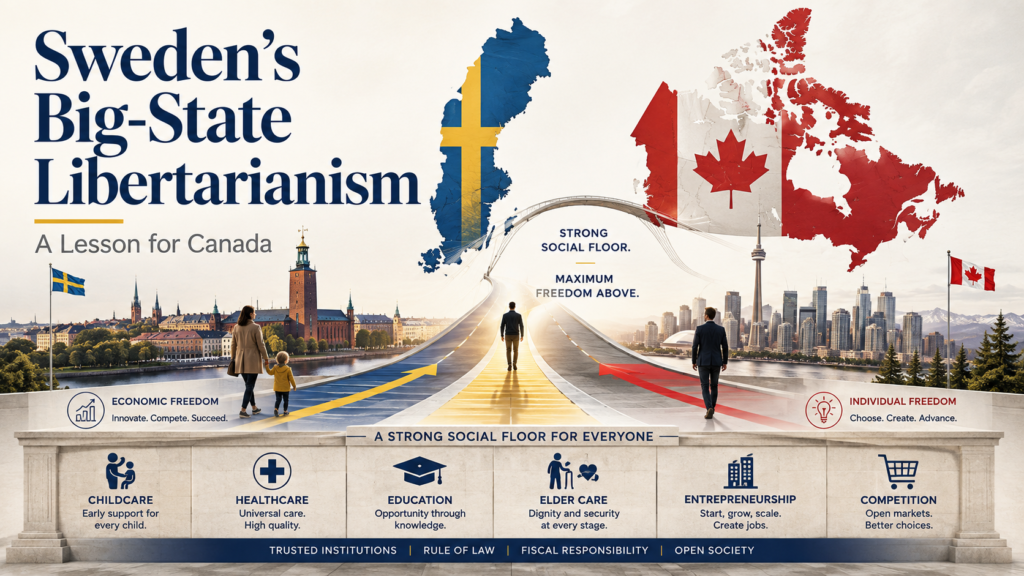


An August 2026 article in The Economist describes Sweden through an apparent contradiction. It is one of the developed world’s most expansive welfare states, yet also one of its most individualistic societies.
Taxes are high, public spending is substantial, parental leave can reach 480 days, universities are tuition-free and union membership remains exceptionally strong. Yet Sweden also has no statutory minimum wage, allows significant private participation in publicly funded services, maintains relatively flexible labour markets and has produced an unusually large number of successful entrepreneurs and billionaires.
The Economist describes this model as “individualism done collectively.”
The deeper idea is what Swedish historians Henrik Berggren and Lars Trägårdh call “statist individualism.” Sweden did not build its welfare state simply to redistribute income or expand government. It used the state to reduce individuals’ dependence on other people.
That distinction is crucial.
Affordable childcare allows parents, especially women, to work without depending on a spouse or extended family. Public elder care reduces the expectation that adult children must personally care for ageing parents. Student support gives young adults greater independence from their families. Swedish adults are generally treated as individuals within the tax and welfare systems rather than primarily as members of a household.
The result is unusual. Sweden has built a large public sector partly to allow people to live more independently.
This helps explain another Swedish paradox. A strong welfare state has not prevented the country from embracing markets, private enterprise and competition. The state establishes a strong social floor, but it does not necessarily insist on directly providing every service.
Private providers participate in areas such as healthcare, education and elder care while government continues to finance access. Sweden therefore separates two questions that political debates elsewhere often confuse: Who pays for a service, and who provides it?
A service can be publicly financed without being exclusively government-operated.
The Swedish labour market reflects the same philosophy. Sweden has no national statutory minimum wage because wages are largely negotiated through collective bargaining between unions and employers. Strong institutions replace some of the detailed regulation used elsewhere.
Sweden’s system is therefore difficult to classify through the traditional left-right divide. It combines high taxation and generous social programs with private enterprise, competition and substantial personal autonomy.
Its objective is not simply equality. It is independence.
For Canada, that may be the most useful lesson.
Canada should not copy Sweden’s tax levels or simply expand government spending. Without Sweden’s institutional effectiveness, labour arrangements and high levels of social trust, that could produce a larger bureaucracy without delivering greater freedom.
Instead, Canada could adopt the underlying bargain: strong social security combined with greater economic freedom.
The clearest example is childcare. Canada has dramatically reduced the cost of regulated childcare through its national program. But affordability means little to a parent who cannot find a place. The Auditor General found that only about 112,000 of the targeted 250,000 new spaces had been created by March 2024, putting the target at risk. The audit also found inadequate information on unmet demand.
That exposes a fundamental policy weakness: subsidizing demand without creating enough supply. A Swedish-inspired approach would focus on the outcome, accessible childcare, and allow public, non-profit and appropriately regulated private providers to expand capacity.
Healthcare presents an even sharper contradiction. Canada already spends heavily to guarantee universal medical coverage, but universality on paper does not guarantee timely treatment. Long emergency-room waits, delayed diagnostic imaging and lengthy waits for specialists and surgery remain serious problems.
A system where everyone is entitled to an MRI, specialist consultation or operation, but many must wait months to receive it, has guaranteed coverage, but not always timely access.
Canada should also remove barriers that restrict individual opportunity, particularly interprovincial trade barriers, occupational licensing obstacles, slow permitting and unnecessary restrictions on competition.
That would produce a more coherent model than simply expanding government.
Sweden’s real lesson is not that Canada needs a bigger state.
It is that a state can be large without becoming controlling when its purpose is to make citizens more independent, not more dependent on government itself.
The Canadian objective should be similar: collective security in the service of individual freedom.
#Canada #Sweden #PublicPolicy #Healthcare #Childcare #EconomicFreedom #Productivity #PublicServices #GovernmentReform #SocialPolicy #CanadianEconomy #Innovation #Competition #EconomicPolicy #TheEconomist