


by Simon Yammine
Nova Scotia Power’s Powering Partnerships Forum, held on September 25, brought together developers, builders, engineers and industry professionals for a morning focused on a challenge becoming increasingly important as Halifax and Nova Scotia grow: how can electrical infrastructure keep pace with development?
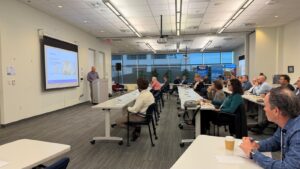
The event was well organized from the start. The reception was warm, the speakers were engaging, and the networking was excellent. More importantly, Nova Scotia Power’s team appeared genuinely interested in hearing about the problems facing developers and builders. Questions were encouraged, concerns were discussed openly, and staff were responsive rather than defensive.
That willingness to listen was perhaps the most valuable part of the forum.
Electricity is no longer something a developer can deal with near the end of construction. Capacity, transformers, service design, electrical rooms, EV charging, and connection timelines can influence a project from its earliest stages. Nova Scotia Power clearly designed the forum around those realities, describing it as an opportunity for the building industry to share insights and contribute to improving its processes.
A Program Focused on Real Development Issues
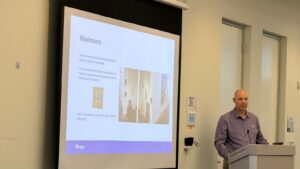
Steve McDougall, Manager of Key Accounts & Commercial Solutions, opened the morning before Chris Smith, Executive Vice President, Finance & Commercial, delivered Nova Scotia Power’s executive update. Smith’s portfolio includes regulatory affairs, load forecasting and customer solutions, areas directly connected to the province’s changing electricity requirements.
The discussion then moved directly into construction and development.
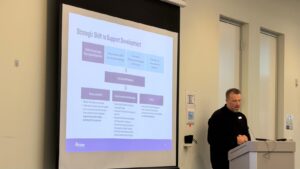
Anthony Murphy, Key Account Manager, and Angie McLeod, Strategic Account Manager, presented on supporting large and complex developments, including upcoming tools and process improvements. Murphy works with industrial, institutional and multi-unit residential customers, while McLeod has extensive experience helping commercial and industrial customers navigate the electrification process.
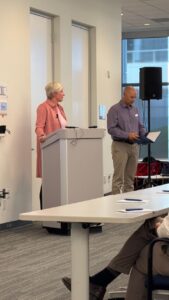
For those involved in apartment and multi-unit construction, Tristan Leopold, Senior Regional Engineer – Metro, addressed MURB Electrical Service Design Considerations, covering planning and implementation. His work includes multi-unit residential buildings, subdivisions and major projects throughout HRM.
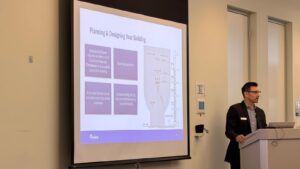
Ed Cullinan, Senior Manager of E-Mobility and Residential Electrification discussed another issue developers increasingly need to plan for: transportation electrification. Nova Scotia Power says its provincial fast-charging network is expanding with 60 new high-powered charging ports, highlighting how EV infrastructure is becoming part of mainstream development planning.
The presenter group also included Jamie Chipp, Director of Key Accounts & Customer Solutions, whose teams cover customer data, load forecasting, residential electrification, e-mobility, large developers and key accounts.
My own dealings with Nova Scotia Power have been consistently positive, particularly in connection with our two 54-unit residential buildings in Amherst. Projects require close coordination on electrical servicing, design requirements and timelines, and I have found the Nova Scotia Power team attentive and responsive throughout the process. I particularly appreciated the efficient and consistent follow-up of Chris Ewoh from Customer Solutions, whose communication helped keep issues moving and ensured that our questions and concerns were addressed promptly.
A Personal Connection
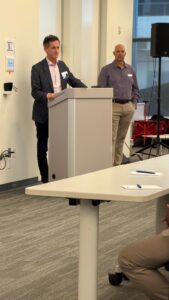
The formal program ended with an address from Nova Scotia Power President and CEO Vivek Sood, who brings more than 30 years of leadership experience across consumer-focused sectors, including retail, wholesale and financial services. Before joining Nova Scotia Power, he held senior leadership roles at Sobeys, one of Canada’s largest food retailers.
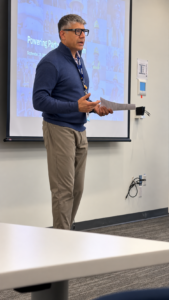
I particularly appreciated the opportunity to connect with Vivek because we found common ground on several levels. I come from a second-generation family of food and consumer-goods retail outlet owners in Lebanon, which made his long experience with Sobeys especially relatable. We also share a connection to military service. I am a former Brigadier General who directed engineering in the Lebanese Armed Forces and an alumnus of the U.S. National Defense University and NESA in counterterrorism, while Vivek serves as an Honorary Lieutenant-Colonel with the 1st Field Artillery Regiment. We also share an appreciation for Pier 21, where he serves as Board Trustee and Vice-Chair.
Top of Form
The Lebanese Presence in the Room
Another thing was difficult not to notice.
By my rough observation, Lebanese Nova Scotians, from both long-established families and newer arrivals, represented close to 20 percent of the room.
Anyone familiar with Halifax construction and development will understand the connection.
Earlier generations of Lebanese immigrants established businesses and became deeply rooted in Nova Scotia. Newer arrivals are continuing that tradition in construction, engineering, development and entrepreneurship.
There is an old joke around Halifax that the construction crane has become Nova Scotia’s unofficial provincial bird.
Judging by both our skyline and the Lebanese presence in the industry, perhaps that bird has acquired a little Lebanese DNA as well.
The humour points to something more serious. Immigration is not simply about people coming to live in a city. Over time, newcomers also build the city, economically, culturally and, in the construction industry, quite literally.
From Conversation to Results
A single forum cannot solve every issue developers experience with electrical capacity, servicing or timelines.
But it can improve something equally important: communication.
The Powering Partnerships Forum succeeded because Nova Scotia Power did not simply present information. Its people listened, answered questions and made themselves available for direct conversations with the industry they serve.
The speakers were accessible. The networking created useful connections. And there was a clear interest in understanding the difficulties customers encounter on actual projects.
The real measure of success will come afterward, when those conversations translate into clearer processes, better coordination and faster solutions.
If that happens, Powering Partnerships will have been more than the name of a forum.
It will have described exactly what Nova Scotia needs as it continues to grow.