


By Simon Yammine
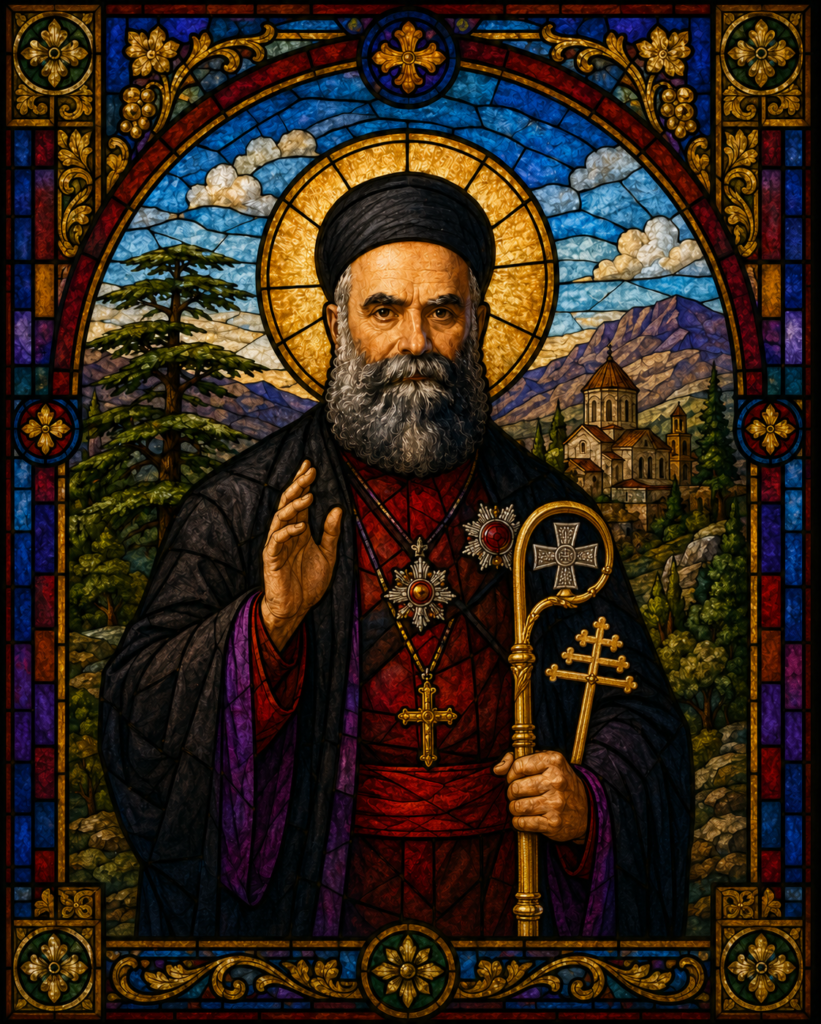
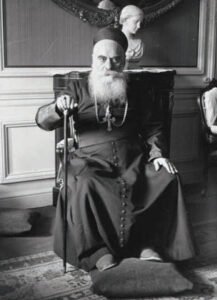
There are moments in the history of nations when the hour does not ask for crowds, but for one man large enough to carry the weight of many. The English saying tells us, “Cometh the hour, cometh the man.” Few figures in modern Lebanese history embody that saying more fully than Patriarch Elias Peter Hoayek. He was not merely a Maronite patriarch during a difficult chapter in the history of the Levant. He was one of the men whose biography became tied to the birth of the modern Lebanese idea and to the historical transformation from the Mutasarrifiate of Mount Lebanon to the State of Greater Lebanon.
Hoayek occupied the patriarchal seat for a long patriarchate of nearly thirty-four years. During that time, he witnessed enormous events, from the end of the Ottoman Sultanate to the emergence of Lebanon, passing through the horrors of the First World War and the famine of Mount Lebanon. For that reason, his journey cannot be reduced to the biography of a man of religion alone. He must be seen as a leader who combined spiritual care and social action on one hand, and institution-building and the political defense of Lebanon on the other.
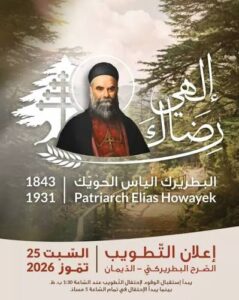
The announcement of his beatification comes in a poor time, a time in which petty men have too often succeeded one another over the nation and its institutions. In such a time, one cannot help recalling another English saying: “One man with courage makes a majority.” Hoayek was one of those rare men. His presence returns, especially more than a century after the proclamation of Greater Lebanon, whenever the difficult Lebanese question is raised: is Lebanon merely a crisis-ridden system, or is it a civilizational mission that always needs men to guard it, as Hoayek guarded it?
The Life and Formation of Elias Hoayek
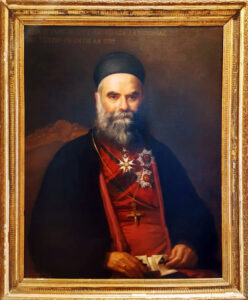
Elias, the eldest of the seven children of Father Boutros Hoayek, was born in 1843 in the town of Helta, in the district of Batroun. He entered the school of Saint John Maron in Kfarhay in 1851, where he began studying Arabic and Syriac. In 1859, he moved to the Seminary of Ghazir, where he studied theology, philosophy, and the rules of French, Latin, and Greek under the supervision of the Jesuit Fathers.
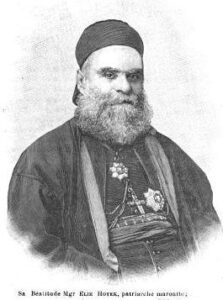
That stage contributed to the early formation of a personality that gracefully combined Eastern culture with European knowledge without becoming alienated from his Syriac Maronite heritage. Hoayek was not a man torn between East and West. He was a man able to draw from both. He belonged deeply to the Maronite Mountain, but his mind was open to Rome, Europe, and the wider world.
In 1865, Patriarch Paul Massad sent him to continue his theological studies at the Pontifical Maronite College in Rome. He remained there until he earned his doctorate and returned to Lebanon. He was ordained priest in June 1870, and soon afterward Patriarch Paul Massad appointed him first as his secretary, and then, in 1872, as defender of the marriage bond in the patriarchal tribunal.
At this early stage, his moral virtues appeared clearly. He was a man of religion committed to transparency and integrity, unaffected by praise or intrigue, and detached from gifts and favors. In short, he was a man of the Church, a humble and wise servant who possessed the courage of the word and expressed his convictions with no beating around the bush. The English saying “A straight tree casts no crooked shadow” fits the impression left by his character. His authority came not only from rank, but from a visible moral straightness.
This courage first appeared in the case of the Bishop of Sidon and Tyre, Boutros Boustani, whom the Ottomans falsely accused of planting the seeds of discord between Druze and Christians. He was humiliatingly exiled to Jerusalem in 1877. A council of bishops met in Bkerke, but no practical result was reached. The more things change, the more they stay the same in Lebanon. Hoayek then resolved to leave everything and return to his village, out of concern for the dignity of the Church and as an expression of refusal to submit to injustice.
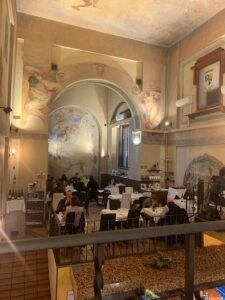
In December 1889, Patriarch Paul Massad promoted him to the episcopate as Bishop of Arqa and Patriarchal Vicar. In May 1890, on the commission of the newly elected Patriarch John El Hajj, Hoayek traveled to Rome to request the pallium of confirmation and to supervise the revival of the Maronite College. In this field, he made great efforts to reopen the college after the old school, today the restaurant Sacro e Profano in the Maronite alley Vicolo dei Maroniti, had been turned to secular uses.
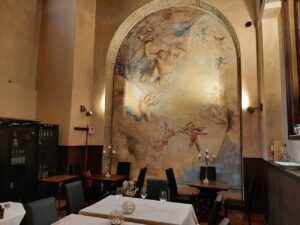
His concern for the Maronite College never ceased. He cared for it with attention and fatherly dedication, and he began expanding it in 1903. Later, he purchased agricultural lands to secure revenues that would guarantee the college’s continuity, so that it would not close again for financial reasons as it had before. This effort was part of his vision for a Maronite Church present in the capitals of decision-making, not closed in on itself within the limits of the mountain, and for a professional Maronite clergy in broad contact with the foci of renaissance.
After the death of Patriarch John El Hajj in December 1898, Hoayek became the seventy-second Maronite Patriarch on January 9, 1899. His election, coming from a modest family that did not belong to the traditional Maronite feudal class, crowned the journey of a man who struggled, worked, and rose through the ranks of his Church until he was elected its head. This strengthened his image as a man of service, not a man of privilege. It also confirmed a Maronite characteristic expressed by the great Lebanese thinker Charles Malik, an Orthodox Christian: the Maronite Church is the Church of the people. Here, the old saying “The crown sits best on the head that did not chase it” seems fitting. Hoayek did not appear as a man hungry for office. He appeared as a servant prepared by discipline for a burden.
The Glory of Lebanon Was Given to Him
Hoayek’s spiritual personality appears in his writings, letters, prayers, and understanding of service. His journey was marked by the idea of living and dying in God’s grace, seeking the will of the Creator, uniting with it, being guided by it, and relying absolutely on God’s mercy and providence. The secret of his success was his deep union with God, his life of prayer, his desire to fulfill God’s will, his surrender to divine providence, and his surrender to the work of the Holy Spirit.
For this reason, he was described as a man of limitless love and as a prophet of his age in his zeal for his Church and for his brothers and sisters in the homeland, without distinction between religions or regions. Among his most famous prayers were: “My God, make me live and die in Your favor,” and “Have mercy, O Lord, have mercy on Your people, and do not be angry with us forever,” which he ordered the Maronites to cry out at the conclusion of every prayer and procession during the years of war and famine.
His prayer to Our Lady of Lebanon remains a summary of this blending between faith and homeland: “O Mary, Queen of the mountains and seas, and Queen of our beloved Lebanon… O Cedar of Lebanon, intercede for us.” For Hoayek, Lebanon was not borders only. It was a spiritual, moral, and political trust.
On the ecclesiastical and institutional level, Hoayek worked to restore churches and monasteries. He sponsored the construction of a large number of churches in Lebanon, and his care extended to churches in Paris, Khartoum, Cairo, Larnaca, and Nicosia. His most important achievement on this level was the founding of the Church and Shrine of Our Lady of Lebanon in Harissa in 1908, in cooperation with the Holy See.
He increased the number of seminaries, founding the school of Mar Abda, the school of Ain Warqa, and two other schools in Qleiaat and Reyfoun. He created the Maronite Diocese of Tyre after separating it from the Diocese of Sidon, and founded the Maronite Patriarchal Vicariate in Cairo. He also established the patriarchal agency in Jerusalem. He looked after the Maronites in Cyprus and sent a delegation to them in 1902. At the end of 1919, he sent a delegation to visit the Maronites in the American continent, and began work on building churches and schools in the New World and establishing dioceses for the diaspora. His goal was that the Maronites would not be absorbed into the dioceses of the Roman Latin Church.
Despite the war, he also cared for construction. He wanted to transform agricultural and traditional houses, where farmers lived near livestock, into two-story homes: a cellar below and a floor for the family residence. The project was implemented around Diman, Qannoubine, Blaouza, Ser’el, and on patriarchal properties.
Alongside his concern for the formation of the clergy, Hoayek carried early on a clear social project. He began founding the Congregation of the Sisters of the Holy Family, with an annexed school, in Byblos in 1895, before it settled in ‘Ebrine in 1896. This women’s congregation was the first association of apostolic life in the Maronite Church before becoming the major Maronite women’s order and playing an essential role in education, social care, and healthcare in Lebanon and the Levant.
The patriarch’s goal was not only to establish a Church institution. It was to uplift the family through the education of girls, the formation of future mothers, and the emphasis on the holiness of the family. In confirmation of his attachment to this project, he broke with the Maronite patriarchal tradition that required patriarchs to be buried near their predecessors, and chose to be buried in the motherhouse of the order in “Ebrine.
As for his relationship with France, Hoayek inherited a complex historical relationship. He saw it as one of friendship, protection, and exchange, not blind dependence. When France was struck by floods in 1910, he asked Maronite parishes to collect aid and send it to help the victims. This reflected a mutual historical bond with France going back to the visit of King Saint Louis to the Qannoubine Valley in the thirteenth century. France returned the favor in 1911, when the French government, through his efforts, gave the Maronites a monastery and church in Paris. In 1913, Hoayek consecrated the Church of the Holy Family Monastery, and in 1915 the parish of Our Lady of Lebanon in Paris was founded. It became an eparchy in 2012.
Materially, Hoayek was known for his asceticism and his lack of attachment to possessions. He died empty-handed. He spent what was available to him on his Sisters and distributed everything he had to the needy. He deeply loved the poor and the needy, wept when he met them, and hurried to help them. His evangelical poverty was not a theory, but a daily behavior translated into his life and positions.
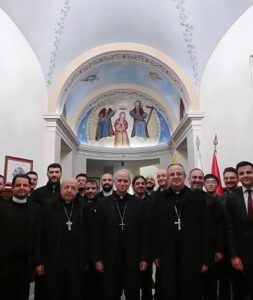
He was called the Father of the Poor, not because he helped them only, but because he understood poverty in all its dimensions. Lack of money is material poverty. Ignorance is poverty of knowledge and progress. Lack of recognition is poverty of dignity. Occupation is poverty of freedom. Distance from God is poverty of the spirit. Actions speak louder than words, and Hoayek’s love for the poor was written in action.
For all these qualities and merits, Patriarch Hoayek deserved to have it said of him: “The glory of Lebanon was given to him.”
Hoayek and the Oppression of the Ottomans
His patriarchate witnessed major national events that imposed themselves on Bkerke. During the era of the Mutasarrifiate, and despite Hoayek’s commitment to his Ottoman citizenship, he did not shy from strengthening Lebanon’s special Mutasarrifiate system and protecting its privileges, while demanding administrative and political reforms. He also sought to improve living conditions, create conditions for a thriving country, and uproot the causes of emigration. Once again, the more things change, the more they stay the same. The patriarch understood that Mount Lebanon could not live without fair administration, a capable economy, and a system that protected its particularity.
The First World War quickly went beyond demands for reforms and became a battle for existence. The war broke out in October 1914, and the Ottoman Sultanate entered it alongside Germany and the Central Powers. The Ottoman army entered Mount Lebanon and dissolved its Administrative Council in March 1915. The Turks abolished the Mutasarrifiate system and foreign privileges, then blockaded the mountain by land and tightened surveillance over its shores.
The final blow was the spread of locust swarms across Mount Lebanon, “they blocked the light of the sun,” contemporaries narrated. This resulted in a terrible famine in which one-third of the population died. Hoayek fought fiercely against the decision to starve the Lebanese, confronting the Ottoman plan expressed by Enver Pasha, one of the three leaders of the Committee of Union and Progress ruling in Istanbul, when he said: “We dealt with the Armenians by the sword, and we shall deal with the Lebanese by famine.” The genocide of the Armenians, the Sayfo of the Syriacs, and the famine of the Maronites and Mount Lebanon belonged to the same tragic age.
To confront this existential ordeal, Hoayek placed the financial and real estate capacities of the Church at the disposal of the Lebanese. He redirected the funds of the patriarchate and his private funds to help the hungry and feed them. The patriarchal seat became a central place for securing food for starving people. He issued orders to the endowments and monasteries to support the poor, and to mortgage, borrow, and sell for that purpose, just as Abbot Charbel Kassis would do more than half a century later.
It is as though the destiny of the Maronites has been to defend this mountain that embraced them and that they embraced for long centuries. The Maronite clergy became a network of resistance to famine. The patriarchate issued directives to all its dioceses and monasteries, and to all priests, monks, nuns, confraternities, and endowments, each within its own domain, to submit weekly lists on ways to support the poor, Muslims, Christians, and Druze alike.
Hoayek also instructed the secretary of the patriarchate, Father Paul Akl, to open lines with the Lebanese diaspora to provide financial aid to all Lebanese without discrimination. The patriarchate secured food supplies and medical assistance from European countries, even reaching to the American Red Cross, which sent a shipload that was unloaded inside the campus of the American University of Beirut, as the historian Issam Khalifeh mentions.
In the Holy Valley, his social care appeared in its most obvious form. The journalist and researcher Georges “Arab mentions that Hoayek’s era was marked by humanitarian commitment and comprehensive solidarity with the poor. “Arab stressed that the careful follow-up of the parishes and communities living around Diman and the Holy Valley preserved the lives of all those living there, and no death from hunger was recorded among them. Hoayek faced the famine by opening the Qannoubine mill and doubling its production capacity. He distributed daily, weekly, and monthly assistance, including food supplies and financial support, as documented in the archives of the patriarchal seat in Diman. In addition, he was keen to secure the costs of medical care and hospitalization for the needy, even paying burial costs for families unable to do so.
Politically, his confrontation with the commander of the Ottoman Fourth Army was marked by courage and caution. Jamal Pasha tried to exile him. When he failed, he summoned him first to Sawfar to investigate the relationship of the Maronite Church with France. In May 1916, the sixth day of which witnessed the famous executions of Beirut and Damascus, he summoned him a second time and accused him of being behind French articles about the plan to exterminate the Lebanese by famine. A third time, he met him in Bhamdoun in July 1917 before detaining him in Qornet Chehwan at the beginning of 1918 in preparation for exile. But Jamal Pasha was later forced to release him after the intervention of the Vatican and the Emperor of Austria, an ally of the Sultanate.
Patriarch of Greater Lebanon
The war ended, but the patriarch’s role did not end. It moved instead to the direct political defense of Lebanon. After the collapse of Ottoman rule in October 1918, representatives of Prince Faisal, son of Sharif Hussein, tried to raise the Arab flag in Baabda. Hoayek did not sympathize with the demands for the establishment of an independent Arab government in Mount Lebanon. Rather, he welcomed the entry of British and French forces into the mountain and coastal cities. The Arab flag was removed, the Arab government was dissolved, and the Administrative Council of Mount Lebanon, which the Ottomans had suspended, returned to work.
In December 1918, the first official Lebanese delegation went to the Peace Conference in Paris, headed by Daoud Ammoun, to demand Lebanon’s independence and the expansion of its borders. That was a stage in which projects clashed. Prince Faisal represented the Arabist and Islamic current demanding Syrian and Arab unity, while France and England sought to expand their spheres of influence. France itself was considering the possibility of establishing United Syrian States that would form a kind of confederation. Hoayek, however, held firmly to the Lebanese cause: the independence of Lebanon with the expansion of its borders.
France tried, through correspondence between Bkerke and Georges Picot, to convince Hoayek of the advantages of unity with Syria. His answer was firm: complete independence.
On May 20, 1919, the Administrative Council declared the independence of Lebanon within the borders of 1860. After Faisal declared in Damascus that Lebanon was part of Syria, the patriarch headed a delegation in July to the Peace Conference in Paris, where he was received as an honored guest by the French government. Hoayek submitted an address to Clemenceau, head of the French government and president of the Peace Conference, demanding the complete and absolute independence.
But political realism, based on what was being debated in France, led him to adopt the memorandum he submitted to the Peace Conference on October 25, 1919, under the title Les revendications du Liban, demanding the French Mandate in order to contain Faisal’s aspirations and convince France of the Lebanese cause.
On November 10, 1919, Hoayek obtained a written pledge from Clemenceau promising the Lebanese independence with the annexation of the plains and seaports. This pledge was considered a document of independence. Hoayek returned to Beirut in December 1919, where he was received like as a hero.
The battle did not end with this declaration. Despite the appointment of Gouraud as High Commissioner over Lebanon and Syria, Clemenceau considered an agreement with Faisal that would leave the administration of some regions to the Damascus government. At that point, Faisal returned to the claim that Lebanon would not be expanded and would not become independent from Syria, but would receive broad autonomy at best. Hoayek rejected this proposal and entered into confrontation with a faction of French diplomats who supported that project.
Because of the seriousness of the matter, and because it was impossible for him to travel again to Paris while he was seventy-eight, he sent a third delegation headed by Bishop Abdullah Khoury. The delegation included Alfred Sursock, an Orthodox; Kamel Bey El Assaad, a Shiite; and Prince Tawfik Arslan, a Druze. The delegation focused its demands on expanding Lebanon with the plains and coastal cities on one hand, and on confirming the French Mandate as a guarantee of Lebanon’s independence from Syria on the other.
In March 1920, Faisal and his allies held the Second Syrian Congress, which proclaimed Faisal king over Syria, Palestine, and Lebanon. Lebanese fears of annexation to Syria increased, especially after the participation of some Christian spiritual leaders in the pledge of allegiance and the sympathy shown by others toward the Syrian project. By arrangement of the patriarch, official and popular Lebanese movements opposing the establishment of the Syrian kingdom escalated. Meetings were held and demonstrations set out in Baabda. Some demonstrators raised a tricolor flag, blue, white, and red, with a green cedar in the middle.
Then came the San Remo Conference in April 1920, entrusting France with the mandate over Syria while omitting any mention of Lebanon. The patriarchate continued its efforts until the proclamation of the state in September.
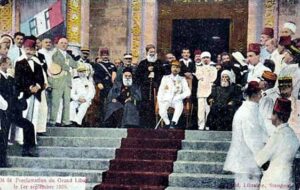
On September 1, 1920, General Gouraud, with Hoayek on his right and the Mufti of Beirut, Mustafa Naja, on his left, proclaimed the State of Greater Lebanon from the Pine Residence in Beirut, in the presence of local Christian, Muslim, and French figures. Decree No. 318 had been issued on August 31, defining the borders of Greater Lebanon according to what the head of the Maronite Church had sought to achieve. Lebanon’s area became 10,452 square kilometers while the Mutasarrifiate had been about 3,500 square kilometers. The districts of Hasbayya, Rashayya, Baalbek, and Zahle were added, along with the provinces of Beirut and Tripoli and their dependencies, to the newborn state.
Hoayek’s Lebanon and Its Antithesis
The proclamation of Greater Lebanon detonated deep contradictions. Lebanese nationalists, especially Maronites, saw in it the fulfilment of their history and struggle since Fakhr al-Din and Patriarch Douaihy, in order to obtain a homeland where they would not live as dhimmis. On the other side, broad Sunni sectors rejected belonging to the emerging homeland for religious, political, and economic reasons, feeling that they had been separated from the Syrian interior and the Arab Islamic world.
The internal Christian debate was no less complex. Some believed, in a view that would return periodically at every crisis, that Greater Lebanon was “a bridge too far,” because the Mutasarrifiate of Mount Lebanon had contained a Christian majority, while the new regions included a Muslim majority, threatening the future of Christians. Some Maronite leaders warned of Muslim demographic growth and demanded a return to a smaller Lebanon with only some vital areas added. Among the most prominent of these were President Émile Eddé, Bishop Ignatius Mubarak, Suleiman Boustani, and others.
In contrast, Hoayek’s choice, he who had just emerged from the calamities of war and famine, was Greater Lebanon because the entity could not live without plains, cities, ports, and economic borders capable of guaranteeing its survival. His project was broader than the protection of one community and deeper than a political reaction, because it combined existential anxiety with economic realism.
The successive ordeals that struck the small homeland may appear, on the surface, to support the view of Hoayek’s opponents regarding the expansion of the Mutasarrifiate. But careful examination of the circumstances of the founding and the reasons for the decision points in another direction. Applying Aristotle’s method of logical refutation and its applications with Karl Popper leads us to the conclusion that the only logical alternative to Hoayek’s state, after excluding other possibilities such as joining a Syrian confederation, would have been the establishment of a state similar to Israel. Without entering into dogmatic interpretations, this option would have been between Lebanon, a state we failed to govern properly, and an entity in conflict with its surroundings whose fate, however long delayed, would resemble the fate of the Crusader kingdoms and principalities.
No rational person can place on Hoayek the burden of our failure to establish a capable and fair state, nor our mastery in reproducing what may be called the “Turkish Set” but in European suits. We left the peripheries in backwardness, except for a pioneering Shihabi experience despite a few flaws, and handed the country over to a multi-confessional kleptomaniac class, even if it was falsely described as “Political Maronism.”
The proclamation of Greater Lebanon, despite its importance as a founding event, did not cancel the pivotal questions that ensued. The new state was born amid economic, demographic, and cultural contradictions. Economically, Beirut was connected to the mountain, while Tripoli and Sidon were more attached to Syria, so the people of those two cities felt that their role had diminished. The new division also separated the inhabitants of the Bekaa from Damascus and the inhabitants of the South from Haifa. In contrast, the Christians of smaller Lebanon enjoyed a more independent and developed economy thanks to the silk trade, while the peripheral regions were subject to severe agricultural feudalism and the control of large landowners.
Demographically, the Maronites were no longer an absolute majority as they had been during the Mutasarrifiate, while new sects entered into one non-homogeneous entity. Culturally, education in the mountain was advanced because of the Maronite Pontifical College, the missionaries, and contact with the West, while the regions directly subject to the Ottomans were less fortunate in education and cultural structures. These contradictions were among the causes of the shortcomings that later appeared in building one homeland out of different communities.
In facing these contradictions, Hoayek was not a man of isolation. He was a leader for all Lebanese, according to the slogan he launched in 1923: “Lebanon is one sect, Lebanese.” What the great patriarch feared most for Lebanon’s future were: a project that would dissolve Lebanon into Syria, and a project that would turn the Mandate into colonialism. Between these two dangers, he tried to preserve the independence of the entity and the dignity of the people. To confront these catastrophic possibilities, Hoayek worked tirelessly to move the various Lebanese groups from sectarian withdrawal into a shared national space, while respecting the particularities of the sects and their personal status systems.
Lebanese in This World and the Next
In December 1931, The Patriarch succumbed to illness, and his condition steadily declined. He received the divine sacraments and slept in peace on the 24th of that month.
With the announcement of his beatification, it is not strange that Hoayek returns today, nearly a century after his departure, just as he was in life: larger than life and still occupying the public mind.
But what is most astonishing nationally, in a time of division and fragmentation, is the miracle behind the beatification. In 1965, Nayef Abou Assi, an officer in the Lebanese Army from the Druze community, was healed from chronic bilateral spondylolysis after he saw the patriarch in his dream and woke afterward cured. Even on the path he walked toward holiness, Hoayek refused to be anything but a unifying figure.
For that reason, his title, Patriarch of Greater Lebanon, remained more than a ceremonial title. It is the title of a man who transformed a geographical, political, and spiritual idea into a state, and carried on his shoulders all the contradictions of Lebanon: poverty and freedom, Church and homeland, France and Syria, mountain and coast, fear for existence and faith in coexistence.
As we prepare for the celebration of his beatification, we ask God to grant us leaders of this caliber. The English saying “Where there is a will, there is a way” may stand here in place of the Arabic wisdom that one great resolve can revive a nation. Lebanon has had the borders. It has had the memory. It has had the sacrifices. What it too often lacked was the will, the discipline, and the stature of men like Hoayek.
#PatriarchEliasHoayek #Beatification #GreaterLebanon #PatriarchOfGreaterLebanon #Dimane #MaroniteChurch #LebaneseHistory #Lebanon #MaroniteHeritage #OurLadyOfLebanon #SpiritualHorizons #FaithAndNation #LebaneseChristianHeritage #CedarWhispers #LebaneseDiaspora