
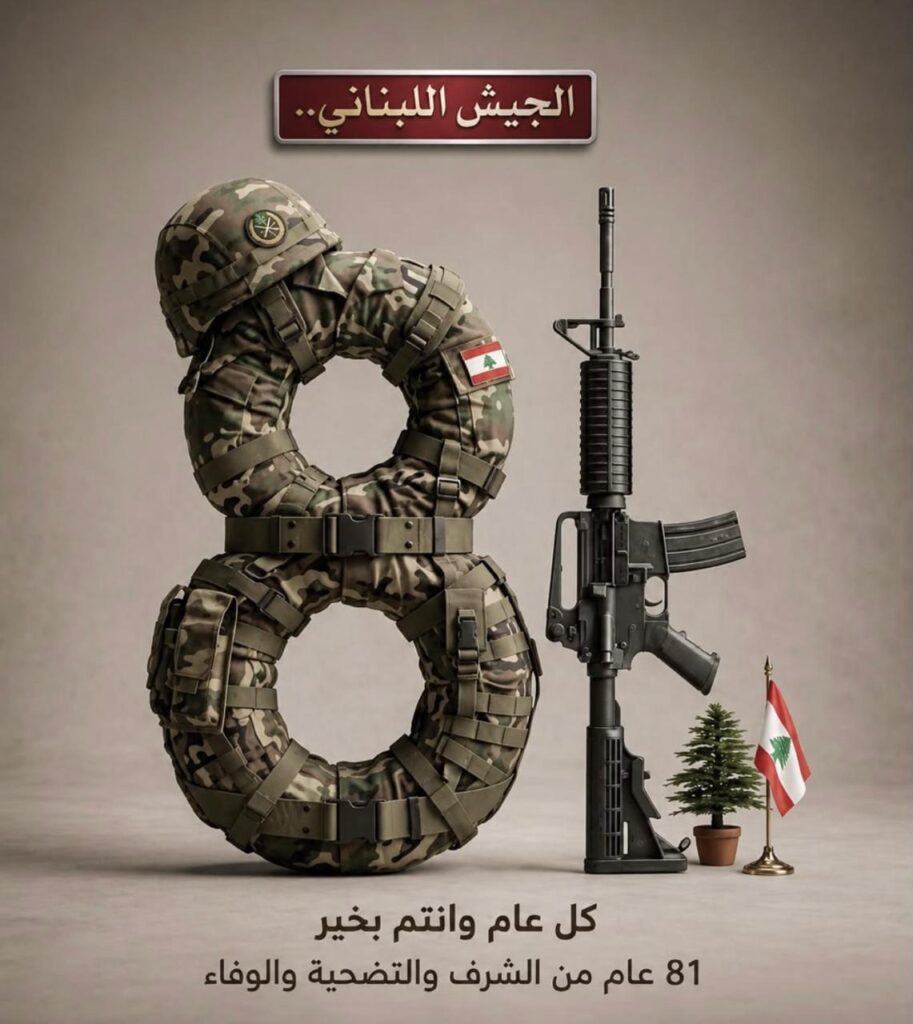


After more than years decades in uniform, it pains me more than I can express to be far from Lebanon on the Army’s anniversary, far from my comrades and from the officers, non-commissioned officers, and soldiers whom I had the honour of leading.
From my first day in the Army, I made a decision that guided my entire career: I would serve Lebanon, and no one else. The Bible tells us that “no servant can serve two masters.” I believed that a soldier’s loyalty could not be divided between his country and any person, party, or private interest.
As a professional engineer, I could have taken a second job after duty hours or opened a private engineering office alongside my military service, as many did. I refused. Such work was against the law, but that was not my only reason. I believed that the Army deserved all my time, all my energy, and my complete loyalty. For me, the Army was never merely a job. It was a full-time duty and a way of life.
For years, I fought from within for economic rectitude and the responsible management of national resources. Since 2008, I had been a voice crying in the wilderness, warning that the Army and the wider public sector could not continue growing beyond what Lebanon’s economy could sustain. This was not a popular position, but leadership is not the art of saying what people want to hear. It is the responsibility to say what must be said before it is too late.
By 2018, the numbers had reached unprecedented levels, defended by one justification after another. I had spent years raising the alarm, but nothing changed. The words widely attributed to Einstein became painfully relevant: “insanity is doing the same thing repeatedly and expecting a different result.”
Then came the financial collapse of 2019. The suffering of our military personnel became unbearable. Their salaries could no longer cover the cost of reaching their duty stations even once a week. Those who had chosen to serve their country honestly were left facing impossible choices: panhandling, dependence, or corruption.
The final blow came with the Beirut port explosion in 2020. Whatever the immediate trigger may have been, whether the error of a welding technician or a hostile attack, the deeper causes were corruption, negligence, and our failure, as public servants, to protect the people we swore to serve. No one showed enough integrity to accept the ethical responsibility that comes with public office. A quarter of the capital lay in ruins, yet not a single senior public official made even the empty gesture of pretending to resign.
Today, as on every day, I think of the officers, non-commissioned officers, and soldiers who served under my command. I think of their hardship, their wounded dignity, and the families struggling beside them.
Most of all, I think of the families of our fallen soldiers, especially those who fell under my command in the Battle of Nahr al-Bared. I think of our wounded and permanently disabled soldiers, who gave their bodies and part of their lives to Lebanon.
To everyone who knew me as a commander or as a fellow officer, I say this from my heart: I hope you understand
My departure was not an escape from responsibility. It was an attempt to preserve what remained of the dignity of the uniform after I could no longer bear to see honourable soldiers forced to choose between serving their country and feeding their families, or public institutions failing to protect the people entrusted to us and whom we had sworn to protect.
I miss you. I carry your suffering with me wherever I go. Distance has not weakened my loyalty to Lebanon, nor erased years of duty, sacrifice, memories, and comradeship.
I still hope that one day we will be able to return, not to recreate the past, but to help build a country worthy of your sacrifices. A country that respects those who serve it honestly, and where we can stand together to hold accountable everyone who brought Lebanon to this condition.
On the Army’s 81st anniversary, I bow before our fallen, salute our wounded and their families, and stand beside every soldier who continues to serve despite everything.
You remain Lebanon’s dignity when its dignity is violated, and its hope when hope is difficult to find.