


By Simon Yammine
When Cedar Whispers published “Can Modular Construction Help Nova Scotia Build Faster and Cheaper?” in August, the central argument was deliberately cautious.
Factory-built housing can shorten construction schedules, reduce exposure to weather, improve repetition and quality control, and potentially lower financing costs. But modular construction only delivers those advantages when there is enough volume, standardization, financing and predictable demand to keep factories operating efficiently. Cedar Whispers
A new development makes that discussion worth revisiting.
The Financial Post reports that HanMac Capital, the family investment company connected to Clearwater Seafoods co-founder Colin MacDonald, is betting on the growth of prefabricated housing in Canada. HanMac is a majority investor in Ontario-based AXYZ Automation Group, which manufactures automated cutting equipment and has been developing technology aimed specifically at residential prefab construction.
HanMac Capital has deep Halifax roots, while the MacDonald family is closely associated with one of Nova Scotia’s best-known business success stories. This is therefore more than another government announcement about modular housing. It represents private capital seeing a commercial opportunity in industrialized construction.
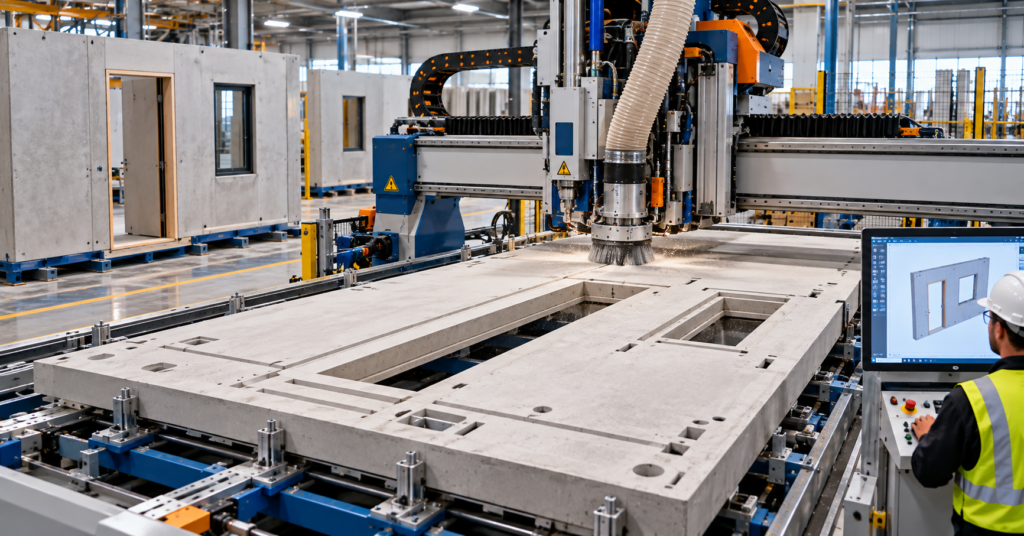
AXYZ is targeting equipment at small and medium-sized builders, potentially allowing more companies to move portions of construction from outdoor job sites into controlled factory environments. The technology can automate the cutting of components for walls, including openings for windows, doors and building services.
That matters because one of Canada’s construction problems is productivity.
We still build much of our housing largely project by project and site by site. Modular and prefabricated construction introduce more of the logic already common in manufacturing: repeatable designs, controlled production, specialized equipment and economies of scale.
Our earlier article highlighted exactly this opportunity in Nova Scotia. The province is already using modular housing in communities including Lower Sackville and Amherst, while an Amherst-based operation has been developing prefabricated apartment units for multi-residential construction. Cedar Whispers
But the warning from August still stands.
A factory alone does not make housing cheaper.
Factories need orders. Developers need financing. Municipalities need predictable approval processes. Designs must be repeatable, and transportation and site assembly have to work economically. Without a steady pipeline, expensive manufacturing capacity simply becomes another fixed cost. Cedar Whispers
What has changed is that the movement is gaining credibility.
Federal housing policy is explicitly supporting factory-built and modular construction, established international companies are entering the Canadian market, and now private investment connected to Nova Scotia is moving toward construction automation.
That does not prove modular housing will solve Canada’s affordability problem.
But it strengthens the argument we made earlier:
Nova Scotia should not be asking whether modular construction will replace conventional construction. It should be asking where modular can do the job faster, more predictably and at lower total cost — and how we create enough demand to make local manufacturing viable.
Our earlier article is worth another look:
Can Modular Construction Help Nova Scotia Build Faster and Cheaper?
#NovaScotia #Halifax #Construction #ModularConstruction #PrefabConstruction #Housing #HousingSupply #ConstructionTechnology #Automation #RealEstateDevelopment #Manufacturing #Innovation #BuildingIndustry #CedarWhispers