
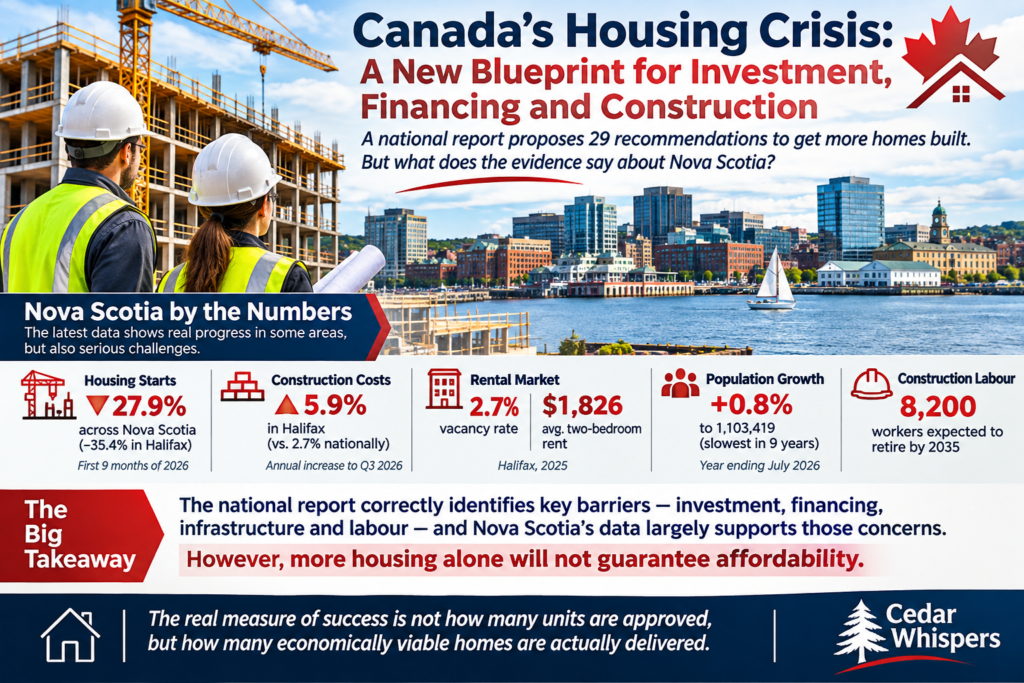


Canada does not simply need more housing targets. It needs a system capable of turning proposed developments into completed homes.
That is the central message of a major new report released in November 2026 by the National Housing and Investment Initiative (NHII), a coalition bringing together some of Canada’s largest financial institutions and leading residential developers.
Entitled Recommendations for a Sustainable Canadian Housing Market, the 35-page report presents 29 recommendations organized around four priorities: attracting investment, reforming housing finance, stabilizing immigration planning and improving housing data.
Its underlying argument is that Canada’s housing difficulties cannot be solved through construction targets alone. Developers must secure financing, municipalities must provide infrastructure, lenders must manage risk, and households must be able to afford the homes being built.
Unless these elements work together, ambitious housing announcements may produce relatively few additional homes.
A Housing Industry Under Pressure
The report begins by emphasizing housing’s importance to the Canadian economy.
Citing Statistics Canada, it states that residential investment supported more than 1.2 million jobs in 2025, generating approximately $152.1 billion in economic activity.
Yet the industry faces significant uncertainty.
Following the pandemic-era housing boom, higher borrowing costs, changing market conditions and weakening consumer confidence have challenged the economics of new developments.
Construction costs remain elevated, while the gap between what housing costs to build and what households can afford continues to constrain investment.
The federal government’s ambition to achieve 500,000 housing starts annually illustrates the scale of the challenge.
However, the NHII questions whether measuring success primarily through housing starts is sufficient.
It argues that policymakers should also monitor sales, vacancy rates, affordability, rental prices and the broader health of the construction pipeline.
A housing target has little practical value if developers cannot finance projects or buyers cannot afford the finished product.
1. Attracting the Capital Needed to Build
Perhaps the report’s most consequential finding concerns investment.
Citing research by RBC, the NHII estimates that addressing Canada’s housing shortage could require approximately $2 trillion in capital deployment over five years.
Such investment cannot come from government programs alone.
The report therefore recommends creating conditions that make Canadian housing projects more attractive to private and institutional investors.
One proposal is particularly relevant to developers: in-stream protection.
Under this framework, applicable development fees, charges and regulatory requirements would be established early in the approval process and remain fixed as a project advances.
This would protect projects from unexpected regulatory or cost changes after financing decisions have been made.
The report also calls for faster approvals, more predictable zoning and stronger federal incentives for municipalities that adopt effective development practices.
Another major proposal would expand federal construction financing to include qualifying condominium projects.
Currently, federal financing programs provide important support for purpose-built rental construction. The NHII argues that ownership housing, including condominiums, townhouses and missing-middle developments, needs comparable financing mechanisms.
Government-backed credit enhancements could allow financially viable projects to proceed even when conventional presale requirements are difficult to satisfy.
For rental housing, the report proposes additional tax incentives.
These include a capital-gains rollover mechanism for investors who reinvest proceeds from existing rental properties into new construction, a modernized Multi-Unit Residential Building tax program, and a Canadian equivalent of the American Low-Income Housing Tax Credit.
The objective is to encourage investment in new housing supply rather than simply transferring ownership of existing properties.
2. Rethinking How Infrastructure Is Financed
The report also identifies infrastructure financing as a major obstacle to development.
New housing requires water, wastewater systems, roads, transportation connections and utilities.
Traditionally, municipalities have relied partly on development charges and other upfront payments to finance this infrastructure.
These costs can significantly affect project feasibility.
The NHII recommends exploring alternative mechanisms, including Tax Increment Financing, Special Districts, Municipal Utility Districts and Local Improvement Districts.
Tax Increment Financing, for example, uses a portion of future increases in property-tax revenues to finance infrastructure improvements.
Other models spread infrastructure costs over longer periods through bonds, property assessments or utility charges.
These approaches could reduce the amount developers must finance before construction begins.
However, they do not eliminate infrastructure costs. They change when those costs are paid and who ultimately bears them.
The report also recommends reconsidering restrictions on foreign investment where that investment directly creates new housing, while maintaining protections against speculation in existing homes.
3. Making Housing Finance More Responsive
The second major pillar addresses credit risk.
The NHII argues that Canada’s mortgage regulations must protect financial stability without unnecessarily preventing creditworthy households from purchasing newly constructed homes.
Its proposals include targeted down-payment assistance for first-time buyers, adjustments to mortgage qualification requirements and greater flexibility for builder-funded financing incentives.
The report recommends refining the mortgage stress test rather than abandoning responsible lending standards.
It also proposes reducing government-imposed costs on new housing and making certain housing-related tax relief more permanent.
One more controversial recommendation involves reconsidering part of the principal-residence capital-gains exemption to support other housing incentives.
The central challenge is balancing easier access to financing with the risk of encouraging excessive borrowing or increasing prices.
The report acknowledges that mortgage stress tests have improved borrower resilience. Any changes would therefore require careful evaluation.
4. Immigration Stability and Construction Labour
The NHII’s third pillar examines immigration from two perspectives: housing demand and construction capacity.
Population growth creates demand for additional homes. At the same time, immigration supplies workers needed to construct them.
The report argues that unpredictable changes in immigration levels make long-term housing investment and municipal infrastructure planning more difficult.
It recommends extending immigration planning from three to five years, supported by a longer-term ten-year framework.
It also calls for immigration policies that better reflect shortages in skilled construction trades.
This is particularly important as experienced tradespeople retire and the industry struggles to replace them.
The report’s message is not simply that Canada needs more or fewer immigrants.
Rather, population policy, housing production and labour-force planning must be better coordinated.
5. Better Housing Data, Better Decisions
The fourth pillar addresses a fundamental weakness in Canadian housing policy: fragmented information.
Different municipalities, provinces and federal agencies collect different housing statistics using inconsistent definitions and reporting periods.
Consequently, an approved development may be counted in the housing pipeline even when financing problems or construction costs make it unlikely to proceed.
The NHII proposes establishing a National Housing Intelligence System, potentially managed through a public-private organization.
It recommends standardized reporting on approvals, permits, construction starts, completions and the time required to move between these stages.
Municipalities with populations exceeding 10,000 would participate, alongside qualifying builders and developers.
Better information could help governments identify bottlenecks, investors assess market conditions and municipalities plan infrastructure.
The distinction between homes approved, homes under construction and homes actually completed is essential.
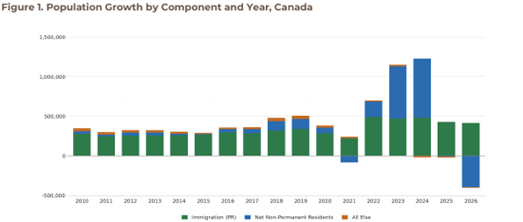
NHII Key Data Points during the Development Life Cycle.
An Ambitious Blueprint, but Not a Guaranteed Solution
The report makes a persuasive case that housing policy must address the entire development process.
Nevertheless, its recommendations reflect the perspective of an industry-led coalition whose members have a direct financial interest in housing development.
Proposals involving tax concessions, public credit guarantees and relaxed financing requirements require independent assessment of their costs and risks.
Similarly, spreading infrastructure expenses over decades may improve initial affordability without reducing the total amount paid by residents.
The real test is whether these reforms produce more completed homes at prices Canadians can afford, rather than simply improving returns for investors.
That distinction should guide the federal government’s response.
________________________________________
Nova Scotia’s Housing Market: Does the Evidence Support the National Report?
Nova Scotia provides a revealing test of the National Housing and Investment Initiative’s recommendations. Its housing market is experiencing a troubling combination: falling construction starts, rising building costs, slowing population growth and persistent affordability problems.
However, the provincial evidence also challenges the assumption that attracting more investment and building more housing will automatically resolve affordability.
Housing Construction Is Slowing Sharply
The strongest evidence supporting the report comes from housing construction statistics.
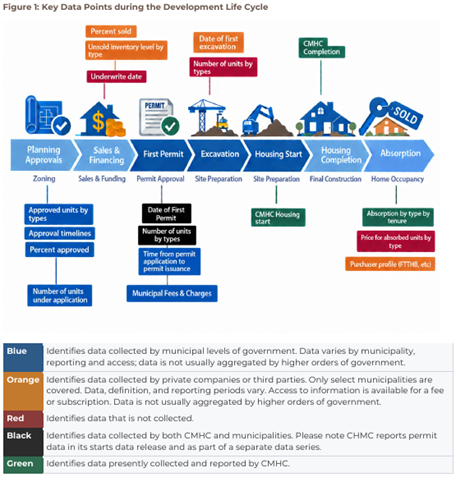
According to Nova Scotia’s Department of Finance, housing starts across the province declined 27.9% during the first nine months of 2026, compared with the same period in 2025.
The decline was even more pronounced in Halifax, where starts fell 35.4%.
By comparison, housing starts across Canada declined only 4.6% during the same period. Nova Scotia recorded the steepest provincial decline.
These figures reinforce the report’s warning that Canada’s housing production pipeline is vulnerable.
However, there is an important qualification.
Despite fewer new starts, Halifax had 14,573 housing units under construction in September 2026, an increase of 12.7% from September 2025.
This apparent contradiction reflects the difference between projects already underway and developers’ willingness to initiate new construction.
The immediate concern is not necessarily a shortage of construction activity today, but a weakening pipeline of projects for tomorrow.
NHII Housing starts, year-to-date (January–September).
Construction Costs Are Rising Faster Than the National Average
Nova Scotia also provides strong evidence for the report’s concerns about development costs.
Statistics Canada’s Building Construction Price Index shows that residential construction prices in Halifax increased 5.9% between the third quarters of 2025 and 2026.
Nationally, the increase was 2.7%.
Halifax recorded increases of 6.3% for single-detached homes, 6.0% for townhouses, 5.8% for high-rise apartments and 5.6% for low-rise apartments.
These figures matter because construction budgets are established well before projects are completed.
When building costs rise faster than achievable selling prices or rental revenues, financing becomes more difficult and developers may postpone projects.
For Nova Scotia developers, cost escalation is not merely a national concern. It is a particularly acute local problem.
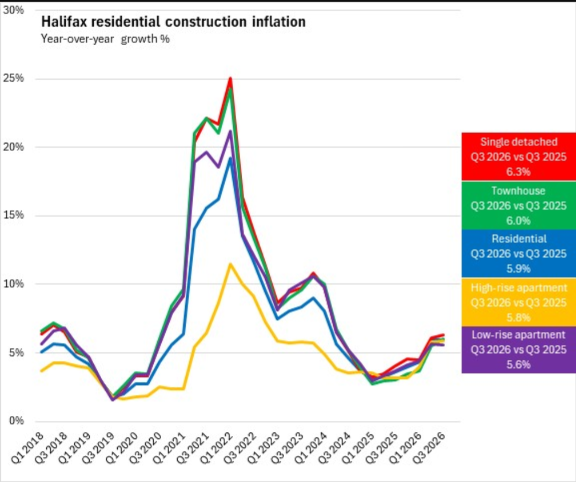
Halifax residential construction inflation, Q3 2026 .
More Apartments, but Affordability Remains Elusive
The rental market presents a more complicated picture.
According to CMHC’s 2025 Rental Market Report, Halifax’s purpose-built apartment vacancy rate increased to 2.7% as new supply entered the market and population growth slowed.
Nevertheless, the average rent for a two-bedroom apartment reached $1,826, with same-sample rents increasing 6.7% during the year.
CMHC also reported that newly constructed apartments experienced relatively high vacancy rates, while affordable rental units remained scarce.
This finding is particularly significant.
It demonstrates that an increase in housing supply does not necessarily translate into affordable housing for lower-income households, especially when newly constructed units require high rents to cover development costs.
CMHC’s June 2026 analysis estimated Halifax’s balanced rental vacancy range at approximately 3% to 4.5%, suggesting the market remained somewhat undersupplied overall.
Yet the same analysis identified deteriorating affordability for existing Halifax tenants.
The evidence therefore supports additional housing construction, but it also suggests that the type, cost and location of new housing matter as much as the number of units delivered.
Slower Population Growth Changes the Equation
The national report emphasizes predictable immigration policies to support housing investment.
Nova Scotia’s recent demographic figures reinforce that argument.
The province’s population reached 1,103,419 on July 1, 2026, an increase of just 8,262 people, or approximately 0.8%, over the preceding year.
This was its slowest population growth in nine years.
Immigration remained substantial, with 9,564 immigrants arriving during the year, but the province also experienced its first annual decline in non-permanent residents since 2021.
For developers, these changes have important consequences.
Apartment buildings financed during a period of rapid population growth may reach completion when rental demand is expanding more slowly.
This supports the report’s call for stable population planning, but it also challenges policies that assume housing demand will continue growing at its previous pace.
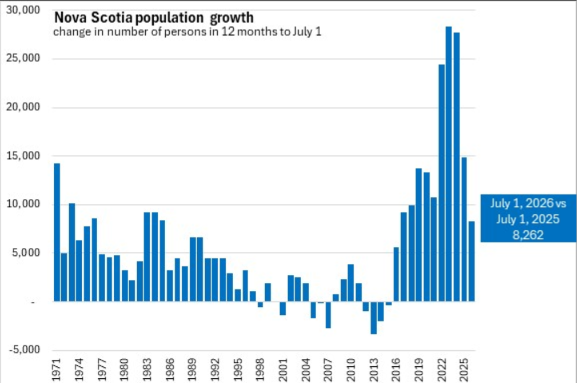
Nova Scotia population growth, year ending July 1, 2026.
Infrastructure and Labour Remain Structural Obstacles
The report’s emphasis on infrastructure financing is particularly relevant to Halifax.
In July 2026, the provincial government introduced regulations intended to improve coordination between the municipality, Halifax Water and provincial authorities.
The government explicitly acknowledged that water, wastewater and other infrastructure requirements can delay housing construction.
Halifax Water’s published regional development charges amount to approximately $5,406 per new apartment unit for water and wastewater infrastructure combined.
A proposed revision to these charges was subsequently suspended pending clarification of the province’s development-charge freeze.
These costs illustrate the report’s argument that infrastructure financing affects development feasibility.
However, eliminating or deferring charges does not eliminate the underlying infrastructure expense. Someone must ultimately finance the required upgrades.
Labour presents another challenge.
According to BuildForce Canada, approximately 8,200 Nova Scotia construction workers are expected to retire by 2035, potentially leaving a shortage of 1,300 workers after accounting for new entrants and employment growth.
More revealingly, BuildForce projects residential construction employment declining 15% by 2035, while non-residential construction employment increases 22%.
Major hospital, industrial and infrastructure projects could therefore compete with residential developers for skilled trades.
What Should Nova Scotia Take From the Report?
The available evidence strongly supports three of the report’s central arguments: construction costs are undermining development feasibility, infrastructure constraints affect housing delivery, and demographic uncertainty complicates investment decisions.
However, Nova Scotia also demonstrates the limitations of treating additional construction as a complete solution.
New apartments can remain vacant because their rents exceed what households can afford, even while less expensive housing remains scarce.
Meanwhile, a slowdown in population growth can reduce demand just as projects initiated during stronger market conditions reach completion.
Nova Scotia’s housing challenge is therefore not simply to build more homes. It is to deliver the right housing, at sustainable costs, in locations where genuine demand exists.
For policymakers, developers, lenders and construction companies, the priority should be to improve project feasibility without encouraging construction that local households cannot support.
The critical question is no longer how many housing units Nova Scotia can approve. It is how many economically viable, genuinely affordable homes the province can deliver.