

This text is never meant to be final. It’s a register, not a report. A place where oral tradition is written down before it fades, and where good deeds are kept visible to be emulated. It is unfinished by design, because there are more small stories to be unearthed.
By Simon yammine
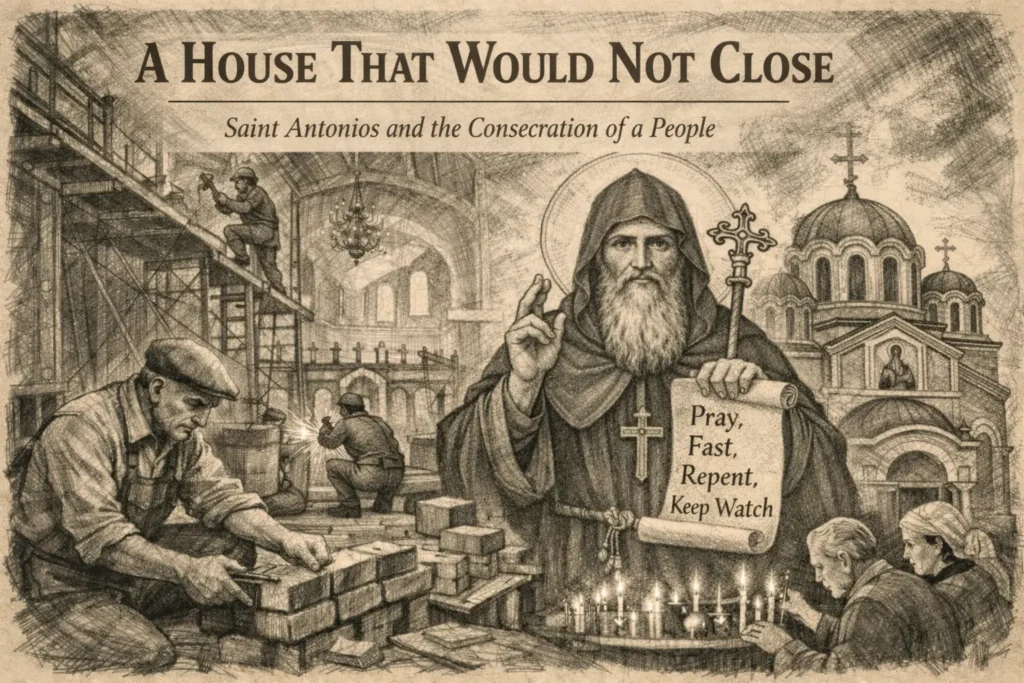
On May 24, 2025, under Halifax skies that felt almost intentionally bright, St. Antonios Antiochian Orthodox Church received what every church longs for and what very few communities live long enough to see with their own eyes: the consecration of an altar, the sealing of relics, the anointing that turns a structure into something irreducibly more than architecture. That day is now written into the soul of the Lebanese Orthodox community in Halifax.
And yet, if we tell the story of St. Antonios beginning with that day, we risk doing it ethically wrong. The way we sometimes retell victories as if they were inevitable.
Because before the oil, there was the work.
Before the procession, there were meetings.
Before the incense, there were budgets.
Before the chanting, there were drafts, redrafts, permits, delays, arguments, reconciliations, doubts, and that uniquely Lebanese thing where five people do the work of fifty and then refuse to take credit.
This is a story about a church. Yes.
But it is also a story about Orthodox perseverance in Nova Scotia.
It is a story about what happens when a small immigrant community decides that it will not live here temporarily.
It is a story about a people who refuse to disappear.
The Lebanese Orthodox community in Halifax began organizing spiritually in the late 1970s. Exact dates blur in memory, as they often do when you are building something with volunteer hours, second jobs, and the exhausting rhythm of starting over in a new country. But the shape of the story is clear.
There was a small group.
There was deep attachment.
There was the village mindset, the kind of attachment Orthodoxy carries strongly among people from smaller towns, where faith is not a Sunday routine but an inherited atmosphere.
Before Saint Antonios parish was established, many Lebanese Orthodox families attended Saint George’s Greek Orthodox Church on Queen Street. For some, that was enough. The theology was the same. The liturgical structure was the same. The Byzantine rhythm of prayer is a kind of unifying spiritual muscle memory. Language mattered, but it was not everything.
Still, a longing persisted for something distinct, not in faith, but in belonging. When you are an immigrant, you can share a sacred space and still feel like a guest. So, the hope grew for a parish where Greek, Arabic and English could coexist, where families could hear their heritage without apology, and where the Lebanese Orthodox presence would become visible, coherent, and permanent.
Many streams converged to lead us where we are now. Some of those streams were personal and informal, and some were organized and institutional. They moved in parallel for a time, until they met.
George Esber arrived in Canada on a tourist visa in the mid-1970s. He had long dreamed of becoming a priest and serving at the altar of the Lord. Yet, as the only male child in a family of eleven children, he was not encouraged to take that path. In response to the Lebanese Civil War, Pierre Trudeau introduced some special immigration measures that helped George regularize his residency. George began visiting different parishes until he eventually settled at St. George’s Church. There, his desire to serve the Church and his community grew stronger.
Soon, he set out to find Orthodox families in Halifax, hoping to form a parish. As a newcomer, the task was not easy. His brother-in-law, Pierre Jabbour, introduced him to Zakhour Faddoul, now a deacon in the Maronite Church, who helped him follow the Orthodox faithful throughout Halifax. Through these connections, George gradually established contact with around forty Orthodox families in Halifax. His efforts then extended to Prince Edward Island, where nearly one hundred Orthodox families were living at the time.
At approximately the same time, a group of Lebanese Orthodox families, under the supervision of the late Latify Boudreau, began considering the founding of an Antiochian Orthodox church in Halifax. Latify reached out to her former priest at St. Nicholas Church in Montreal, seeking advice and assistance in establishing the first Antiochian Orthodox church in the Maritimes. At that time, she didn’t know any locals who could help her start a new parish.
The community increasingly felt the need for liturgical services in Arabic, particularly for baptisms, weddings, and funerals. One decisive moment that pushed that initiative forward came through Anthony Nahas insistence that his son Leo’s wedding be celebrated in the language of his ancestors rather than in Greek. To officiate the wedding, deacon George Esber contacted an Orthodox priest in Montreal. Heavy snowfall prevented the priest from reaching the Maritimes. As an alternative, a Greek priest conducted the service while the deacon delivered parts of it in Arabic. This event became the spark that galvanized the community. The time was ripe to organize seriously and to establish an Antiochian Orthodox parish. That is how institutions begin most of the time. Not with a grand plan, but with one person who refuses to compromise.
A few committed individuals began meeting regularly with the help of Father Joseph Chahine, the first clergyman to sponsor the initiative. The goal was to identify 25 active Orthodox families willing to support a new parish. Their first meetings took place at St. Matthias Anglican Church. This is one of those Halifax details that reads like a parable. Years later, St. Matthias would become the future home of St. Antonios itself.
The Archdiocese in New Jersey was contacted. Metropolitan Philip Saliba sent a layman, Faris Haddad, to assess the situation and gather the Orthodox community in Halifax.
A group of laymen pledged and signed their commitment. The signatories were Bassam Nahas, Bechare Habib, George Abou Haidar, Fr. George Esber, George Lawen, Dr. Joseph Lawen, Latify Boudreau, Michael Kharma, Michel Al Khouri, Moufeed Khoury, Ramez Haddad, Sassyne Amyoony, and Toufic Tannous. Metropolitan Philip Saliba blessed the formation of St. Antonios Antiochian Orthodox Christian Church on May 20, 1980.
St. Nicholas Antiochian Church in Montreal provided support through Father Joseph Chahine. Ernest Saikaly, vice chairman of the Archdiocesan Board of Trustees, donated the church’s first iconostasis and visited Halifax several times to provide guidance and encouragement.
The hope became a mission. The parish was founded under the patronage of Saint Anthony the Great. That same year, Archbishop Saliba visited Halifax to witness the devotion of a growing community. Immigrant communities often live with the feeling that they are building alone on the edge of the world. A visit from a hierarch is recognition; a spiritual endorsement, the kind that turns an idea into a vocation. When you build in diaspora, you are not merely building utility. You are building proof. Proof that you are not passing through. Proof that your children will have a memory stronger than assimilation.
The first building officially associated with the parish, in August 1980, was an existing church at 2455 Windsor Street. It was not a perfect fit, but there is something sacred about imperfect beginnings. They force you to rely on each other. Memories from those years remain vivid not because the building was magnificent, but because the effort was intimate.
Parishioners gave generously of both time and money to turn the community’s dream into something real. Among the most committed were Yoseph Lawen, Moufed Khoury, Latify Boudreaux, Ramiz Haddad, Bassam Nahas, and many others. One witness remembers being about twelve years old when the church opened and feeling tremendous pride: this is our church. To have “our own church” symbolically meant that families who left Lebanon were no longer only surviving in Canada. They were established in Canada. They were writing their own narration.
The opening of the newly purchased church was marked with a sacramental milestone. The wedding of Bassam and Linda Nahas, presided over by Archbishop Elia Salibi, materialized the community’s longing for Orthodox services held in Arabic. Bassam was Anthony’s son and Leo’s brother. The event symbolically linked the founding of the parish with the very family whose determination helped ignite the movement.
During this time, Father Elia Shalhoub and his wife, Khourieh Odette, were sent to serve as the first full-time clergy family for St. Antonios. His mission was to establish a solid foundation spiritually and administratively, serving through financial difficulties and the challenges of maintaining engagement.
Some stories function as small icons of perseverance. A grandfather who lived half a block away on Charles Street would take on work wherever he could, including painting the old church’s wooden front stairs year over year. He did not want the church to look old. That small act is a theology of belonging. It is what immigrants do when they feel the weight of representing their community. The church could not look abandoned. The place had to look alive, even if the people were exhausted.
As the 1980s progressed, the parish, celebrating the final payment of the mortgage, chose to remortgage to purchase a neighbouring house at 2465 Windsor Street as the priest’s residence.
But in the late 1980s, tensions in Lebanon affected the diaspora community’s internal life. The ongoing burden of funding and sustaining the parish also tested everyone. The devoted members remained, heralded by parish council chair Rafat Nasrallah, determined to keep the church alive, but St. Antonios was in a fragile state.
When Father Maximos Saikali arrived in Halifax in August 1991, few families remained active. Many have distanced themselves due to internal conflicts and financial burdens. Sunday liturgies were sparsely attended.
In his first week, Father Maximos called every parishioner’s home to introduce himself. By the second Sunday, the church was filled. He made it clear that they needed God’s presence more than God needed their attendance. As a bold demonstration, he eliminated traditional membership dues, telling people to give as they are able, and promising that if anyone was in need, the church would provide.
Khourieh Rita played an integral role in this revival, attracting many with her chanting and welcoming spirit. Together, they reshaped parish life, revitalizing youth programs and strengthening communal belonging.
The revitalization was not only spiritual. The basement hall, structurally unsafe with rotted pillars, was reinforced. It was turned into usable space mainly through the persistent work of Fred Halef. The latter worked tirelessly with Father Maximos each evening to ensure the parish had a safe space to gather. The Lawen family installed a cost-effective heating system to make the building more comfortable during harsh winters.
A free Sunday School bus service was launched in 1992 to bring over 100 children from Dartmouth, Lower Sackville, Bedford, and Halifax. Recognizing the need to serve a diverse community, Father Maximos initiated a full English Liturgy in 1993. The parish extended its reach to Prince Edward Island. Father Maximos travelled monthly to serve liturgies for a small group of Orthodox families there, and that effort grew into SS. Peter and Paul Church, the second Antiochian parish in the Maritimes. Saint Antonios was not simply surviving. It was planting.
A climate emerged in which the community recognized a need to share their true values, faith, and heritage. The Halifax Lebanese Festival was born, originally established as the St. Antonios Lebanese Festival. The festival created unity. It gave people purpose. It became one of the most successful festivals in Nova Scotia. Following the festival, more families joined and sought ways to remain connected, leading to the Lebanese Directory.
The Olympic Garden Hall, at 2304 Hunter Street, was undergoing a foreclosure process amid a tangle of mortgages and urgency. It had three mortgages: approximately $280,000, $200,000, and another $200,000. The first was held by a company owned by the property owner. The second mortgage was with TD Bank. A lender from New Brunswick held the third one. This detail matters because it shows how messy reality is behind every “success story.”
The Hall was brought to Fr. Maximous’ attention; his response was decisive; the church should buy it. A small team assembled quickly and met with the head of TD Bank. They offered $5,000 for the $200,000 mortgage. TD accepted $10,000. You can call it a miracle. You can call it Levantine cunning, but that single moment is the kind of moment that changes a community’s trajectory.
Then the quasi-impossible task arrived: raising $280,000 in less than two weeks. Joseph Lawen stepped forward first with a substantial offer. Several others matched and contributed. The total was raised. The property was secured via court foreclosure process. The cost to the church was roughly $290,000. The official record credits leadership in the purchase to Vrege Armoyan, Besim Halef, Louis Lawen, and Mounir Haddad.
The hall was purchased on December 22, 1998. It became integral to community life, hosting cultural events, banquets, and church activities. The parish now has a real space, parking, and additional revenue. Even more, it became the engine of the annual Lebanese Festival.
By 2012, St. Antonios had grown to over 250 families, and the need for a larger permanent home became pressing. For many years, the congregation had St. Matthias Anglican Church for major services such as Holy Week. The idea of acquiring the building was not new.
When the Anglican church came up for sale, the parish held an Annual General Meeting and decided overwhelmingly to pursue the purchase. Besim Halef, as parish council chairman, acted swiftly to secure the property, and within days, the deal was executed.
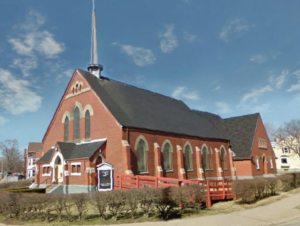
Details matter because they show that buildings hold layers before they become “ours.” A former Anglican parish did not become Orthodox by demolition. It became Orthodox by transformation, by prayer occupying it again and again until the space learned a new language.
The parish acquired the building in May 2011. The purchase price was about $1.3 million. The church had recently emerged from its financial difficulties, thanks to the purchase of the Hall and the success of Lebanese festivals. That stability made the purchase possible, but it still felt daunting. There was shock at first, and excitement. Half the people were thrilled. Half felt nervous. Other religious groups had offers, and the parish was fortunate to secure the building by what may have been a day or two.
There were doubts and fears about taking on such responsibility, and those doubts were not irrational. The building was old. It was cold to operate and costly to heat. It had not been renovated in decades. It carried an architectural identity different from Byzantine Orthodox form. It had functional problems, including access and parking.
Some had a different dream, building a new church on Kearney Lake Road. The suburban model promised ease: new construction, clean planning, simpler systems. One parishioner even offered to build it on his dime.
This created a divide rooted in geography and lifestyle: urban versus suburban. Renovate the Windsor site or build new at Kearney Lake. That divide lasted years and tested unity. These are painful details, but they belong to history. Unity is not the absence of conflict. Unity is the willingness to remain a family even when you disagree.
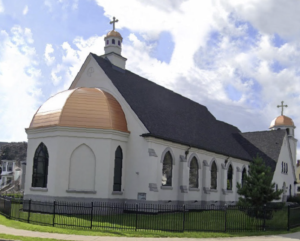
The church building was almost 100 years old. There were leaks through the brickwork, but it was structurally sound. What was uncertain was not whether the building could stand. It was whether it could become something that functioned as an Orthodox church in a modern Canadian city. The existing parking lot was a grassy field. The entrance was off the corner of Chebucto and Windsor, making it difficult and unsafe for people to pull over and access the church. And architecturally, the church was Gothic, not Byzantine.
The project required a dramatic conceptual shift: flipping the entrance and the altar. This was not only symbolic. It was also functional. It allowed a driveway and parking area that the church badly needed. But the biggest risks at the start were more financial than technical.
The initial budget estimate was roughly $1.5 million. But the drawings at hand adopted a long-term vision for quality and architecture. Once functionality and long-term efficiency were fully incorporated, the budget increased to about $2.5 million. People questioned aluminium windows instead of vinyl. Stucco instead of vinyl siding. Commercial-grade roof instead of a sturdy roof. A more economical solution would have been easier. But easy is not always faithful.
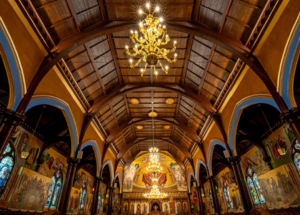
Renovation requires strong leadership, because such projects invite endless compromise.The construction team held firm, insisting on quality, aesthetic integrity, and operational efficiency. The church was to be built in a way that would not burden future generations with constant repairs. In the end, the project was not a renovation. It was a transformation that preserved elements of the Anglican building that carried beauty: stained glass, wood ceilings, posts… The character of the old church contributed to the feel of the new one. The building became an Orthodox church without erasing its past, the way someone becomes Canadian without losing Lebanon.
No parish story is complete without acknowledging the human difficulty. There was Ongoing work. Financial discussions. Politics, in the way communities often experience politics: not ideology, but personalities, approaches, wounds, and the tension between those who want to preserve and those who want to change. Perfect harmony is not a sign of holiness. It can be a sign of lethargy. What matters is whether the community endures, and Saint Antonios endured.
Renovations are already hard. Renovations with multiple opinions are harder. Some involved lacked experience. The project manager had to enforce professional standards while respecting volunteer efforts. Behind walls and under floors, discoveries forced adaptation. External walls were gradually shifting due to the roof load. Threaded rod connections were added to maintain structural integrity. The floor required reinforcement.
Budget limitations influence decisions in every project. But in this case, they did not become an excuse to reduce quality. A major example is HVAC. A high-quality commercial HVAC system was originally designed, but it was expensive and difficult to integrate without damaging the architecture. Alex Halef arrived with a simpler, efficient, lower-cost system that was practical to install without harming the building’s architecture.
Stained glass was another high-stakes issue. Each stained-glass window could have cost over $100,000 to replace or fully restore. Instead, new thermally glazed aluminium windows were installed in front of them. The stained glass remained in place while the building was modernized. This solution preserved beauty for generations.
The most complex part of the renovation was the altar. The team removed the entire brick wall, which served as a shear wall, to create a 30-by-30-foot opening.
The construction project had no official fundraising committee. Two-thirds of the members were not directly supportive of the building project due to cost concerns. Yet those who were supportive were extraordinarily generous. One elderly lady gathered all her gold in a bag and handed it to the priest. “This is all I have”, she said. Funding came from multiple layers. The church had already saved about $500,000 from the festival. About six families contributed around $600,000. The remaining families contributed about $200,000 collectively.
Many companies beyond the Orthodox community stepped in with donated labor, discounted materials, or preferred pricing. In total, that support is estimated at roughly $800,000 to $1,000,000. In an era when churches are being demolished, Halifax helped build one. That fact deserves gratitude.
For the church acquisition and development, a long list emerges, including Besim Halef, John Lawen, Fr. Maximous, Mike Haddad, Fred George, Dr. Joe Lawen, Bassam Khoury, Eli Hage, Abe Salloum, Ramzy Tawil, Ghazzan Haddad, Fouad Mina, Riad Habib…
Ramzy Tawil served as construction manager. George Lawen and family were major financial contributors. Louis Lawen, and Dexel, provided development services, design drawings, and project management, while his brother Peter assisted with construction management. John Lawen was heavily involved with the wood-carved altar from Lebanon, while his sister Diane took charge of the bell.
Leadership balanced ambition with financial responsibility. People saw progress and began to give slowly. Toward the end, a $500,000 loan was borrowed and later paid back after the sale of the Kearney Lake land. The renovation was a testament to parishioners and friends, and specifically highlights the expertise of the Construction and Capital Campaign Committee. The committee included Abraham Salloum, Affaf El Jakl, Alex Halef, Antonious Elias Nahas, Besim Halef, Eli Hage, Fouad Mina, Fred George, George Armoyan, Jack Fares, John Lawen, Louie Lawen, Fr. Maximos Saikali, Michael Haddad, Michael Lawen, Mounir Haddad, Ramzi Tawil, Saad Massan, and Vrege Armoyan.
When the church was completed in 2015, a shift occurred. Many who had opposed the project became among the most active people in the church today. People did not remain stuck in old arguments. They showed up, and they served. We fight, we disagree, we complain, we stress, we worry, we doubt, and then, when the dust settles, we cook together, we pray together, we bury our dead together, we baptize our children together, and we remember that in diaspora. We do not have the luxury of permanent division.
The first service in the newly transformed St. Antonios took place in October 2015. The community rejoiced in its new home, yet felt a real sadness in leaving the Windsor Street church that had held more than three decades of memories. The move included a procession from the old church to the new, carrying sacred items, icons, and relics. If a single sentence captures diaspora identity, it is this. We carry our altar with us.
As Antiochian Maronite Christians, shaped more by the collegial tradition of the pentarchy than by Petrine supremacy, we see the 1054 schism less as a true theological dividing line and more as a historical rupture. Our saints are older than our polemics. The liturgy is older than our modern labels. We are one people shaped by one geography of saints, one landscape of monasteries, one culture of fasting and feasting, one language of incense and chant, one inheritance that survived empires, genocides, migrations, and civil wars.
We cannot pretend to be neutral. We are proud to see this. Proud in a way that surprises us, because pride is a complicated word for oriental people. In Lebanon, we learned the hard way that institutions do not survive by accident. They survive because people accept sacrifice. They survive because someone stays late when nobody claps. Orthodox Christians in Halifax built what so many communities elsewhere are losing. In a time when churches in the Western World are closing, being sold, or demolished, Saint Antonios Parish did just the opposite.
But one question will always linger: what should today’s generation owe this church? The answer is simple and demanding. Honor the ancient roots of those who came from the land marked by the footsteps of Jesus and pass that stewardship forward. This is not romanticism. Diaspora faith is not automatic. A church can be inherited and still be lost if it is not nourished.