


Introduction
In this meticulously researched study, Dr. Ziad Jalbout confronts one of the most dramatic and morally charged episodes of ancient military history: Alexander the Great’s siege of the city of Tyre and its occupation in 332 BC. Perched defiantly on an island just off the coast, Tyre resisted Alexander’s armies for seven relentless months, a resistance so fierce and sustained that it came close to shattering the conqueror’s expansionist ambitions altogether. While Western historians have returned to this battle again and again, filling dozens of volumes with analysis and interpretation, it remains strikingly marginal in Lebanese military and historical scholarship. For this reason, Dr. Jalbout underscores the necessity of revisiting this episode through a modern scientific lens, grounded primarily in the writings of ancient historians and reinforced by the weight of contemporary archaeological discoveries.The study unfolds across three carefully structured sections.
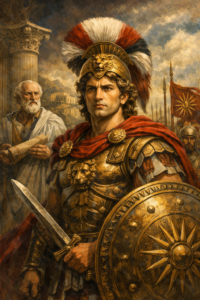
The first section examines Alexander the Great himself, delving into his leadership traits, his military doctrine, and the early battles he fought against the Persians at the dawn of his eastern campaign. The second section illuminates the circumstances surrounding the Battle of Tyre, the motives that led to it, and the historical background of the city, tracing its origins and prosperity while seeking to explain why Tyre alone, unlike the other Phoenician cities, chose resistance over submission.
The third section offers a precise and unflinching account of the battle itself, detailing the preparatory stages, the balance of forces between the two sides, and the succession of military actions that culminated in Alexander’s victory and the brutal massacres he carried out after occupying the city, massacres that claimed the lives of thousands of Tyrians.
First section: Alexander the Great, his leadership character and his eastern campaign
At the beginning of this study, Dr. Jalbout finds it essential to illuminate the character of Alexander the Great, a military commander who never tasted defeat, a son shaped profoundly by the influence of his parents, and a student whose intellect and imagination were sharpened by his teacher, Aristotle. This section also explores the formation of the Macedonian army and its combat doctrine under Alexander’s command, before presenting a concise account of the major battles he fought against the Persians prior to his arrival in the Levant and his decision to lay siege to Tyre.
The character of Alexander the Great
Alexander was born in 356 BC in Macedonia, north of Greece. By the age of thirty, he had forged one of the largest empires the ancient world had ever known. His character was deeply molded by his father, King Philip II, from whom he inherited not only a formidable army but also a kingdom that exercised authority over all the Greek city-states. Alongside this paternal legacy stood his intense bond with his mother, Queen Olympias, whose love for her son was so fierce that she was later accused of orchestrating the murder of her husband Philip to ensure Alexander’s accession to the throne.
Alexander’s parents played a decisive role in shaping his personality. Olympias was renowned for her exceptional beauty, but also for her intelligence, wisdom, cunning, and courage. Her concern with personal grooming led her to Babylon, where she fumigated herself and bathed in frankincense, a precious incense. This journey occurred while she was pregnant with Alexander, and upon his birth she named him “Is Kandar,” meaning “the spirit of incense.” Olympias at times served as a priestess in the temple and claimed divine ancestry, asserting that Alexander was the son of the god Zeus.
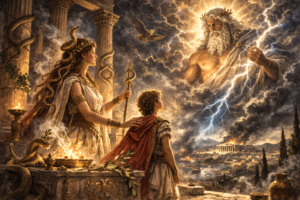
Gradually, the young Alexander came to believe these claims. Olympias personally supervised his upbringing, training him in combat and horsemanship. According to Plutarch, Alexander’s conviction that he was of divine origin sustained his pride and shielded his spirit from despair throughout the long years of campaigning and conquest.
Philip II, Alexander’s father, was physically strong and athletic, possessed immense courage, and was known for his fierce temperament. He was deeply inclined toward warfare, yet he was also merciful, faithful to his promises, and respectful of others. Philip stood as Alexander’s supreme role model, one whom he emulated at every stage of his life, having grown up witnessing his father achieve victory after victory. The relationship between Philip and Olympias, however, was strained. Matters worsened when Olympias claimed that Alexander was not Philip’s biological son but rather the son of Zeus. Philip responded by openly flaunting his relationships with other women, provoking Olympias until tensions culminated in her conspiring with one of the generals to arrange Philip’s assassination, thereby ensuring that power passed to her son.
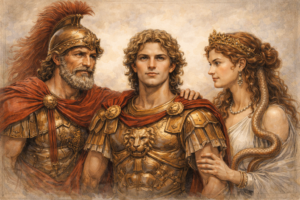
Alexander’s intellectual formation was also profoundly influenced by his teacher Aristotle, one of the greatest philosophers of Greece and a disciple of Plato. Aristotle rigorously trained Alexander in rhetoric and literature and encouraged his curiosity in science, medicine, and philosophy. He assumed responsibility for Alexander’s education at the age of thirteen and continued to instruct and discipline him for four years. During this time, he ignited in him a deep thirst for knowledge and a passion for reading. Among the works most cherished by Alexander was the Iliad. He was particularly inspired by Achilles, the hero of this epic, a fascination that may help explain why Alexander persevered before the walls of Tyre just as Achilles once did before the walls of Troy.
The Macedonian army and its combat doctrine
Alexander was a commander of exceptional distinction who never suffered defeat, even when facing armies that often surpassed his own in numbers and equipment. Scholars who have studied Alexander’s military genius consistently highlight several factors behind his repeated successes, foremost among them his extraordinary ability to exploit terrain, regardless of its nature. He was equally renowned for his relentless audacity and for insisting on placing himself at the forefront of his troops, adopting a novel combat style known as the oblique order. Before presenting this military brilliance in detail, Dr. Jalbout offers a brief historical overview of the origins of the Macedonian army.
The establishment of the Macedonian army is attributed to Philip II, who ruled Macedonia from 359 to 336 BC. His primary objective in creating this force was to rival and overpower the other Greek kingdoms. Sons of noble families filled the ranks of the Macedonian army, forming a crucial source of its strength and a foundational element of its structure. Philip used revenues from gold mines within his territory to equip the cavalry with advanced military gear and to arm the infantry with the most modern weapons, while also training them in sophisticated military techniques.
Under Philip II, this army unified Greece under Macedonian domination. Under Alexander, it crossed the kingdom’s borders as part of an ambitious project aimed at conquering the ancient world ruled by the Persian Empire. By the ancient world, Dr. Jalbout refers to the regions that today include Iraq, Iran, Turkey, Syria, Lebanon, Palestine, Jordan, Egypt, and beyond.
Alexander’s military brilliance lay in his mastery of terrain, his relentless training of infantry and cavalry, and his daring strategic vision. His soldiers displayed unwavering loyalty toward him because he fought alongside them and remained constantly present during their training. He equipped his army with a deadly weapon far ahead of its time: spears reaching up to six meters in length, capable of striking the enemy from a distance. Alexander did not choose his battlefields; he confronted the enemy wherever he encountered them, on ground they themselves had selected. His comprehensive understanding of battlefield conditions and his exceptional ability to mobilize troops and organize formations allowed him to transform imposed circumstances into advantages.
Alexander fought at the head of his troops and often reserved for himself command of the right wing during attacks, while entrusting his most renowned generals with holding the enemy on the left. This disposition reflected his aggressive nature, for he was known for his ferocious offensive momentum, to the point that it was said he nearly lost awareness of himself when the trumpet sounded the start of battle. He employed the oblique order, a tactic inherited from his father, in which the powerful right-wing cavalry forced the enemy’s left wing out of position, while the other Macedonian wing held firm, allowing Alexander to strike laterally into the enemy’s exposed flank.
The history of relations between Persia and Greece
The Persian Empire was founded by Cyrus the Great around 559 BC. At its height, it spanned the entire Near East, including western Turkey, Iraq, Iran, Syria, Lebanon, Palestine, and Egypt. This vast expansion enabled Persia to dominate the land and sea trade routes leading to the Mediterranean.
Cyrus is regarded as one of the most significant kings in Persian history, and much has been written about his policy of tolerance and openness. He was followed by Darius the Great, and later by Darius’s son Artaxerxes I. Greek historians wrote extensively about these rulers, particularly in relation to the campaigns they led against Greece during the Greco-Persian Wars, which began in 499 BC and ended in 449 BC. These wars allowed Persia to secure control over vast territories in Asia Minor, although they were accompanied by setbacks that Greek sources exaggerated to portray themselves as achieving great victories. The challenge lies in the fact that most surviving accounts come exclusively from Greek writers, leaving the Persian perspective absent.
The Battle of Thermopylae illustrates this imbalance clearly. Greek accounts claim that 300 Spartan warriors halted the advance of a Persian army said to number 180,000 soldiers, elevating the Spartans to legendary status. This story continues to inspire books and films to this day, yet it fails to emphasize objectively the strength of the Persian army, which advanced after Thermopylae, occupied Athens, and burned it. While acknowledging the Greeks’ defense of their homeland, Dr. Jalbout argues that the heroism described in these sources is greatly overstated. In reality, there were no decisive Greek victories over Persia in these encounters. The Persian Empire remained a colossal power, while the Greek city-states were small and fragile entities on its periphery. This reality would change only with Alexander’s eastern campaign in the mid-fourth century BC. From that moment onward, speaking of major victories over Persia became not only possible but undeniable.
Alexander’s eastern campaign
Following Philip’s death, Alexander ascended the throne of Macedonia and Greece at the age of twenty. He spent two years consolidating control over the Greek territories before turning eastward. The first clash between Macedon and Persia occurred at the Battle of the Granicus River, which flows through the region of Troy and empties into the Sea of Marmara in present-day Turkey.
At the battle’s outset, the Persians deployed their cavalry along the steep riverbank, with mercenary troops positioned behind them. Alexander placed his cavalry on one flank, prompting the Persians to shift their forces in response. Then, leading a detachment of horsemen, Alexander launched a sudden attack against spear- and arrow-bearing troops on the opposite flank, who were unable to withstand his assault. Timing also played a decisive role. Alexander attacked in the afternoon, when the sun stood low on the horizon directly in the Persians’ eyes, blinding them and sowing confusion. This battle revealed Alexander’s brilliance in organization, surprise, and decision-making, as well as the loyalty of his commanders.
Although the Battle of the Granicus was somewhat unplanned, it paved the way for the decisive confrontation at Issus. There, the Persian king Darius III assembled an army that Greek sources claimed exceeded two hundred thousand men. Issus lay near the Cilician Pass on the Gulf of Alexandretta. The narrow plain favored Alexander’s smaller force of no more than thirty thousand soldiers and nullified the Persians’ numerical superiority.
By nightfall, the Macedonians reached the pass leading to the Persian camp and secured the surrounding heights. At dawn, Alexander launched his attack from elevated ground. Observing the Persian formations, he noted that their cavalry was concentrated on the right wing, suggesting a planned envelopment of the Macedonian left. He altered his plan accordingly, secretly shifting cavalry from right to left to strike the Persians at their weak point.
Alexander aimed to break through the Persian left and reach the center, where Darius commanded from his chariot. His sudden assault caused panic. As Alexander advanced toward him, Darius fled, triggering the collapse of the Persian army. Though Darius escaped, members of his family were captured. In exchange for their release, Darius offered Alexander control of Persian territories west of the Euphrates. Alexander refused and advanced along the eastern Mediterranean coast to seize control of the ports. Many cities surrendered, but Tyre resisted, enduring a seven-month siege due to its strategic importance for naval dominance.
Second section: Background and motives behind Alexander’s siege of Tyre
This section examines the events preceding the siege of Tyre. After Issus, Alexander recognized the need to pursue the regrouping Persian forces, but this was hindered by the naval superiority of the Phoenician fleet allied with Persia. He therefore moved to bring the Phoenician cities under his control. Arwad, Byblos, and Sidon submitted. Tyre, however, declared neutrality. Dr. Jalbout details the factors behind this choice and the deeper motives that drove Alexander to reject Tyre’s neutrality and insist on its subjugation.
Tyre through history
Tyre lies on the eastern Mediterranean coast, in the heart of the region that witnessed the rise of Phoenician civilization. Founded by Sidonians in the twenty-eighth century BC, it reached unparalleled prosperity two thousand years later. Its wealth drew the ambitions of ancient powers, subjecting it to repeated trials.
The city was founded on islands about eight hundred meters offshore. Its earliest core centered on a temple to Melqart, surrounded by fishing communities. The Tyrians called it “Ṣur,” meaning “rock.” Though modest at first, Tyre entered its golden age in the first millennium BC. King Ahiram connected the islands by filling in the sea. Tyre faced Assyrians, Egyptians, Persians, and others, sometimes paying tribute, sometimes resisting behind its mighty walls. In the sixth century BC, it withstood a thirteen-year siege by Nebuchadnezzar without falling.
Tyre’s walls were built of massive stones, crowned with towers and crenellations. The city had fortified gates, a northern harbor guarded by towers and ships, now known as the Fishermen’s Harbor, and a larger southern harbor secured by iron chains stretched between defensive towers.
Indirect motives for the siege
Alexander sought control of the Phoenician coast to deprive Persia of its fleets and secure the route to Egypt. Historical relations between Greeks and Phoenicians further fueled his determination. Phoenicians had founded colonies across the Mediterranean, including Carthage, whose armies later achieved great victories, such as Hannibal’s triumph at Cannae.
Cadmus of Tyre taught the Greeks the alphabet and was the brother of Europa, whose name was given to the European continent. Greek mythology recounts Europa’s abduction by Zeus in the form of a bull from the shores of Tyre. Though mythological, these stories reflect real historical connections and tensions. Phoenicians were masters of the sea and commerce, pumping life through the Mediterranean. Some scholars argue that Greek feelings of inferiority toward Phoenician superiority drove Alexander’s desire to end their dominance. Greek supremacy, in his view, could not be complete while Phoenician merchants retained independence.
Finally, the Phoenician fleets had supported Persian campaigns against Greece during the Greco-Persian Wars from 499 BC to 449 BC. For Alexander, all who had participated in those wars would have to pay the price.
Alexander’s Campaign in Phoenicia
Despite Alexander’s decisive victory over the Persians at the Battle of Issus, the Mediterranean Sea itself remained under Persian influence, for the Phoenician fleets had aligned themselves with Persia and reinforced its naval power. This reality placed a severe constraint on Alexander’s ambitions. To pursue the Persians and confront them in the very heart of their empire, he first had to neutralize their dominance at sea. As long as the Phoenician fleet stood behind Persia, this objective remained unattainable. Confronted with this strategic impasse, Alexander made a fateful decision: he would march against the Phoenician cities one by one, determined to dismantle the naval backbone that sustained Persian power.
As noted earlier, following the Battle of Issus, the Macedonian king advanced southward along the Phoenician coastline. Along this route, he encountered the son of the king of Arwad, who approached him bearing a golden crown, the keys to the city, and everything subject to the authority of its ruler. The king of Arwad himself was absent, at sea, commanding his fleet under Persian orders. Alexander then moved on to Byblos, which surrendered without resistance. When he reached Sidon, the city’s inhabitants welcomed him with overwhelming enthusiasm, hailing him as a liberator from Persian domination.
Sidon’s reception of Alexander carried deep historical weight. The city had risen against Persian rule between 346 and 345 BC, prompting the Persian king Artaxerxes III to lay siege to it. Some historical accounts claim that forty thousand Sidonians, rather than submit to enslavement and captivity, chose death, setting their city ablaze and perishing within it. Other historians offer a different portrayal, suggesting that the Sidonians continued to resist from within after their walls fell into Persian hands, until the Persians entered, burned sections of the city, killed inhabitants, and crushed the revolt with ruthless force. As will become evident later in this study, history would repeat itself in haunting fashion when the Macedonians eventually succeeded in capturing Tyre. What must be emphasized here is that while Sidon was being devastated by Persian violence, Tyre maintained its strongest relations with Persia.
Alexander eventually reached the outskirts of Tyre. In response, the city sent a delegation that offered him a golden crown and abundant supplies of food as gestures of goodwill. Alexander received the envoys warmly and expressed his desire to offer sacrifices to Melqart in the god’s temple within the city walls. This request, however, concealed deeper intentions. At that time, a commander’s entry into a city to worship in its principal temple was widely regarded as implicit recognition of his sovereignty.
The Tyrians firmly refused. They declared that no Macedonian or Persian would be permitted to enter their city. Instead, they advised Alexander, who considered himself a descendant of Heracles, to offer sacrifices at the temple of mainland Tyre, arguing that it was far older than the temple on the island. They further insisted that sacrifice within Melqart’s temple inside the island’s walls was a privilege reserved exclusively for the kings of Tyre. Through this position, Tyre sought, unlike the other Phoenician cities, to remain neutral in the conflict between Macedonians and Persians. The city leaned toward concluding a treaty with Alexander, not submitting to his authority. Alexander rejected the very notion of neutrality. From that moment, he resolved to besiege Tyre and capture it, regardless of the cost.
Tyre Bars Alexander from Entering
Tyre greeted the Macedonian conqueror as he approached, yet steadfastly refused to admit him into its walls or its temple. This refusal constituted a direct and serious challenge to Alexander’s authority. In response, he imposed a siege upon the city, determined to weaken it and ultimately seize it by force. Tyre’s position stood in sharp contrast to that of the other Phoenician cities, which had opened their gates to Alexander and submitted without resistance.
The Tyrians’ refusal to yield stemmed from profound confidence in the strength of their economy, the solidity of their fortifications, the power of their fleet, and the resilience of their political system, all of which will be examined below.
Tyre was constructed on an island surrounded by the sea, encircled by massive walls and defended by towering fortifications. A sea channel approximately eight hundred meters wide separated the island from the mainland. There was no ground surrounding the island where ladders could be erected to scale the walls, nor any space to position siege engines to batter them. Alexander possessed no ships capable of bringing him close enough to the walls to strike or climb them. By contrast, Tyre commanded a formidable naval fleet capable of defending the island, reinforcing the Tyrians’ belief that their city was impregnable.
Adding to this confidence were Persian promises. The Persians assured the Tyrians that if they resisted Alexander and refused to submit to him, they would be granted complete independence and permanent freedom from interference in their internal affairs.
The Persians were not alone in urging resistance. The Carthaginians also encouraged the Tyrians to bar Alexander from entering their city. This encouragement arrived through a Carthaginian delegation that came to Tyre to participate in the annual festival of the god Melqart. The delegation implored the Tyrians to remain steadfast against the Macedonians, promising support that would soon arrive from Carthage.
It must be noted that Tyre was regarded as the nurturing mother of Carthage, founded around 814 BC by the Tyrian princess Elissa. The name Carthage derives from Qart Ḥadasht, meaning “the new city.” Over time, Carthage built a vast empire that dominated large portions of the Mediterranean basin. It possessed a powerful fleet and a growing military and economic strength that could not be underestimated.
Tyre was governed by a democratic system, representing an ancient form of democracy recognized in historical sources. Today, historians commonly agree that democracy began in Athens. The Greek cultural and political legacy, preserved to this day, clearly demonstrates the early existence of democracy there. Nevertheless, Greek democracy was neither the only form of democracy in the ancient world nor necessarily the earliest. Most Phoenician cities were city-states governed democratically.
Research into this subject remains in its early stages, yet an increasing number of scholars have begun to speak of Phoenician roots underlying Greek democracy. When examined more deeply, the origins of democratic systems appear to extend back to the earliest human communities. It is difficult to imagine that such small groups were ruled by dictators. Rather, their governance must have rested on consultation and cooperation. Tyre’s democratic system was particularly strong, and the Tyrians perceived in Alexander a totalitarian military ruler who might abolish their consultative order if they submitted to him.
Third Section: The Course of Operations and Alexander’s Victory
Combat began in January 332 BC between the Macedonians and the Tyrians, who resisted Alexander the Great with remarkable courage, supported by their city’s position on an island in the sea, ringed by high walls. We possess detailed accounts of the military operations of the Battle of Tyre, most of them recorded by Greek historians. Although these sources are not impartial, they remain highly valuable for their precision and clarity, offering a vivid picture of the course of events.
This section presents those events, beginning with the preparatory stages preceding the siege, followed by the initial Tyrian superiority, and finally the dramatic reversal of the balance of power after the fleets of several Phoenician cities intervened on Alexander’s side. This intervention led to his victory, his entry into Tyre, the city’s destruction, and the execution of horrific massacres.
The Preparatory Stages of the Battle
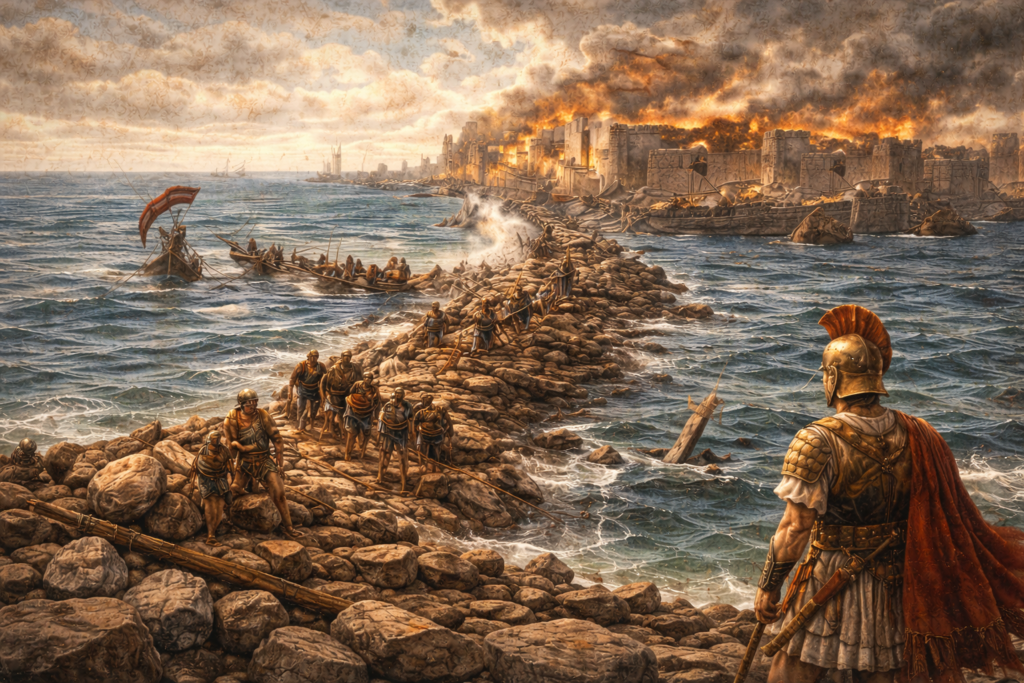
When Tyre refused to submit, Alexander assembled an army of fifty thousand men before its walls. He began carefully planning the city’s capture, strengthening his soldiers’ resolve and convincing them of the necessity of this confrontation. He gathered intelligence and devised a plan whose essence, he claimed, was inspired by the god Heracles, thus cloaking it in religious authority and placing it beyond criticism. The core of this plan was to link the island to the mainland by constructing a stone causeway across which soldiers could march on foot to assault the city.
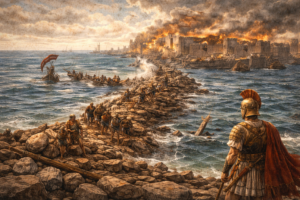
Before launching the siege, Alexander sent a delegation to Tyre to threaten and warn its inhabitants. The Tyrians seized the envoys, killed them, and cast their bodies from the tops of the city walls. This act became the first spark and the direct cause of the outbreak of hostilities.
Alexander then gathered his troops and delivered a powerful speech, urging them to fight, raising their morale, and persuading them of the necessity of besieging Tyre. He reminded them that this city was the only one that had dared to confront them and halt their uninterrupted sequence of victories. He declared that they could not proceed to Egypt and then to Persia without controlling Tyre, with its powerful fleet and strategic position. According to Alexander, the capture of Tyre, followed by Egypt, would deprive the Persians of any opportunity to reorganize their forces and would open the path toward pushing them back to the Euphrates River. He further emphasized that leaving disloyal cities within occupied territories was impossible, as such cities could become internal threats to the Macedonian project in the future.
Alexander dreamed that the god Heracles took him by the hand and guided him across solid ground toward Tyre’s walls, opening its gates so that he entered and offered sacrifices in its temple. In Greek mythology, Heracles is the elder son of Zeus, the legendary hero who was deified after death and who saved Mount Olympus from the evils of his uncle, the god of death, after immense exertion. Invoking Heracles in this context symbolized the many hardships Alexander would face and overcome, just as that hero had done.
Drawing inspiration from this dream, Alexander resolved to fill in the sea channel separating the island from the mainland, ensuring access to the walls over solid ground. He personally inspected the coastal areas opposite Tyre, searching for the materials necessary to execute his plan. Timber and stone were found in mainland Tyre and in Mount Lebanon, providing the resources required for the undertaking.
Macedonian engineers drove two parallel rows of wooden piles into the seabed at the coastal point nearest the island and extending toward it. This labor was exhausting, particularly as the water deepened closer to the island. The space between the piles was then filled with stones and rubble transported from the mainland. At first, the work progressed quickly, but it slowed as the depth increased.
The Tyrians observed these efforts with little concern, especially since the causeway remained invisible above the water in its early stages. Tyrian sailors would sail near the workers, mocking them and asking whether their king Alexander was stronger than the Phoenician god of the sea.
As construction advanced, Alexander entrusted command of the siege to one of his generals and departed toward the Beqaa region. This move appears to have been a deliberate act of psychological warfare, intended to suggest that the siege of Tyre was neither so critical nor so dangerous as to demand his constant presence. Through this gesture, Alexander also sought to demonstrate that he would not devote all his energy or all his time to the capture of a single city.
The Balance of Power Shifts in Favor of the Macedonians
Alexander had swept through Asia Minor with astonishing speed, yet now he found himself stalled before the walls of Tyre, losing precious time and achieving no tangible results. The contrast weighed heavily on him. For the first time since the launch of his eastern campaign, doubt crept in. He began to contemplate lifting the siege and continuing his march toward Egypt, but fear for his name and reputation restrained him. He knew that his enemies would seize upon this moment and brand it a defeat, an unforgivable blemish on the image of an undefeated conqueror.
Amid this uncertainty, events began to turn in Alexander’s favor. He succeeded in creating a large naval fleet and bringing it into the battle, while at the same time, his soldiers completed the construction of the causeway, making it possible to reach the walls of Tyre by land. Compounding this shift was the failure of the reinforcements the Tyrians had long awaited from Carthage, which never arrived. Together, these developments altered the course of the battle and overturned the balance of power decisively in Alexander’s favor.
Alexander realized that unless he introduced naval warfare into his operations, he was advancing steadily toward failure. His solution was clear: impose a naval blockade on Tyre. He headed to Sidon to assemble a fleet. Meanwhile, the kings of Arwad and Byblos, upon learning that Alexander had taken control of their cities, decided to abandon the Persian fleet, return to their ports, and join the Macedonian side. In addition, a large number of ships from Cyprus and several Greek islands rallied to Alexander. When he returned from Sidon, he commanded a fleet estimated at 223 ships, with which he imposed a tight naval blockade around Tyre.
The Tyrians attempted to break this blockade through a naval attack, choosing the afternoon hours when the Macedonians typically rested. Fortune, however, favored Alexander. He had not yet taken his afternoon nap and was able to respond immediately. Leading a counterattack at sea, he thwarted the Tyrian effort and secured a clear naval success.
The danger posed by the newly formed Macedonian fleet extended beyond the blockade itself. The ships became platforms for siege machinery, including towers and battering rams. A battering ram consisted of a wooden beam capped with metal, suspended by ropes on a wheeled structure, allowing it to be swung with great force against city walls. During the siege of Tyre, it was sometimes necessary to use two ships to carry a single tower or battering ram.
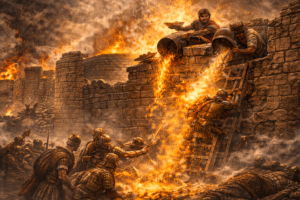
Another severe blow to the Tyrians came with the completion of the causeway. For the first time, Tyre could be reached by land. Siege towers and battering rams were erected opposite the walls and fixed on the dry ground of the causeway. Yet the Tyrians continued to defend their city with extraordinary ingenuity and courage. They filled leather sacks with seaweed and hung them from the walls to absorb the shock of the battering rams. They poured glowing hot sand and boiling oil from cauldrons atop the walls, so that the grains of sand embedded themselves in the armor and flesh of the Macedonian soldiers. Divers slipped into the water and cut the ropes securing the ships that carried the siege machines, forcing Alexander to replace them with iron chains.
Another devastating blow struck the Tyrians on the psychological front. A Carthaginian delegation arrived in Tyre announcing that Carthage would not be able to send reinforcements, as it was itself engaged in war. Soon after, the high priest dreamed that the god Melqart was leaving the city, an omen of grave misfortune. The seriousness of the situation became unmistakable. The Tyrians began evacuating as many women, elderly men, and children as possible to Carthage, while prayers rose from the temple of Melqart, pleading for divine intervention to save the city.
The Fall of the City and the Carnage
Alexander now judged that the decisive moment had arrived. The changes in the course of the battle had tilted decisively in his favor, both at sea and on land. In the month of August, he launched his final assault, unleashing the full might of his forces. He succeeded in opening a breach in the southern walls of Tyre, a breach that allowed him to enter the city. The Tyrians fought for their land until their last breath, and their relentless resistance only intensified the severity of Alexander’s revenge. After entering the city, Alexander committed the most atrocious crimes in Tyre, before proceeding to organize victory celebrations and offering sacrifices to its god.
The Macedonian assault was overwhelming. Siege towers and battering rams encircled the island from every direction. While the eastern walls were exceptionally high and strong, the southern fortifications were weaker and lower. Alexander exploited this vulnerability, concentrating his efforts on the southern walls until he created a breach and forced his way inside. He directed his main attack toward this opening. Ships hurled ladders against the walls, and organized groups of fighters climbed them, leaping onto the ramparts and descending into the city.
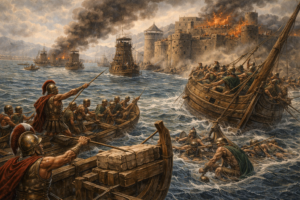
One group succeeded in seizing two of the city’s towers. Under their protection, the breaching force advanced through the opening and moved directly toward the royal palace, besieging it and storming it. At the same time, Phoenician ships advanced toward the city’s harbors. Sidonian, Byblian, and Arwadian ships opened the southern harbor, while Cypriot ships attacked the northern harbor, allowing Macedonian fighters to pour into the city from multiple directions. Once the defense system collapsed, the siege towers pressed against the walls became bridges over which thousands of Macedonian soldiers streamed into Tyre.
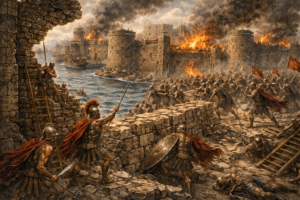
Militarily, Tyre had fallen. But its people did not surrender. Instead, they confronted the Macedonian killing machine with a bravery rarely equaled in history. Most of the Tyrians chose to resist to the end. Soldiers fought in front of their homes and among the attackers, battling to the death and refusing to fall without exacting revenge. Those without weapons climbed onto rooftops, tearing stones from the buildings and hurling them down upon the invaders as they moved through the narrow alleys.
Elderly men, women, and children sought refuge in the temple of Melqart. Others barricaded themselves inside their homes, awaiting whatever fate would come. Some fled toward the Phoenician ships anchored in the southern harbor. Although these ships had fought alongside Alexander, the bonds of kinship that linked their crews to the people of Tyre ultimately stirred their consciences and compelled them to rescue their brothers, even if only in secret.
Alexander ordered the killing of all inhabitants except those who had taken refuge in the temples. Heralds roamed the streets repeatedly announcing this decree, yet none of the defenders surrendered. Massacres followed, resulting in the death of eight thousand Tyrians, according to Greek sources. When the Macedonians grew weary of killing, they crucified two thousand Tyrian fighters along the shore. Thirty thousand survivors were sold into slavery.
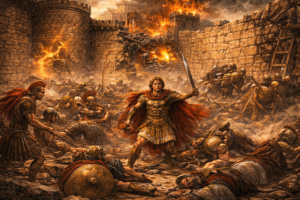
Alexander walked upon blood as he made his way to the temple of Melqart, where he offered sacrifices before his troops, the king of Tyre, and the city’s administrative body, all of whom he forced to attend the victory celebrations. The ships that had taken part in the fighting were decorated with flags and lights and sailed majestically before the island. Athletic contests and torch races were organized in front of the temple during the celebrations. Alexander’s joy was immense. The nightmare that had nearly shattered his ambitions was over. He could now continue his march to Egypt and from there to Persia and beyond, inscribing his name in history as one of the greatest military commanders of all time and, by modern standards, as one of history’s war criminals.
Conclusion
At the conclusion of this study, it is essential to reflect on the lessons of the siege of Tyre, a battle whose victims numbered in the tens of thousands of soldiers defending their homeland. For seven months, Tyre resisted one of the greatest armies the world has known, coming close to defeating it. The evidence of the courage displayed by the Tyrians reaches us through Macedonian historians themselves, lending it substantial credibility.
Judgments about Tyre’s actions may vary according to time and perspective. Some argue that submission to Alexander, as chosen by the other Phoenician cities, might have spared Tyre the destruction it endured. Yet regardless of differing viewpoints, it remains certain that the people of Tyre sacrificed themselves for their city. It is also important to note that the support provided to Alexander by Sidon, Byblos, and Arwad played a decisive role in tipping the balance of power in his favor. This reality must not be judged through a projection of the present onto the past. Historical events must be understood within their own geographical and temporal contexts. Nevertheless, it can be said that the fragmentation of brothers, driven by narrow interests, ultimately led to the destruction of Tyre.
The battle of Tyre stands as a rare and invaluable source for understanding Phoenician military history. This people is widely celebrated for its achievements in trade, architecture, seafaring, and the invention of the alphabet, yet far less is known about its military capabilities. The events of this battle therefore constitute a rich repository of military knowledge. The material presented here may form the foundation for a broader and more comprehensive study illuminating Phoenician warfare.
Finally, it is hoped that this study contributes, even in a modest way, to greater awareness of the importance of studying history in order to understand the present and draw meaningful lessons. It is also hoped that it draws attention to the urgent need to preserve archaeological sites in Lebanon as living witnesses to the events of a distant but defining past.
