

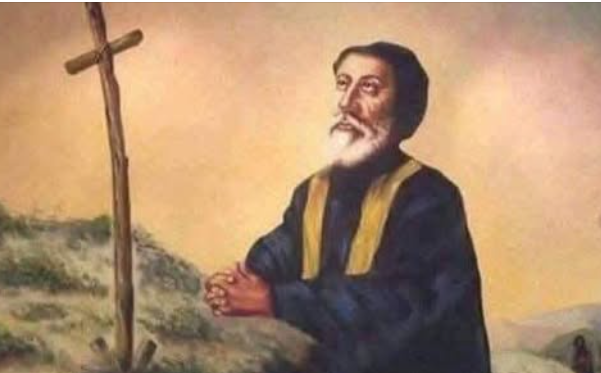


For the Lebanese and Eastern Christian diaspora, Saint Maron is not merely a figure from antiquity. He is a living presence, a thread woven through centuries of faith, suffering, solitude, and freedom. His name echoes in monasteries carved into cliffs, in liturgies sung in Syriac, and in communities scattered across continents. Saint Maron’s story did not conclude with his death in the early fifth century. In truth, it only began there. What followed was one of the longest uninterrupted journeys of Christian fidelity in history, carried by monks and martyrs, patriarchs and scholars, villagers and migrants, all convinced that faith must remain free, rooted in truth, and open to the universal Church.
Saint Maron, also known as Maroun or Maro ܡܪܘܢ, whose name is often rendered as “the little lord,” was born around 350 AD in Cyrrhus, near Antioch, in what is today northern Syria. Antioch at the time was one of the great capitals of the Roman Empire, a center of learning, theology, and Christian life. It was there that Maron was formed as a priest and where he likely studied alongside Saint John Chrysostom. Antioch shaped Maron intellectually, but the wilderness would shape him spiritually.
At a certain point, Maron chose to leave the world and embrace solitude. He withdrew to the Taurus Mountains northwest of Aleppo, adopting the life of a hermit. His withdrawal was not an escape from humanity, but a radical turning toward God. According to Theodoret of Cyrrhus, the principal historical source on Maron’s life, the place where he settled had previously been a pagan site. Maron did not destroy it. He sanctified it. Through prayer, fasting, and constant presence, he transformed the space into a place of Christian worship.
Maron lived entirely exposed to the elements. He refused caves or shelters and prayed under the open sky, enduring sun, rain, snow, and hail. This was not a rejection of the physical world, but a profound theological statement. For Maron, creation itself was a pathway to God. He did not separate the spiritual from the material. God was present in all things, and all things pointed toward God.
This form of asceticism was new. Theodoret describes it as a radical and innovative approach that soon spread throughout Syria and Lebanon. Saint Maron’s example directly influenced the broader ascetic movement of the region, including the emergence of the Stylites. Saint Simeon Stylites, who would later live atop a pillar for decades, did not arise in a vacuum. The idea of radical bodily exposure as a means of spiritual purification and witness had already been embodied by Maron.
Yet despite his solitude, Maron was never detached from people. Men and women gathered around him in great numbers. He healed the sick, prayed for the afflicted, and treated not only physical ailments but wounded souls. Theodoret records that Maron applied “suitable treatment to souls as well.” He taught chastity, prayer, meditation, labor, and above all love. His holiness attracted disciples of both sexes, forming the nucleus of a living spiritual movement.
Maron’s reputation reached the highest levels of the Church. Around 405 AD, Saint John Chrysostom, then suffering exile and humiliation, wrote to Maron asking for his prayers. The letter reveals profound reverence and affection. Chrysostom wrote that Maron was carried constantly in his soul. This exchange firmly situates Maron within the heart of the universal Church and among its most revered spiritual figures.
Saint Maron was not the founder of a separate confession, nor the originator of a doctrinal deviation. He belonged to the Antiochene tradition and to the undivided Church. His sanctity was recognized across the Christian East long before later ecclesial fractures emerged. Saint Maron is venerated not only by the Maronite Church, but also by the Church of Constantinople.
Alongside his ascetic life, Saint Maron was also a missionary. His spirituality was not inward-looking. He preached Christ wherever he went, seeking the conversion of both pagans and lukewarm Christians. In Kafr Nabu, he transformed a pagan temple into a Christian church, marking the beginning of widespread conversion in the region. This missionary spirit would eventually reach Mount Lebanon through his disciples.
Saint Maron died around the year 410 in Kalota. The location of his burial remains debated, with traditions placing it either in Arethusa along the Orontes River or in Brad north of Aleppo. What is certain is that his influence did not die with him.
After his death, his disciples organized themselves more formally. In 452 AD, a great monastery known as Bet Maroun was established and flourished as a center of prayer, theology, and mission. The community became known for its strict asceticism and unwavering orthodoxy. When the Council of Chalcedon in 451 affirmed that Christ is one person in two natures, fully God and fully man, the followers of Saint Maron stood firmly in support.
This fidelity carried a terrible cost. From the sixth century onward, Maronite monks were persecuted precisely for their loyalty to Chalcedon and the orthodox faith. In 517, three hundred and fifty monks were massacred. In 694, five hundred more were killed. Persecution did not weaken the movement. It purified it.
In 685, the Maronites elected Saint John Maron as their first Patriarch. His election was affirmed by Pope Sergius I, confirming that the Maronite Church was in communion with Rome from the beginning. Under his leadership the mountains of Lebanon became both refuge and cradle. The Church flourished under the Cedars, in the valleys of Qannoubine and Qadisha. In Syriac memory, Qornet el Sawda, the highest peak in Lebanon, is remembered as the mountain of martyrs, bearing silent witness to those who chose fidelity over safety.
After the Counter-Reformation, ties with Rome were strengthened through renewal rather than correction. The Maronite College in Rome, founded in 1584, produced generations of scholars and church leaders. Patriarch Estephan Doueihy preserved Maronite memory through historical scholarship and reform. Patriarch Elias Hoayek later carried this legacy into the political realm, playing a decisive role in the establishment of Greater Lebanon in 1920 as an oasis of freedom of belief and thought.
Charles Malik, an Orthodox by confession and one of the principal authors of the Universal Declaration of Human Rights, understood that what distinguished the Maronite Church was that it was a Church of the people, not of empire. Syriac Christianity flourished around monasteries rather than palaces, shaped by prayer rather than power. Saint Maron did not write about human rights. He lived freedom before it had a name.
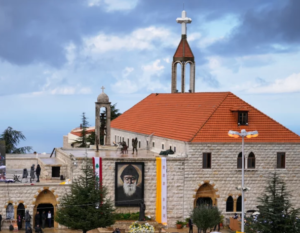
Today, Saint Maron is often depicted in a black monastic habit, holding a crosier crowned with a cross. His feast is celebrated on February 9. His relics are venerated in Italy, and his statue stands on the outer walls of Saint Peter’s Basilica, unveiled by Pope Benedict XVI in 2011.
For the diaspora, this story is not nostalgia. It is a vocation. Our ancestors endured persecution to protect their faith. Their shield was prayer. From their suffering emerged liturgy, tradition, and freedom. Saint Maron stands at the beginning of this long road, not as a divider, but as a unifier. He belongs to the universal Church and to all who believe that truth must be lived freely or not at all.