

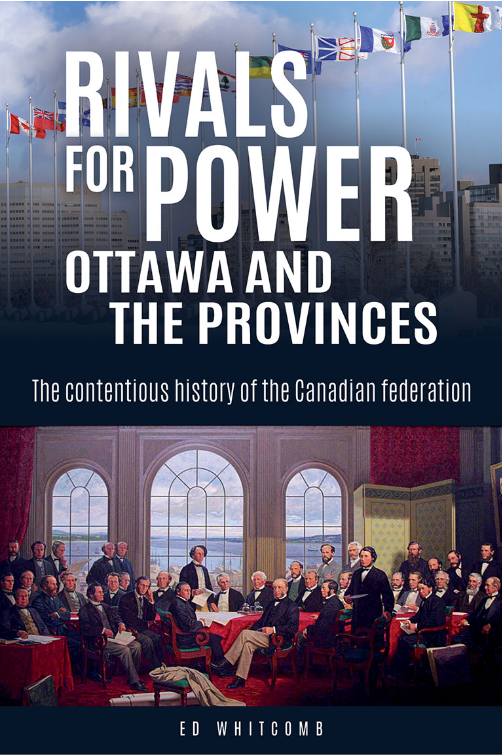


Canada is often described as a quiet country, stable, moderate, and compromise-driven. Yet beneath this calm surface lies one of the most complex and continuously contested federal systems in the world. Rivals for Power: Ottawa and the Provinces peels back this calm exterior to reveal a persistent struggle over authority, legitimacy, and identity at the heart of the Canadian state.
The book is not merely a historical account of constitutional disputes. It is an exploration of how power actually functions in Canada, how it is negotiated, resisted, and reshaped over time, and why federal-provincial conflict is not a failure of the system, but one of its defining features. The authors argue that Canadian federalism is best understood not as a settled framework, but as an ongoing rivalry between levels of government, each claiming democratic authority and institutional legitimacy.
This rivalry has shaped Canada’s political development from Confederation to the present day. It has influenced economic policy, social programs, national unity debates, Indigenous relations, and Canada’s response to crises.
The Central Question: Who Governs Canada?
At its core, Rivals for Power asks a deceptively simple question: Who governs Canada? Is it the federal government in Ottawa, with its control over national institutions, taxation, and international representation? Or is it the provinces, which exercise constitutional authority over education, health care, natural resources, and most areas of daily life?
The book’s central argument is that the Canadian Constitution does not provide a definitive answer. Instead, it creates overlapping claims to authority that have been interpreted, challenged, and renegotiated for over 150 years. Federalism, in this view, is not about clear lines of jurisdiction but about permanent ambiguity managed through political conflict.
This ambiguity is not accidental. The Fathers of Confederation deliberately constructed a system that blended centralized and decentralized elements. While the federal government was initially envisioned as dominant, provincial governments quickly asserted themselves as legitimate political actors with their own democratic mandates. Over time, the balance of power shifted, often in ways the original architects did not anticipate.

Confederation and the Myth of Centralization
The book begins by dismantling a common myth: that Canada was designed as a strongly centralized federation. While early constitutional language appears to favor Ottawa, actual political practice quickly diverged from this vision.
Provincial governments, particularly in Ontario and Quebec, resisted federal encroachment almost immediately. Through court challenges, political mobilization, and strategic use of public opinion, provinces expanded their authority and redefined federalism in practice. Judicial decisions from the Judicial Committee of the Privy Council often favored provincial autonomy, reinforcing this trend.
The authors emphasize that federalism did not “drift” toward decentralization by accident. Rather, decentralization emerged from active provincial resistance and the growing democratic legitimacy of provincial institutions. As provinces developed their own bureaucracies, policy expertise, and electoral bases, they became indispensable actors in governance.
Federalism as a System of Rival Governments
One of the book’s most important contributions is its framing of federalism as a system of rival governments, not simply divided jurisdictions. Both federal and provincial governments claim to represent the public interest. Both levy taxes, deliver services, and answer to voters. This creates inevitable competition.
Unlike unitary states, where authority flows from a single center, Canada’s federal system generates multiple centers of power. These centers do not merely coexist; they compete for influence, resources, and public legitimacy. The authors argue that this competition is not pathological. It is the engine that drives policy innovation, accountability, and adaptation.
Federal-provincial conflict, therefore, should not be viewed as a failure of cooperation. Instead, it reflects the reality that governments with overlapping responsibilities must continuously negotiate their roles. Cooperation occurs not despite rivalry, but because of it.
Executive Federalism and Elite Bargaining
A major theme in Rivals for Power is the rise of executive federalism, a system in which key decisions are negotiated behind closed doors by political executives rather than debated openly in legislatures.
First ministers’ conferences, intergovernmental agreements, and informal negotiations have become central to Canadian governance. While this approach allows flexibility and rapid decision-making, it raises serious democratic concerns. Citizens often have little visibility into how decisions are made or who is accountable for outcomes.
The authors do not present executive federalism as a conspiracy or democratic betrayal. Rather, they argue it emerged as a pragmatic response to complexity. When jurisdictions overlap and constitutional amendment is difficult, negotiation becomes the primary tool of governance. However, the book challenges readers to consider the long-term implications of this model for transparency and public trust.
Quebec and the Politics of Distinctiveness
No discussion of Canadian federalism is complete without Quebec, and Rivals for Power treats Quebec not as an anomaly but as a central force shaping the federation.
Quebec’s demands for autonomy, recognition, and cultural protection have consistently pushed the boundaries of federalism. From language laws to constitutional reform, Quebec governments have challenged Ottawa’s authority and forced Canada to confront fundamental questions about identity and unity.
The book emphasizes that Quebec’s role is not solely disruptive. By articulating alternative visions of federalism, Quebec has expanded the space for diversity within the Canadian state. Asymmetrical arrangements, special agreements, and policy flexibility often emerged first in response to Quebec’s claims, later benefiting other provinces as well.
The Charter and the Transformation of Power
The introduction of the Canadian Charter of Rights and Freedoms marked a profound shift in federal-provincial dynamics. By empowering courts to review legislation, the Charter added a new actor to the federal system and altered how power is exercised.
While the Charter is often celebrated as a unifying national document, the book highlights its complex effects on federalism. On one hand, it strengthened national standards and individual rights. On the other, it constrained provincial autonomy and transferred significant authority to the judiciary.
The authors note that provinces have responded strategically, using tools like the notwithstanding clause and intergovernmental coordination to protect their policy space. The Charter did not eliminate rivalry; it reshaped it.
Fiscal Federalism and the Politics of Money
Money is power, and Rivals for Power devotes significant attention to fiscal federalism, the system of taxation, transfers, and spending that underpins Canadian governance.
The federal government’s superior revenue-raising capacity allows it to influence provincial policy through conditional transfers, particularly in areas like health care and social services. Provinces, however, resist what they perceive as federal intrusion, arguing that spending power undermines the constitutional division of powers.
The book does not take a simplistic position on this debate. Instead, it shows how fiscal arrangements reflect broader struggles over autonomy, responsibility, and accountability. Transfers can promote national equity, but they can also blur lines of responsibility, making it difficult for citizens to know who is accountable for policy outcomes.
Crisis as a Catalyst for Change
Throughout Canadian history, crises have accelerated federal-provincial conflict and cooperation alike. Wars, economic depressions, constitutional crises, and public health emergencies have forced governments to test the limits of their authority.
The book illustrates how crises often temporarily strengthen Ottawa’s role, only for provinces to reassert themselves once the immediate danger passes. This cyclical pattern reinforces the idea that Canadian federalism is dynamic, responsive, and fundamentally contested.
Rather than producing permanent centralization or decentralization, crises expose underlying tensions and prompt new bargains between governments.
Federalism as Process, Not Blueprint
The overarching message of Rivals for Power is clear: Canadian federalism is not a finished design. It is a process shaped by political struggle, institutional adaptation, and societal change.
Attempts to “fix” federalism through grand constitutional reforms have repeatedly failed. The book suggests this is not because Canadians are incapable of reform, but because federalism thrives on flexibility rather than rigidity. Informal practices, negotiated agreements, and evolving norms have proven more effective than formal amendments.
This perspective challenges readers to embrace uncertainty as a feature, not a flaw, of the system.
Why This Book Matters Today
In an era of rising polarization, regional alienation, and global uncertainty, Rivals for Power offers a valuable lens for understanding Canada’s resilience. The same rivalries that frustrate policymakers also prevent the concentration of power and allow diverse voices to shape governance.
Ed Whitcomb’s book reminds us that conflict is not inherently destructive. When managed through institutions, negotiation, and democratic accountability, it can be a source of strength.