



By Simon Yammine
Halifax, Nova Scotia — November 8, 2025

HALIFAX — The ninth edition of the Lebanese Film Festival in Canada (LFFC) launched Friday evening at Dalhousie University’s Life Sciences Centre, drawing attendees to a more than 2-hour program of short films that explored the intersections of displacement, loss, and cultural reinvention. Hosted in collaboration with the Alliance Française Halifax and Dalhousie University, the event marked the start of a four-day Halifax leg running through November 11, part of a broader cross-country tour extending to Calgary and Vancouver later this month.
The festival, which celebrates Lebanese cinema, music, and heritage during Lebanese Heritage Month, featured a bilingual welcome from Taghrid Abou-Hassan from the Alliance Française Halifax. Abou-Hassan emphasized in her opening remarks the Francophonie’s role in fostering Lebanese-Canadian connections. Doors opened at 6 p.m. at the venue on 6100 University Avenue, with screenings commencing at 7 p.m. in the Kenneth C. Rowe Management Building.

The lineup of shorts — Alitisal, Wingo, Lorraine, The Dancer, Still Grieving… — offered a compact yet poignant anthology, followed by a discussion with guests and networking that lasted late until 23:00. Themes of immigrant identity and unresolved trauma dominated, resonating with Canada’s growing Lebanese diaspora. Organizers noted a diverse crowd, including university students, local film hobbyists, and French-language enthusiasts, though the Lebanese-Canadian community turnout was lighter than anticipated, prompting quiet discussions about bolstering engagement from Lebanese associations.
A Curated Selection: Shorts That Bridge Personal and Political
Alitisal (2024, 18 minutes, dir. Sabine Kahwaji), a drama tracking three first-generation Lebanese-Canadian siblings — Wissam, Nour, and George — as they navigate mental health crises triggered by the 2020 Beirut port explosion, their parents’ fate hanging in limbo. Set over a single tense night, the film dissects sibling rivalries and immigrant power dynamics amid collective fear, earning murmurs of recognition from the audience.
Wingo (2024, 14 minutes, dir. Edward Gebrael), an unspecified genre piece following young Theo, confined in a household marked by his father’s drug dealing and his mother’s addiction-fueled affection. Mentored by his imaginary superhero friend Wingo, Theo plots an escape requiring “a clear mind, physical speed, and a leap of faith.” The film’s blend of whimsy and hardship elicited light laughter interspersed with reflective pauses, highlighting childhood resilience in unstable environments.
The Dancer (2024, 15 minutes, dir. Celine Hammoud) introduced a narrative of quiet renewal. Protagonist Sama, grieving the loss of her sole inspiration, abandons dance and retreats to her grandmother’s village, where an encounter with a child named Nader sparks tentative revival. Hammoud, based in Beirut, crafts the story as a meditation on healing through movement. Hammoud later reflected during the Q&A.

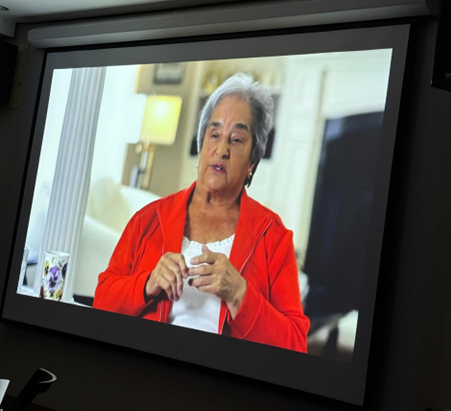
The session’s emotional pivot came with Lorraine (2025, 15 minutes, dirs. David Gosine and Allison Basha), a documentary profiling Lorraine Michael, the trailblazing Lebanese-Newfoundlander who served as Newfoundland and Labrador’s NDP leader from 2006 to 2015. Tracing Michael’s path from immigrant roots in a tight-knit Lebanese community to her time as a Catholic nun and eventual political activism, the film underscores her advocacy for labor rights, women’s issues, and cultural preservation. Archival clips and interviews portray Michael as a symbol of perseverance, with a voiceover noting, “Embrace your unique cultural identity — it’s the fuel for change.” Gosine and Basha, Newfoundland-based filmmakers with personal ties to Lebanese heritage, attended in person, fielding questions on Michael’s influence on future leaders. “Her story shows how one person’s hyphen — Lebanese-Newfoundlander — can reshape politics,” Gosine said post-screening.

Anchoring the program was Still Grieving (2022, 29 minutes, dir. Carl Haddad), a drama centered on a 60-year-old woman (played by Ghada Sultan) confronting eviction from her late father’s sprawling 400-square-meter Beirut home. As she sifts through artifacts tied to his legacy — including fading tools of the bookbinding trade like *reliure* (binding), embossing, and *dos de livre* (spine crafting) — the film layers personal mourning with broader socioeconomic critique. Set in the Ras El Nabaa neighborhood’s Mohamad El Hout Street, once an upscale, multi-faith enclave near the old Ministry of Defense and National Museum, it reflects the area’s decline: from mid-20th-century vibrancy to civil war-era abandonment, ’90s grit, and recent real estate-driven gentrification with high-rises displacing residents. Lebanon’s rent control laws amplify the injustice, pitting tenants’ attachments against landlords’ financial strain. The screening concluded to sustained applause, with several attendees wiping away tears.

Cross-Continental Q&A: Voices from France and Lebanon
The discussion unfolded as a hybrid affair, bridging time zones to connect Halifax’s Atlantic Standard Time with Haddad’s early morning in France and Hammoud’s in Lebanon.
Haddad, a young Lebanese producer who relocated to Paris lately, delved into Still Grieving’s Beirut setting, his feed flickering against a Parisian skyline.
Hammoud, joining from Beirut amid golden-hour light, addressed The Dancer’s autobiographical echoes. “For creators staying in Lebanon, amid all the exodus, it’s reclamation: the country breaks you, but motion mends.” When asked about sustaining art in turmoil, Hammoud paused, her connection lagging briefly. “By fleeing inward first. Roots regrow, even in cracked soil.”
Gosine, present in the room, chimed in on Lorraine, linking Michael’s activism to contemporary diaspora challenges. “From nun to NDP firebrand, she proved culture isn’t a sidebar — it’s strategy for equity.” The exchange highlighted the festival’s intent: not just screenings, but dialogues that fuse personal narratives with policy.
Networking and Reflections: Building Bridges in a Modest Turnout
The formal program wrapped at 11:30 p.m., transitioning to informal networking. Attendees, including a handful from Halifax’s Lebanese community, swapped insights on the films’ relevance to Canadian integration. David Gosine fielded congratulations, discussing potential future collaborations. “Events like this seed the next wave of hyphenated stories,” he noted.
Organizers expressed satisfaction with the intimate scale, which allowed for deeper interactions, though one organizer gently observed the Lebanese diaspora’s underrepresentation. “As the historic backbone of Canada’s Francophonie — tied to France since the Mandate — we hoped for fuller seats from our broader networks,” she said. Honorary Consul Wadih M. Fares, whose WM Fares Group has backed Lebanese initiatives across the Maritimes for nearly three decades, was praised in remarks for his “fingerprints on every cultural spark here.” Fares, who serves as consul for the Maritime provinces, has championed events from epilepsy awareness to economic ties.
Looking Ahead: From Workshops to Red Carpets
Day 2 (Saturday, November 8) shifts to the Diman Association Canada at 345 Kearney Lake Road in Bedford, kicking off at 1 p.m. with LFFC Film Fun workshops for teens, followed by a 40-minute animation shorts session at 7 p.m. The evening culminates in “Beirut Beats,” a door-open party at 8 p.m. celebrating Lebanese Heritage Month with DJ Milo C. and live performance by Joey Daniel, sponsored by Shawarma City and Beirut Animation Nights.

Sunday’s Day 3 (November 9) elevates to glamour at the Canadian Museum of Immigration at Pier 21 (1055 Marginal Road), site of countless Lebanese arrivals. A red-carpet reception begins at 6 p.m., including cocktail photo sessions and guided museum tours at 6 and 6:30 p.m. The 7:30 p.m. ceremony precedes the screening of Arze by Mira Shaib at 8 p.m., followed by a 9:30 p.m. discussion with guest of honor Betty Taoutel and networking until 10 p.m. Backed by New Dimension of the Universe and the WM Fares Group, the venue’s immigration focus adds poignant layers.

The festival closes Monday (November 10) at the Scotiabank Theatre Halifax (190 Chain Lake Drive, Bedford) with the 7 p.m. premiere of Nohad Al Chami — A Sign of Faith* by Samir Habchi, a discussion at 8:30 p.m., and networking until 9 p.m. Due to high demand, an additional 9 p.m. screening has been added.
