



The red carpet rolls out across the main hall of the Canadian Museum of Immigration at Pier 21, catching the glow of the lights and the excitement in the room. It’s a cool Halifax evening, and the Lebanese Film Festival in Canada (LFFC) is hosting its biggest event, the Red Carpet Gala.
The place is buzzing. Families, artists, students, and community leaders arrive dressed to impress, stopping for photos and quick hugs before heading inside. It’s more than a movie night. It feels like a big family gathering where everyone shares the same hometown, even if that home sits thousands of kilometers away.
Pier 21 couldn’t be a better choice for the night. The museum once welcomed immigrants from every corner of the world, including many Lebanese families. Tonight it welcomes their stories.
A Hall Full of Meaning
Guests wander through the museum before the show, pausing at exhibits filled with old passports, ship trunks, and black-and-white photos of newcomers stepping into Canada for the first time. The word Welcome appears on the wall in dozens of languages. It hits home. The same place that once marked a beginning for their grandparents now celebrates their legacy.
The hall feels alive with conversation. You hear Arabic mixed with French, and English with a hint of Beirut. University students chat with elders, and volunteers rush around with polite smiles. Sequined gowns shimmer under the lights while phone cameras flash everywhere. This is not just a screening, it’s a homecoming.

Taghrid Abou Hassan Opens the Evening
At exactly 7:30, the lights dim and Taghrid Abou Hassan, from the Alliance Française Halifax, takes the stage. Calm, confident, and perfectly bilingual, she guides the evening with warmth and grace.
She thanks the Mic Mac people for its generosity and reminds the crowd that cultural respect grows stronger when shared. She also acknowledges WM Fares Group, Dalhousie University, and Alliance Française Halifax, along with the volunteers and sponsors who made the festival possible.
Her words are heartfelt and full of pride. She sets the tone for the evening, one that balances elegance with familiarity. Applause rolls through the hall like a wave.
Lena Metlege on Culture and Heritage
Next up is Lena Metlej, minister of immigration, who brings quiet strength and dignity to the podium. She talks about culture as something we live, not something we store away. Heritage, she says, isn’t a museum piece but a living thing that grows and changes with each generation.
She speaks of Lebanese families who have carried music, language, and faith across oceans, transforming nostalgia into creativity. Her words land gently but firmly. The applause that follows feels respectful and full of understanding.

Consul Wadih Fares and the Power of Cinema
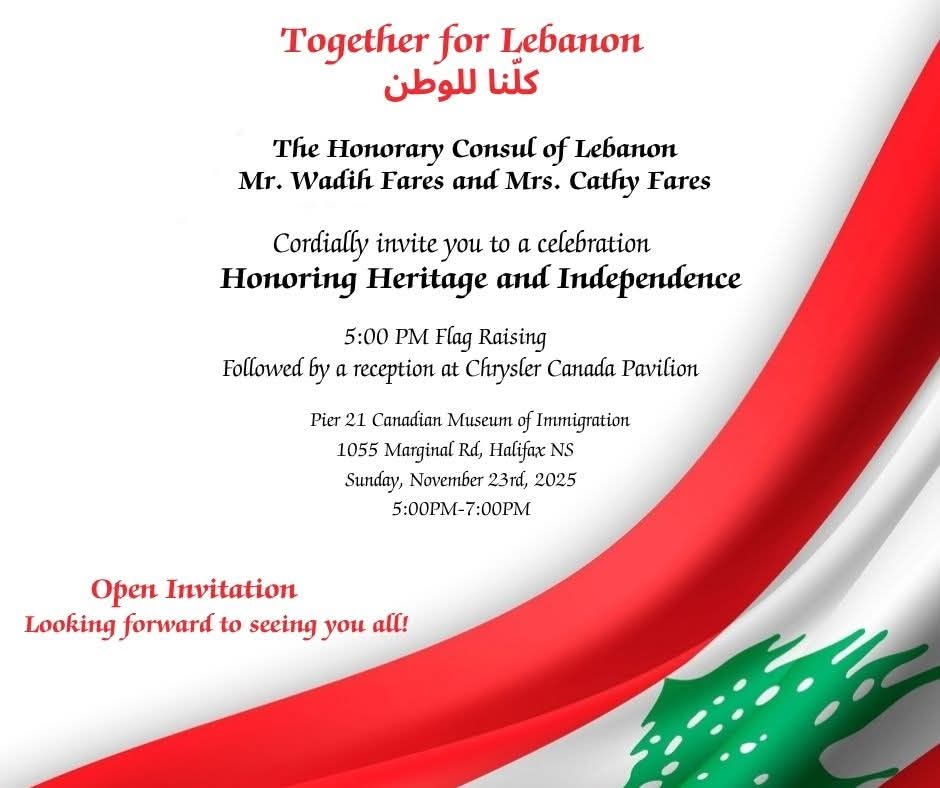
Next is Wadih Fares, Lebanon’s Honorary Consul in Nova Scotia, under whose patronage the festival takes place, follows next. Always warm and genuine, he speaks about the power of film to bring people together. Cinema, he says, tells stories that everyone can feel, even without words.
He explains how Lebanese films don’t just belong to Lebanese audiences; they help everyone see a piece of their own lives in them. They’re about love, loss, resilience, and hope.
He thanks the LFFC team and recognizes organizations for being part of the night. The applause grows louder, and the smiles in the audience say it all.

The Founder’s Vision and the Team Behind It
Then Hay Love, founder and executive director of the Lebanese Film Festival in Canada, takes the microphone. Her smile shows equal parts pride and exhaustion. She speaks from the heart, reflecting on how far the festival has come and the people who made it happen.
She describes every year as a new challenge, full of late nights, travel, and endless planning. But what keeps it going, she says, is passion and community. The festival, for her, is proof that art connects people no matter where they are.

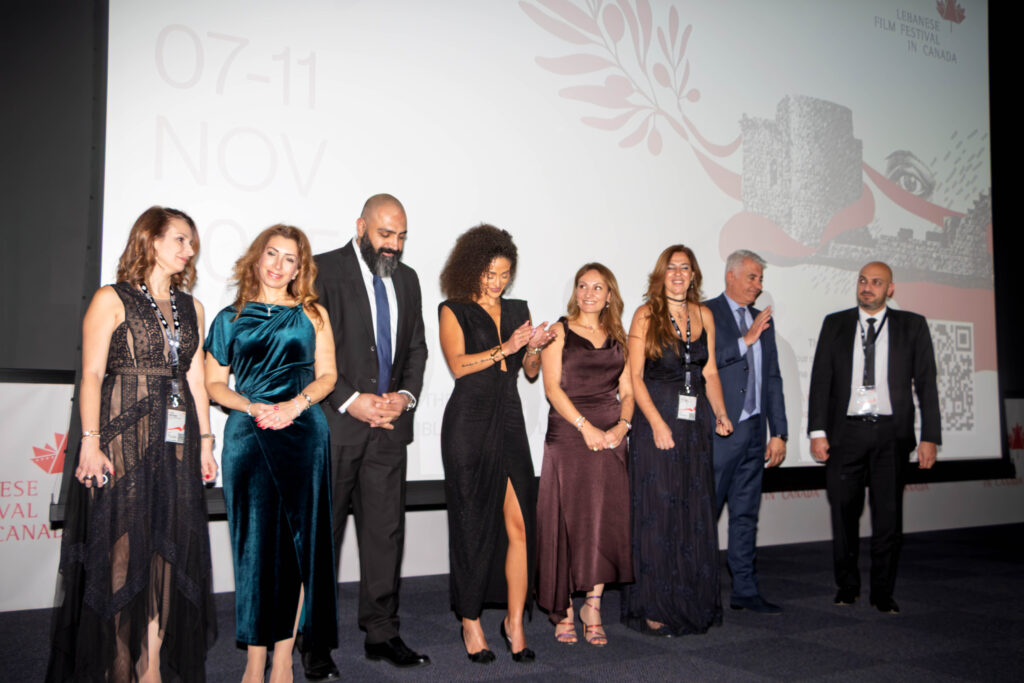
Then she invites the Halifax team on stage: Peggy, Sandra, Mony, Tatiana, Daisy, Miled, Dany, and Simon. The applause is instant. The team walks up together, waving to the crowd and taking in the moment. Cameras flash, people cheer, and the founder looks on proudly. These are the people who kept the dream alive, quietly turning effort into magic.

The Screening of Arzeh
The lights fade again, and silence takes over. The feature presentation begins: Arzeh, directed by Mira Shaib and starring Betty Taoutel.
The opening scene glows with the light of Beirut mornings. The story follows Arzeh, a mother trying to hold her world together, torn between love for her son and the harshness of life around her. Her strength, quiet but unbreakable, mirrors the cedar tree, Arzeh in Arabic, that stands on Lebanon’s flag.
Betty Taoutel commands the screen. Every pause, every glance, carries meaning. She plays Layla as a mystery, a woman made of concealed pain and silence. The film’s imagery mixes beauty and sadness, the kind of contradiction that feels familiar to anyone who loves Lebanon.
When the credits appear, the hall bursts into applause. Most people applauded while few wiped away discreet tears. The energy is pure emotion that spreads from one row to the next.
The Q&A: Making Art in Hard Times
After the applause dies down, Betty Taoutel returns to the stage for a short discussion about the film. The audience listens closely as she talks about what it took to make Arzeh.
The project began in 2019 and then the world changed. Lebanon’s economic collapse hit, then came the pandemic, and finally the Beirut explosion. Each crisis delayed production, yet somehow the film survived.
She talks about creating art when everything around you is unstable, how artists in Lebanon keep working even when power cuts or uncertainty make it almost impossible. For her, art is the one way to bring order to chaos. It’s how people heal and how they keep hope alive.
She explains how the characters in Arzeh — Arzeh, Layla, and Kinan — represent the Lebanon of today, caught between memory, survival, and hope. What the audience might see as a happy ending, she sees as something more complex. Arzeh is forced to adapt to a world without justice. To regain what was stolen from her, she must steal. It’s not triumph but endurance, a reflection of what it takes to keep standing in a society that keeps falling apart.
The audience sits quietly, absorbing every word. When she finishes, the applause starts softly and then grows, filling the hall again.
The Faces in the Crowd
Everywhere you look, you see generations of Lebanese-Canadians together. The accents vary, the stories differ, but everyone belongs. In that moment, the festival feels less like an event and more like a family reunion with better lighting.
The crowd isn’t only Lebanese. Representatives from Dalhousie, Eastlink, Acadia Marjam, ICI Canada, Halifax Transit, ISANS, and the Mayor’s Office are scattered through the audience, along with plenty of curious locals who just love film.
For many non-Lebanese guests, it’s their first introduction to Lebanese cinema. They come for the movie and leave talking about the warmth, the food, the laughter, and the people. Halifax feels suddenly bigger, more connected, and more alive.

Behind the Scenes
Behind the lights and applause hides a small but mighty army making everything look easy. Tatiana, the event planner, somehow keeps the night flowing smoother than a dabke line. Miled, quiet but always sharp, handles all the technical chaos on barely two hours of sleep and still manages to smile for photos. Dany, the omnipresent multitasker, lives by Robert Baden-Powell’s wise words: “Try and leave this world a little better than you found it.” Judging by the night’s success, mission accomplished. Peggy and Sandra welcome guests with the warmth of your favorite aunt at Sunday lunch, gracefully directing traffic like airport ground crew minus the neon wands. Meanwhile, Mony and Daisy make sure every sponsor, partner, and probably half of Halifax is smiling, fed, and feeling important. And behind all that organized chaos? A tiny but mighty army of volunteers — Rita Bassil, Caroline Jarmash, Rayan Hobeika, Peron Geaitini, Joya Boutros, Karl Karam, Maya El Semaani, Luciana Sassine, Lea Aluie, Ibrahim Haddad…you name it, they were everywhere at once doing everything.
Big shout-out to celebrity hairstylist Sarkis Fenianos for giving our leading ladies their red-carpet glow, and to makeup artist Mona for sealing the deal. And just when you thought it couldn’t get classier, the saxophonist Roy Youness stepped in smooth, soulful, and stealing hearts one note at a time. Hannah Hutchinson and Jeremy Armstrong, our volunteering Haligonian photographers and video wizards, running around faster than paparazzi at Cannes, captured every smile, tear, and shawarma bite like true pros. Chris Beani, LFFC’s roaming photographer, Abir Chami social media lead, and festival’s designer Hind Asali worked their magic too. And let’s not forget Joelle Kassir from Images for Life Canada, the talented red-carpet videographer who captured the lights, the laughter, the chaos, and the charm with an artist’s eye and the patience of a saint.
And then there’s Jimmy Hallal, with the precision of an engineer and the flair of an artist, transforming simple banners into photo-worthy masterpieces that gave the whole setup a Hollywood vibe. His work made every sponsor’s logo shine brighter than a disco ball at 2 a.m. Right beside him in the hall of fame, Jason Amiouny orchestrated the red carpet, making sure every step, smile, and snapshot looked straight out of a movie premiere.
As for the museum crew, they couldn’t have been more helpful, probably impressed by how the Lebanese manage to turn every event, even in a museum, into a full-blown cultural celebration or most probably still grateful for the legendary Lebanese touch (thank you, Wadih Fares!) that helped put the museum on the international map.
Every person played a part. It’s the kind of teamwork that defines Lebanese gatherings: a mix of improvisation, efficiency, and good humor.
Art as Healing
By the end of the night, one message stands out above all others: art heals. Every speech, every scene, every conversation circles back to that truth.
Minister Metlege’s words about cinema bringing people together echo long after she speaks. The festival isn’t just about film, it’s about connection. It keeps dialogue alive between Lebanon and its diaspora, between Lebanese and Canadians, and between the past and the future.
Halifax as a Cultural Crossroads
Halifax shines tonight as a city that welcomes the world. Once known mainly for its ships and history, it now shows a new face: a city of culture, diversity, and creativity. The LFFC fits perfectly here. It feels like it belongs.
Backed by the Canadian and provincial governments, along with Dalhousie University, Alliance Française, Air Canada, WM Fares Group and many other sponsors, the festival keeps growing every year. It has now become part of Halifax’s cultural identity. What began as a modest idea has evolved into a beloved local tradition.
The LFFC Halifax Red Carpet Gala doesn’t end with the credits. It continues in the smiles, the conversations, and the shared sense of pride that everyone carries home.
Lebanon may be far away, but nights like this prove it never really leaves anyone’s heart.
