

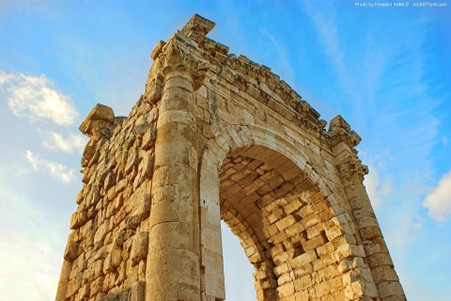


The Birth of a Maritime Civilization
Long before the rise of Greece or Rome, the city of Tyre—Ṣūr in Phoenician, meaning “rock”—emerged from the Mediterranean waves as one of humanity’s first great maritime powers. Perched on an island off the coast of modern Lebanon, Tyre’s natural harbour and defiant cliffs shaped a people whose destiny lay on the sea. Archaeologists trace its origins to around 2750 BCE, when early settlers learned to trade, navigate, and build ships that carried their purple-dyed goods across the known world.
The purple dye, extracted painstakingly from murex sea snails, became Tyre’s signature. Kings, priests, and emperors coveted it; poets immortalized it. Through trade in textiles, glass, and fine crafts, Tyre became the beating heart of Phoenician civilization—an archipelago of city-states united not by land but by sea, language, and enterprise.
Myths that Crossed the Seas: Cadmus, Europa, and Elissa
From this small coastal city sailed myths that reached the farthest corners of Europe. According to legend, King Agenor of Tyre had children whose names would define continents and civilizations: Europa, whose abduction by Zeus gave her name to Europe; Cadmus, who brought the alphabet to Greece; and Phoenix, from whom the Greeks later named the Phoenician people.
Another daughter, Elissa—better known as Dido—fled Tyre and founded Carthage on the North African coast. Through these stories, the city’s name became woven into the very etymology of Europe, literacy, and Mediterranean civilization. For a people now scattered across continents, the Tyrian legacy offers a poetic echo of migration and adaptation.
The historian Sabatino Moscati, in his studies of Phoenician culture, emphasized that these myths were not mere fables but reflections of real movements of people, trade, and influence. To him, Phoenicia was a civilization of expansion by sea, not by conquest—and Tyre stood at its helm. Recently, the geneticist Pierre Zalloua, in Scientific American, commented that the Phoenicians were a culture of integration and assimilation, leading the article writer to ask if Phoenician culture was like a franchise that others could adopt.
Tyre in the Old Testament: Between Prophets and Kings
The Bible mentions Tyre about 37 times. In the Book of Kings, Hiram I, the wise king of Tyre, forged an alliance with King Solomon of Israel. He sent cedar wood, craftsmen, and gold to help build the Temple in Jerusalem. The partnership symbolized an early bridge between civilizations—faith and trade, artistry and devotion.
Prophets like Ezekiel and Isaiah later spoke of Tyre with a mix of admiration and warning: a city rich and proud, a merchant of nations whose ships covered the seas. When Ezekiel foretold its downfall, he was describing both a political and spiritual reality—the vulnerability of wealth and hubris before the tides of history.
Tyre and the Apostolic Church
Christianity reached Tyre astonishingly early. The Gospel of Mark (7:24–31) and Matthew (15:21–28) record Jesus Himself traveling “to the region of Tyre and Sidon,” where He healed the daughter of a Syrophoenician woman—one of the first Gentiles to experience His compassion. Tyre thus stands as a threshold in Christian history: the moment the message of the Kingdom crossed the boundaries of Israel and embraced the nations.
A generation later, the Book of Acts (21:3–6) tells of Saint Paul spending seven days in Tyre during his journey back to Jerusalem. “We found the disciples there, and stayed with them seven days.” This small phrase reveals a remarkable fact: by the year 58 CE, a Christian community already existed in Tyre. When Paul departed, the believers accompanied him to the shore, kneeling together in prayer—the earliest recorded seaside liturgy in history.
By the 3rd century, Tyre had become a stronghold of early Christianity. Origen of Alexandria, one of the Church’s greatest scholars, spent his final years in Tyre after exile and died there around 254 CE; his presence underscores the city’s growing Christian significance. Later, Eusebius of Caesarea, in his *Ecclesiastical History* (Book 10, Chapter 4), praised the Tyrians for rebuilding their church after persecution under Diocletian.
Eusebius’ *Onomasticon* calls Tyre “a famous city of Phoenicia in which there is a church of Christians even to this day.” St. Jerome, a century later, wrote in his *Commentary on Ezekiel 26* that although the prophet once lamented Tyre’s destruction, “in our time she has believed in Christ.”
During the Council of Nicaea (325 CE), Tyre’s episcopal line contributed to the broader church, with bishops like Tyrannion (martyred under Diocletian) and his successors affirming the faith against heresies in the region. The see of Tyre became a metropolitan under the Patriarchate of Antioch.
Archaeology corroborates these accounts. Excavations in Tyre’s Al-Bass necropolis and near the Cathedral district uncovered 4th-century Christian mosaics and marble inscriptions invoking Christ and the Apostles. The foundations of the basilica described by Eusebius still lie beneath the modern Greek Orthodox Cathedral of Saint Thomas the Apostle, preserving an unbroken link between the Apostolic age and today’s community.
Tyre Against Empires: The Siege of Alexander
In 332 BCE, Alexander the Great, the indomitable Macedonian conqueror, sought entry to Tyre to honour Melqart, the city’s divine patron, with a sacrifice. The Tyrians, unyielding, barred his path. Secure within their island bastion, they held out against him for seven grueling months.
Undeterred, Alexander commanded the construction of a vast causeway from the mainland, rubble by rubble, reshaping the sea into solid ground. Though Tyre resisted with unbridled ferocity, the city fell at last. Yet that defiance etched itself into legend, an enduring tribute to the Phoenicians’ fierce autonomy and unquenchable grit. That causeway still lays beneath layers of silt, a permanent bridge linking the old island to the shore. It endures as both wound and emblem: Tyre may crumble, but it never yields.
This unbowed essence courses through the city’s veins like vital currency. A millennium hence, in 996 CE, amid the Fatimid Caliphate’s sway, Tyre stirred once more in revolt. Under the command of the seafaring Allaqa, it proclaimed its sovereignty, minting coins that bore its own proud mark. For two defiant years, he reigned as a sovereign of the moment—a brief but blazing emblem of Tyre’s indomitable soul. Though ultimately quelled by the era’s mightiest realm, Allaqa’s interlude stands as a cherished chapter in the annals: a resonant call to the city’s deep-rooted independence, where the fire of Phoenician valour burns eternal in its people’s blood.
From Pagan Gods to Christian Saints
Under the Romans, Tyre flourished as a free city, minting its own coins and exporting glasswork and textiles. By the Byzantine period, Christianity had taken firm root. Basilicas, baptisteries, and mosaics adorned its streets. The ruins of a 4th-century cathedral—the one described by Eusebius—still whisper of a community that merged ancient heritage with new faith.
The Archbishop William of Tyre (1130–1186) later chronicled the Crusades in Latin, offering one of the era’s most detailed historical accounts. His writings immortalized Tyre not only as a city of trade but also as a city of memory.
Tyre and the Modern Lebanese Identity
Today, Tyre is a UNESCO World Heritage Site, where Roman streets and Crusader cathedrals rest upon Phoenician foundations. The city’s fishermen still mend their nets on shores once ruled by kings. The ruins of the hippodrome, the mosaics of the necropolis, and the harbour walls all speak to a continuity of life across five millennia.
In modern Lebanon, Tyre holds special meaning: it represents both the rootedness of the south and the openness of the sea. For the Maronite and Greek Orthodox communities, it recalls early Christianity in the Levant. For all Lebanese, it symbolizes endurance—surviving earthquakes, invasions, and wars while preserving its cultural identity.
Tyre’s Global Footprint: From Carthage to Canada
Tyrians were the world’s first diaspora. They founded colonies in Cyprus, Malta, Sicily, Spain, and North Africa—most famously Carthage, where Elissa’s legacy became Rome’s rival. This ancient pattern of migration echoes in the modern Lebanese story.
From the 19th century onward, families from Tyre and southern Lebanon migrated once more—this time to West Africa, the Americas, and Canada. In countries like Sierra Leone, Senegal, and Brazil, Tyrian merchants built communities that mirrored the city’s commercial vitality. In Halifax, Montreal, and Toronto, descendants of Tyre’s families became restaurateurs, engineers, artists, and entrepreneurs, carrying with them a deep pride in their coastal ancestry.
For the Lebanese-Canadian community, Tyre’s story is more than archaeology—it is a metaphor for survival across distance. Just as ancient Tyrians spread their alphabet and culture across seas, their modern descendants spread language, faith, and resilience across continents.
Tyre Today: A Living Palimpsest
Walking through Tyre is like reading history written in layers of stone. The ancient port where Phoenician ships once launched lies beside Roman baths and Byzantine mosaics. Children play soccer amid the ruins of the hippodrome; fishermen haul in nets beside Crusader towers.
Beneath the surface, divers explore submerged harbours—proof that Tyre’s ancient docks, now under the sea, still guard secrets of early navigation. Archaeologists such as Maurice Dunand and more recently Lebanese scholars continue to uncover the city’s strata, revealing inscriptions, temples, and houses spanning four thousand years.
Legacy for the Lebanese in Halifax
For Lebanese families in Nova Scotia, especially those from the south, Tyre is not only a memory—it is a compass. It represents the capacity to connect, adapt, and persevere. The same sea that once carried Tyrian traders now links their descendants across oceans.
Each generation of Lebanese abroad adds another chapter to Tyre’s story. To speak of Tyre is to speak of a people who refused to be confined by geography—a people whose home has always been both land and horizon.