

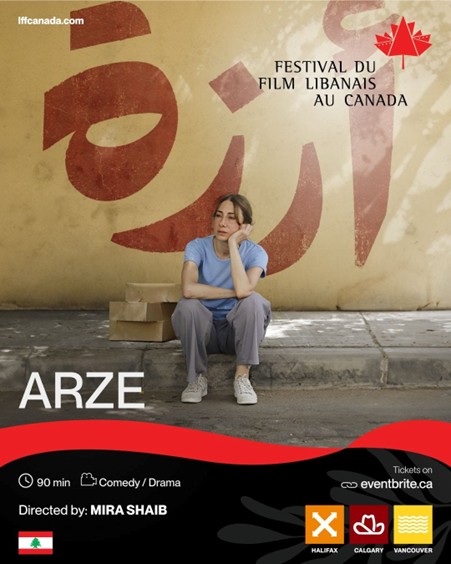

Lebanon’s latest cinematic success, Arzé, directed by Mira Shaib and starring Diamand Abou Abboud, has earned international attention for its vivid and heartfelt portrayal of a struggling mother navigating the streets of Beirut. Premiering at the Tribeca Film Festival 2024 and selected as Lebanon’s submission for the 2025 Academy Awards, the film blends comedy, drama, and social realism to tell a story that feels both personal and universal.

Arzé is a film about survival, identity, and humor in the face of hardship. It captures the contradictions of modern Lebanon with affection and clarity, showing how ordinary people find strength in laughter and perseverance.
A Story of Struggle and Wit
The film follows Arzé, a single mother raising her teenage son Kinan and living with her agoraphobic sister Layla in a modest Beirut neighborhood. Their small pie delivery business represents both independence and vulnerability. When Arzé pawns her sister’s bracelet to buy a scooter for Kinan’s work, it feels like a small victory for the family. That hope is shattered when the scooter is stolen, setting off a tense and often humorous search through Beirut’s maze of districts.
As Arzé searches for the scooter, she must move through a city divided by religion, class, and accent. She adapts her speech, clothing, and behavior in each neighborhood, transforming herself to blend in and survive. What begins as a quest to recover stolen property becomes a larger story about resilience, motherhood, and the ability to reinvent oneself in a divided society.
Mira Shaib’s storytelling is straightforward but full of depth. The stolen scooter becomes a symbol of movement and dignity, two things that many families in Lebanon struggle to hold on to. Every scene of Arzé’s journey reveals how humor and determination keep people going even when circumstances seem impossible.
A Mother’s Voice at the Center
The film’s greatest strength is the performance of Diamand Abou Abboud, one of Lebanon’s most respected actresses. Known for roles in Heaven Without People and Costa Brava, Lebanon, she gives a nuanced and magnetic performance. Her Arzé is tough but loving, vulnerable yet defiant. She carries the weight of her family’s survival with pride, often using wit as both a shield and a weapon.
Arzé is not portrayed as a saint but as a fully human figure who makes mistakes, gets frustrated, and keeps moving forward. Through her, the film highlights the strength of Lebanese women who shoulder the burdens of family and society while receiving little recognition in return. Abou Abboud’s performance grounds the story emotionally and gives it authenticity.
Beirut as a Character
Another major success of Arzé is its portrayal of Beirut. Shot across twenty-one locations in just twenty-three days, the film captures the city’s beauty, tension, and energy. Beirut is presented not as a single space but as a collection of worlds. Each district has its own rhythm, tone, and identity, and the film’s cinematography mirrors that diversity.
The city becomes a character in itself: loud, unpredictable, divided, and full of life. The viewer experiences the noise of traffic, the smell of food, and the chatter of street vendors as if walking alongside Arzé.
Some critics argue that the film’s treatment of Beirut’s sectarian and class divisions is too superficial. The story moves quickly across neighborhoods without fully exploring their deeper histories. Yet this decision also gives the film a sense of rhythm and urgency. It reflects the way real Beirutis navigate divisions daily, often choosing adaptation over confrontation.
Light Humor on Heavy Themes
Mira Shaib takes a bold approach by using humor to explore serious social issues. Poverty, gender inequality, and sectarianism are presented with irony and warmth instead of despair. The comedy never feels disrespectful; rather, it reflects the absurdity of living in a system that constantly fails its people.
The result is a film that feels both entertaining and socially aware. Viewers laugh because they recognize the truth behind the jokes. Lebanese humor has always been a form of survival, and Arzé captures this perfectly.
Still, the balance between comedy and drama is not always consistent. Some scenes move too quickly, leaving emotional moments underdeveloped. The final act, while symbolically powerful, may feel abrupt to some audiences. However, these are minor flaws in a debut film that succeeds in presenting Lebanon’s complexity without turning it into tragedy.
A Promising Debut
For a first feature, Arzé demonstrates remarkable confidence and technical skill. Shaib, who co-wrote the script with Firas Abou Fakher, shows a clear understanding of how to tell a story that connects emotion, humor, and social commentary. The direction is fast-paced and full of visual detail, while the script keeps the dialogue sharp and natural.
At its core, the film is about resilience. It argues that even in a broken system, people can reclaim agency through small acts of courage and creativity. Arzé’s journey becomes a metaphor for Lebanon itself, where survival often depends on humor and adaptability.
Critical Reception
Arzé received a warm welcome at its international premieres. Critics from Variety and Screen Daily praised its energy, charm, and the authenticity of its performances. The film was also selected as Lebanon’s entry for the Academy Awards Best International Feature Film category, a recognition that highlights its global appeal.
Yet not all reviews were glowing. Some critics felt the narrative relied too heavily on familiar tropes of Lebanese cinema, such as sectarian tension and economic hardship. Others wanted more political depth, arguing that the film hints at systemic critique but never fully confronts it.
However, many viewers found this restraint refreshing. Instead of preaching politics, Arzé focuses on individuals and their daily struggle to find dignity and joy. In a time when Lebanon’s political discourse is exhausted, Shaib’s choice to highlight empathy over ideology feels intentional and sincere.
Why the Film Matters
Arzé arrives during one of Lebanon’s hardest periods in decades, when filmmaking itself has become a form of resistance. Creating a full-length feature in a collapsing economy is an achievement on its own. The film stands as proof that Lebanese creativity and determination remain alive.
For Lebanese-Canadians, Arzé carries a special resonance. It speaks to the experience of displacement, adaptation, and identity that defines so many in the diaspora. Watching Arzé move through Beirut’s patchwork of identities mirrors how immigrants navigate multiple cultures in Canada while holding on to their roots.
The title of the film, Arzé, also carries symbolic weight. In Arabic, “Arzé” means cedar, the national emblem of Lebanon. Like the cedar tree, the protagonist stands tall in adversity, rooted in her land yet flexible enough to survive the storm.
Final Thoughts
Arzé is not a flawless film, but it is a deeply human one. It portrays Lebanon with humor, honesty, and compassion, showing that even in the most difficult circumstances, people continue to dream, laugh, and hope. Mira Shaib’s debut marks the arrival of a new voice in Lebanese cinema, one that believes storytelling can bridge divides and inspire resilience.
The film’s greatest strength lies in its authenticity. It speaks in the language of everyday life, mixing pain and laughter in equal measure. Whether you watch it in Beirut or in Halifax, Arzé will feel familiar. It reminds us that no matter where we live, our strength as Lebanese people comes from the same place: courage, humor, and an unshakable will to keep moving forward.