


Why This Story Must Be Told
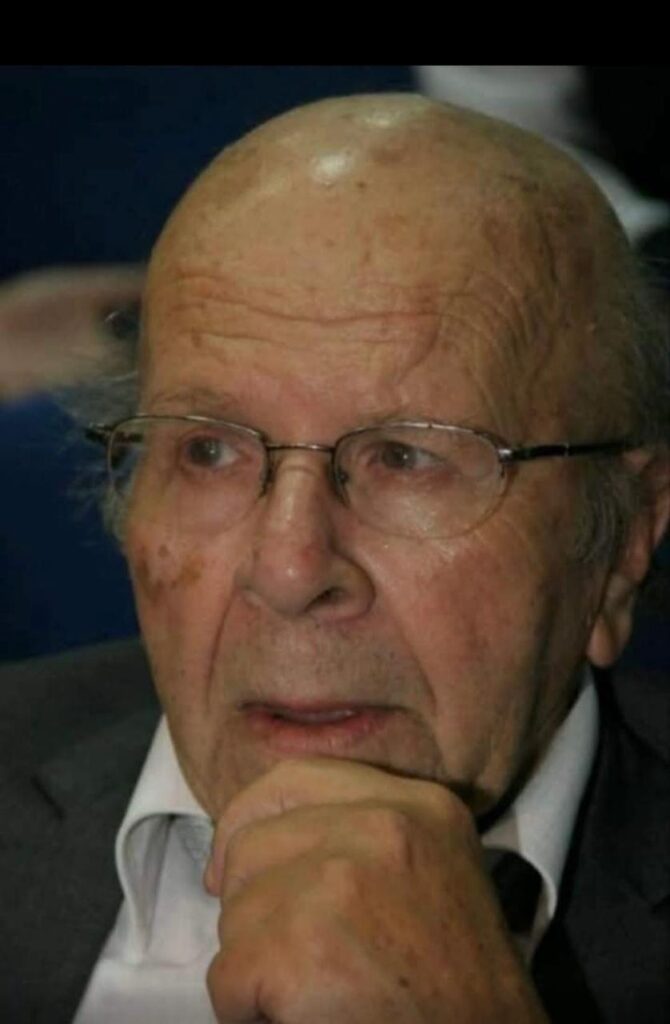
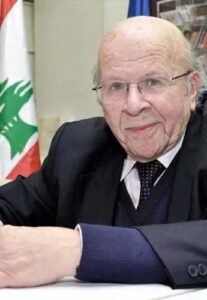
Lebanon has produced many brilliant minds, eloquent poets, and prolific writers. What it has produced far less frequently are teachers whose lives form a coherent moral narrative from classroom to public square, from poetry to law court, from faith to practice. Antoine Sebaalani belongs to this rarer category.
This article is not about nostalgia. It is not a commemorative gesture, nor an academic summary of a literary career. Sebaalani’s life matters not because he struggled, but because he refused to convert grievances into bitterness. It matters not because he taught literature, but because he treated education as a moral act. It matters not because he led a union, but because he insisted that dignity was not negotiable even when he was the one to foot the bill.
A Classroom in Zgharta, Early 1980s
By the early 1980s, Lebanon was no longer simply unstable; it was shattered. War was no longer an episode but a permanent state of existence. Roads could be cut off at any moment. Institutions scrambled just to endure. Families learned to make plans without guarantees and to inhabit uncertainty as their normal reality.
Yet inside one classroom at Collège de La Salle in Zgharta, something remained stubbornly intact. Language. Thought. Moral seriousness.
Antoine Sebaalani entered the classroom without performance. Authority was not announced; it was assumed quietly, as one assumes responsibility. Arabic was the official subject on the program, but it did not remain a syllabus. The curriculum existed somewhere in ministry files and administrative drawers. In his classroom, it was secondary.
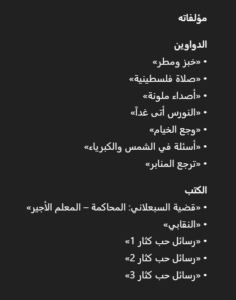
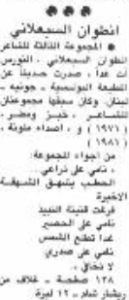
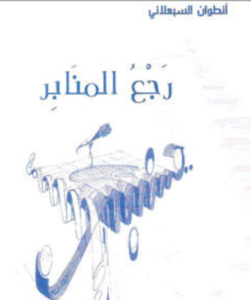
He taught Arabic literature, but not as a closed canon. He introduced students to modern poetry and to voices that were not safely embalmed in textbooks. His discourse with “my friend Tamiras,” in his book Al Nawras Atin Ghadan, still haunts our minds even fifty years later. He preached Arab poets along with non-Arab ones without explanation or apology, as if such boundaries were irrelevant to thought, even poets such as the Palestinian Mahmoud Darwish, whose writings were anathema in that region of Lebanon. We were invited to appreciate his “Mawtini haythu al-ghamām yuʿāniqu asrāba al-ḥamām.” Literature was not treated as heritage to be guarded. It was treated as a living conversation to be entered.
For teenage students in wartime Lebanon, this was not a pedagogical preference. It was an opening. A breach in the belief that knowledge was something delivered from above and memorized below. Sebaalani treated students as colleagues, not subordinates. As writers in formation, not containers to be filled. There was nothing loud about this quiet defiance. That was perhaps its most unsettling quality.
The confrontation with the educational system was not an aim per se. Sebaalani simply behaved as though humanistic education mattered more than institutional comfort. In a Catholic school run by the Frères des Écoles Chrétiennes, this mattered profoundly. The conflict that would later unfold between him and the educational authorities would resemble, in structure if not in tone, what cinema later dramatized in Dead Poets Society. But unlike cinema, consequences in Lebanon did not end with applause or closure. They accumulated slowly and were paid in full.
What distinguished Sebaalani was not only what he taught, but what he made possible. At fifteen years old, I wrote my first article. It was not an assignment. It was not corrected and returned. Antoine Sebaalani published it. He placed it in Al Anwar newspaper, a national daily, without framing it as encouragement or favor. He treated it as a legitimate text worthy of public space even if the job attacked Elia Abou Madi, one of the most famous Lebanese poets. This single act defines a teacher. He showed a teenager that words could leave the classroom and enter the world. For a young student, this is not simply empowering. It is formative. It teaches that language has consequences, and that seriousness is not measured by age.
He went further. Under his guidance, we established “al Mahfal al Adabi,” a literary forum created and run by students. It was not a club in the decorative sense. It was a living institution. Students wrote, edited, debated, and published a magazine composed entirely of student work. This was education as trust.
Formation and Roots
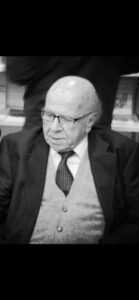
Antoine Sebaalani was born in 1936 in Northern Lebanon. Sebaal, the home of the famous Ass’ad Al Sib‘ali, shaped him early. It produced a sense that endurance is not heroism but habit. Language, faith, and heritage were not abstractions there. They were lived realities.
His formal education followed a path that would later define both his character and his conflict. He studied at Collège des Frères in Tripoli, an institution known for discipline and rigor. He then pursued Arabic literature at Saint Joseph University in Beirut, earning his degree in 1964.
This dual formation mattered deeply. He was shaped simultaneously by Catholic institutional discipline and by deep immersion in the Arabic language and its classical and modern traditions. He belonged fully to both worlds.
Teaching was never, for Sebaalani, a technical profession. It was a moral endeavor. He began teaching in 1956 at a time when teaching still carried social prestige but was already suffering economic neglect. He understood early what many preferred to ignore. Teachers were asked to form minds while being treated as expendable labor.
This tension would crystallize in his poetry, but it was first lived daily in classrooms, staff rooms, and union meetings.
The Craft of Teaching
Sebaalani’s pedagogy was not experimental for its own sake. Authority in his classroom did not rely on intimidation or ritual. Correction was precise but never humiliating. Praise was generous if merited. When he engaged a student’s idea, he did so seriously, as one adult mind addressing another in formation.
He did not teach literature as ornament. He taught it as a calling. Modern poetry appeared naturally beside classical forms. Non-Arab voices entered the classroom without justification. The message was implicit and unmistakable. Human experience precedes classification. Free thought does not require permission.
He trusted students with complexity, and they rose to it. Al Mahfal al Adabi was the natural extension of this trust. It was not an extracurricular flourish only. It was a declaration that students could assume responsibility for language itself. Writing, editing, debate, and publication were treated as serious acts. Education was not preparation for life. It was life, practiced early.
This approach produced something institutions find deeply uncomfortable. Independent minds.
From Classroom to Union Leadership
Outside the classroom, Antoine Sebaalani was already a public figure. Poet. Writer. Union leader.
By the early 1960s, he was active in the private school teachers’ syndicate, representing teachers of the north. In March 1970, he was elected head of the union, a position he would hold until 1992. His tenure coincided with the most turbulent years in modern Lebanese history. Civil war, institutional collapse, fragmentation, and economic precarity defined the context in which he defended teachers’ rights.
He was not a symbolic leader. He was the force behind the union. He transformed it from a ceremonial body into a living institution. He insisted on decentralization and established branches across Lebanon. He refused to allow the union to remain confined to elite institutions. He insisted it belong to all teachers, especially the most vulnerable.
His message was simple and dangerous. Teachers were not charitable volunteers. They were professionals entitled to dignity, stability, and respect. This insistence placed him in direct conflict with powerful educational institutions, including religious schools that publicly preached moral values while privately resisting accountability.
The poem Al Mu’allim al Ajir, the “wageworker” teacher, emerged from this reality. It was not metaphorical. It simply named a condition. That naming would cost him dearly.
When Power Names Its Adversaries
To understand the extent of Sebaalani’s influence, one must look beyond education. During the height of union tension in northern Lebanon, while the government was publicly pursuing a criminal figure in Tripoli named Ahmad Kaddour, a man cast in a Robin Hood role in popular imagination, a revealing moment occurred.
When Kaddour was finally captured and brought in, the prime minister reportedly remarked: “You brought me Kaddour. Now bring me the second Kaddour.” He meant Antoine Sebaalani.
This sentence is not anecdotal. It is diagnostic. It places a teacher and union leader in the same mental category as a wanted outlaw. Not because Sebaalani had committed crimes, but because he had mobilized the teachers. He had organized within the law. He had named injustice clearly and persistently.
Power does not confuse poets with criminals unless it feels threatened. The remark exposed the logic behind what followed. Dismissal. Blacklisting. Relentless pressure. A seventeen-year legal battle.
These were not reactions to a poem. They were attempts to contain a man who had become a reference point for ethical resistance.
Bread, Rain, and the Invisible Father
Sebaalani’s ethical posture did not emerge in isolation. It was inherited. In the prologue of his first major poetry collections, Khobz wa Matar, published in 1971, he writes a dedication without naming its subject: “الى الذي باع زيتوناً كي يشتري لنا علما” To the one who sold olive trees to buy us knowledge.
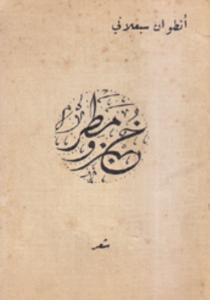
In the Levant, the perennial olive tree symbolizes continuity. It survives generations. To sell it is to trade heritage for something less tangible but more enduring. Education.
The title Bread and Rain becomes more than poetic imagery. Bread is survival. Rain is renewal. Knowledge is dignity. These were the currencies of the Naqib’s life.
Exile Without Leaving
The consequences of Sebaalani’s ethical clarity were severe and enduring. In 1984, he was dismissed from the Frères Institute in Kfaryachit, a school he had been instrumental in establishing as a branch of the Collège des Frères in Tripoli, and which later evolved into one of Lebanon’s most prestigious institutions, Collège de La Salle. He was, in effect, barred from Catholic schools altogether. The irony is impossible to ignore: a profoundly faithful Christian educator was excluded by Christian institutions, not for heresy, but for fidelity to Christian call and La Salle’s ethics.This exclusion was not symbolic. It affected his livelihood. It affected his family. Economic pressure is a powerful disciplinary tool, and it was applied deliberately.
Sebaalani summarized this in A Love Letter to Saint Jean-Baptiste de La Salle The tragedy of the Sebaalani Household. His text addressed the saint not as an accuser but as a son addressing his spiritual father. He framed the catastrophe clearly. Its cause was free, independent union activity within Lebanese law. Nothing else.
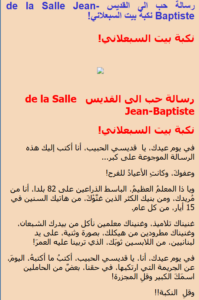
The consequences were brutal. Loss of income. Refusal to pay legal compensation. Pressure during wartime on a household of five. His wife was constrained to leave her teaching position without compensation. His children refused to return to the school that expelled their father.
Catholic institutions closed their doors to him as a teacher. There were offers. Sweden was not theoretical. It was real. His wife’s family was already established there. Africa, where he has many relatives, was an option. He refused.
He moved to Beirut not to reinvent himself, but to persist. He continued teaching where possible. He continued writing. He continued standing where he had always stood. This was exile without departure.
Frère Gabriel and the Human Distinction Inside Institutions
Sebaalani’s conflict was not with Christianity.
His memorial text Frère Gabriel and the Parisian Hat reveals this distinction with clarity. Frère Gabriel was a man of culture, presence, and moral breadth. A director with dignity. A man who respected free union work and refused to be used as a blade against a unionist.
Sebaalani recalls Gabriel defending him as a syndicalist, not a communist. He recalls Gabriel stating that in another country, someone like Sebaalani would be celebrated as a major union leader.
Sister Daniella Harrouk, Superior General of the Sisters of the Holy Hearts of Jesus and Mary, was another example of Christian dedication to the message of the Christ. She opened her school and her big heart to a persecuted militant.
This matters a lot. It shows that institutions are not monoliths. Individuals embody traditions differently. Some live faith as conscience. Others weaponize it as control. Sebaalani’s conflict was never with belief. It was with hypocrisy.
The Seventeen-Year Trial
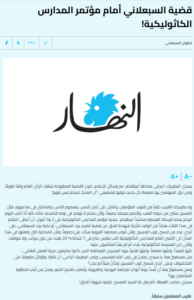
Sebaalani chose law over violence, courts over patronage, always a common currency in Lebanon.
The legal battle that followed his dismissal lasted seventeen years. He was dragged through trial courts, appellate courts, and disciplinary councils. Seventy lawyers volunteered their services. Many were former students.
This is not sentiment. It is proof. When students return as defenders of a teacher’s conscience, education completes its circle.
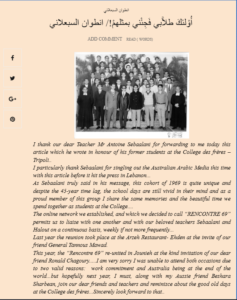
The poet Said Akl famously asked during the proceedings: “…Sebaalani is innocent, and even if we were to assume he were guilty, where is Christ’s forgiveness?…”
Sebaalani survived time. He defeated the infamous Article 29 of the Private Schools Teaching Staff Regulations. He outlasted institutional patience.
Writing as Witness
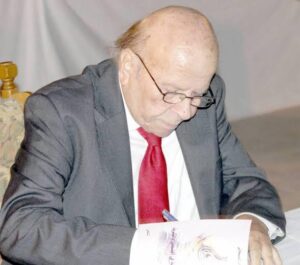
Sebaalani documented his struggle not as self-justification but as record. The Case of Sebaalani. The Unionist. These texts are not memoirs. They are archives of conscience.
His poetry remained sober, sometimes severe. It returned obsessively to dignity, labor, faith, and Lebanon’s moral exhaustion.
Recognition arrived late, but arrive it did.
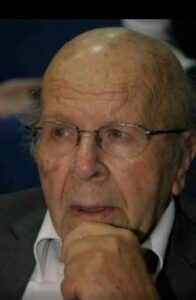
Legacy
Antoine Sebaalani did not found a school bearing his name. He did not build an institution that could be photographed and archived. His legacy is less visible but more durable.
It lives in students who learned early that thought is responsibility. In union colleagues who testify that he transformed a weak organization into a living force. In writings that refuse erasure. In the former students who defended him in court.
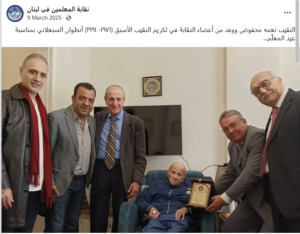
Naqib Sebaalani will always live within us, not as an idea but as a presence. His scarf loosely resting on his wide shoulders, never arranged, never corrected. The trace of Kent cigarettes in the air he left behind is solid proof that memory will always be subjective.
For the thousands of his students, he will always be a Christian Che Guevara without the beret and, of course, without weapons. once condemned and later reflected in the teachings of Pope Francis.
His voice will always resonate within us, wrapped in that unmistakable Sebaal accent: “Yabki wa yadhakou la hoznan wala faraha…”
Remembering Antoine Sebaalani is not nostalgia. It is correction.
Lebanon is full of intelligence. It is poorer in conscience.
Some teachers teach subjects. Others teach freedom and pay for it. Antoine was one of the latter.