


Lent arrives every year with a familiar rhythm, but it is never meant to be routine. The Church is not simply turning a page on the calendar. It is inviting us into a season that has shaped Christian life for nearly two thousand years, and that reaches even deeper into the soil of the Old Testament. Lent is a school of the heart. It trains desire, disciplines the body, and reorders the mind toward God.
In Lebanese communities, whether in the mountains of the homeland or the foggy harbors of Halifax, Lent is also something you can smell and taste. The air changes with the scent of olive oil and za’atar rising from kitchens instead of sizzling meat.
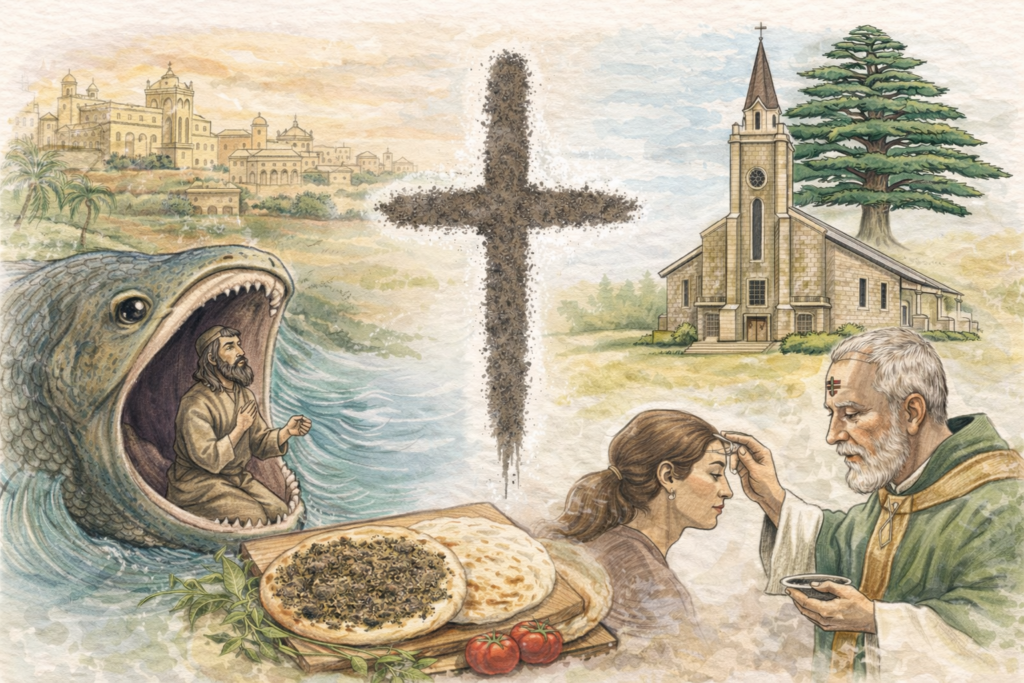
To understand why Lent begins with ashes, fasting, abstinence, and a strong call to repentance, we have to start long before parish bulletins and modern schedules. We have to start with Jonah, the reluctant prophet, commanded by God to warn the wicked city of Nineveh of its impending doom. He flees, boards a ship, gets tossed overboard in a storm, and is swallowed by a great fish for three days and nights. Spat out on the shore, he finally obeys, marching into Nineveh with his dire prophecy: “Forty days more, and Nineveh shall be overthrown!”
The response is astonishing. From the king on his throne to the lowliest citizen, Nineveh repents. They proclaim a fast. They clothe themselves in sackcloth, the rough, itchy garment of mourning. The king himself rises from his royal seat, removes his fine robes, covers himself in sackcloth, and sits in ashes. Even the animals are included in this communal act of humility: “Let man and beast be covered with sackcloth and let them call out mightily to God. Let everyone turn from his evil way and from the violence that is in his hands” (Jonah 3:8).
In the ancient Near East, sitting in ashes symbolized utter dependence on God, acknowledgment of human frailty, and a return to the dust from which we came. Job, after his trials, “sat among the ashes” (Job 2:8). The prophet Jeremiah laments, “He has made my teeth grind on gravel, and made me cower in ashes” (Lamentations 3:16). The Psalms echo this frailty: “For he knows our frame; he remembers that we are dust” (Psalm 103:14).
When Christians adopted ashes at the start of Lent, they weren’t inventing a new custom. They were reclaiming this ancient sign and centering it on the Cross of Christ. Ashes remind us that life is fleeting, that sin clings like dust, and that true renewal comes not from self-reliance but from surrender. This is the heartbeat of Lent: a forty-day journey mirroring Jesus’ time in the wilderness, where He fasted, prayed, and faced temptation.
But to grasp how this practice has fractured and flourished across Christian traditions, we must turn to a pivotal moment in Church history: the Council of Chalcedon in 451 AD. It sought to resolve deep Christological debates about the nature of Jesus Christ. It resulted in a fractured Church. Those who rejected Chalcedon formed the non-Chalcedonian churches. These include the Syriac Orthodox, Coptic Orthodox, Armenian Apostolic, Ethiopian Orthodox, and Indian Orthodox traditions. The Chalcedonian family, by contrast, includes the Eastern Orthodox churches in communion with Constantinople and the Roman Catholic Church, which also includes the various Eastern Catholic rites, including the Maronites.
In the Eastern Orthodox tradition, Lent begins on Clean Monday, the day after Forgiveness Sunday. This is a profound communal rite where the faithful exchange mutual forgiveness, clearing the slate before the fast. Ashes are not typically imposed; instead, the emphasis is on inner purification. The Great Fast, as it’s called, spans 48 days of strict abstinence from meat, dairy, fish (except on certain feast days), oil, and wine. It’s a season of “bright sadness,” as one Russian theologian put it, joyful mourning in anticipation of the Resurrection.
Roman Catholics, meanwhile, mark the start with Ash Wednesday, a day of fasting and abstinence. The ashes, often from the previous year’s Palm Sunday palms, are traced on the forehead in a cross, with the words: “Remember that you are dust, and to dust you shall return” (Genesis 3:19). This echoes Jonah’s ashes but personalizes it: your life is brief, your body temporary, your eternity at stake. The season builds to the Triduum, culminating in Easter Vigil.
Protestants, emerging from the 16th-century Reformation, largely distanced themselves from these ancient practices. Many Reformers like John Calvin viewed Lent as a “man-made” tradition laden with superstition, preferring a focus on Scripture alone rather than ritual calendars. Today, Protestant observance of Lent varies widely. Some mainline denominations, Anglicans, Lutherans, Methodists, retain Ash Wednesday services and encourage spiritual disciplines like prayer, fasting from certain foods, or giving to the poor. Evangelicals and non-denominational churches often treat it as optional, emphasizing personal reflection on Christ’s passion without mandatory fasting.
The Maronite Church, however, offers a distinct flavor to this ancient rhythm, one deeply tied to its Syriac roots and Antiochene heritage. Maronite Lent begins not on Ash Wednesday but on Ash Monday, the Monday following the Sunday of Cana, which commemorates Jesus’ first miracle at the wedding feast. This shift allows for the inclusion of two major feasts during the season: St. Joseph on March 19 and the Annunciation on March 25, days when fasting is relaxed.
Maronite Lent unfolds over a full fifty days, a count that includes the preparatory Sundays and emphasizes a holistic journey to Easter. Ashes are placed on the forehead in the form of a cross, a visible mark that believers carry like a badge of commitment. Unlike some traditions, Maronites do not fast on Sundays. Fish is permitted because it is considered “cold-blooded.”
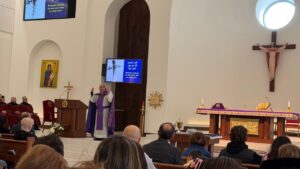
But Maronite fasting is more than rules; it’s a theology woven into the fabric of daily life, especially in the diaspora. At Our Lady of Lebanon Maronite Church in Halifax, Nova Scotia, this tradition pulses with vitality. Father Namatallah Eid, the dedicated pastor, leads the 10:00 a.m. Mass on Ash Monday with a quiet intensity that draws the faithful in. The church fills early. The air carries the faint scent of incense and beeswax candles. Father Eid’s homily cuts to the heart of the season. He doesn’t dwell on rote prohibitions but paints Lent as a time of profound cleansing. “Abstinence isn’t just about what we don’t eat,” he says. “It’s about what we become. Confession is not a courtroom drama but a bath for the soul where the grime of sin is washed away.
During communion, the distribution of ashes begins. One by one, parishioners approach the altar. Father Eid dips into the bowl of gray powder and traces the cross on each forehead. “Remember that you are dust,” he murmurs in Arabic. The cross stays there, a public yet intimate sign of faith.
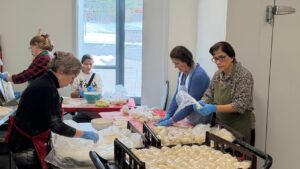
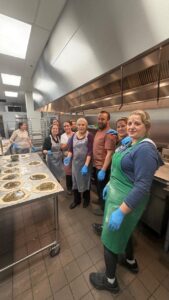
This is where abstinence meets the everyday. At Our Lady of Lebanon, the Lenten manakish sale is a beloved tradition, a fundraiser that doubles as fellowship. Cheese manakish, za’atar-spiced flatbreads, and the classic half-and-half, pre-orders flood in via the parish app. The dough fills the air with the warm, herby scent that screams “home” to every Lebanese heart.
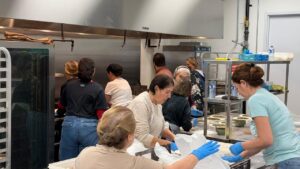
Most of the work falls to the parishioners, and here the gender divide is as predictable as the rising sun. It’s mostly women, grandmothers, mothers, aunts, sisters. They move like a well-oiled machine with surgical precision. And then there are the men. Or, in this case, Chef Jean and me. Two males in a jungle of women. You can picture the scene: we stand amid the chaos, trying to look indispensable. We lift trays of dough like they’re sacred relics. Instructions rain down: “Not that way, habibi! Thinner!” “Carry it higher!” Lent’s humility exercise is in full swing. “We’re the only men,” Jean quips, “surrounded by an army of dough Amazons. If this doesn’t teach us surrender, nothing will.”
Fasting’s roots run deeper than spirituality alone; they entwine with socio-economic realities that shaped Lebanese life for centuries. In the villages of old Lebanon, meat wasn’t daily fare. Animals were treasures: goats for milk, sheep for wool, oxen for plowing. When one was slain, it was an event: a feast for the wider family, shares distributed, and the rest preserved as kawarma, meat cubed, cooked in its own fat, sealed in jars to last through lean months. Fasting, then, was both theological and economic. It curbed indulgence during scarcity, regulated the calendar of plenty, and taught restraint. The Church sanctified these rhythms, turning necessity into virtue. That’s why the Christian calendar brims with more than just Lent. There are the Fast of the Nativity in preparation for Christmas and the Fast of Our Lady in August. These seasons created a yearly cadence: restraint building to joy, simplicity sharpening gratitude. In the diaspora, amid Halifax’s supermarkets stocked year-round, this feels countercultural, a reminder that abundance can numb the soul.
When you weave it all together, from Jonah’s ashes in Nineveh to the cedar-scented kitchens of Our Lady of Lebanon, Lent emerges as a living bridge. It spans the Old Testament’s raw honesty with the Maronite genius for blending faith with life.
The cedar, symbol of Lebanon, doesn’t shout. It stands tall, roots deep, whispering resilience. Every Lent, that whisper returns: cleanse the stains, return to the Source, come home to the feast.
In Halifax, amid the manakish steam and forehead crosses, that home feels closer than ever.