


A changing real estate market is forcing Canadian homeowners to confront a financial reality many have avoided: a property is worth what buyers will pay today, not necessarily what its owner paid several years ago.
A recent Financial Post article examines the growing number of Canadians selling homes at a loss, particularly in the Greater Toronto Area (GTA), where some properties purchased during the 2021–2022 housing boom have fallen substantially in value.
The findings raise an important question for homeowners and investors across Canada: Is it better to accept a loss now or wait years for prices to recover?
1. The Scale of the Losses
Research by Valery Real Estate examined 27,272 GTA home sales over a one-year period ending in October 2026.
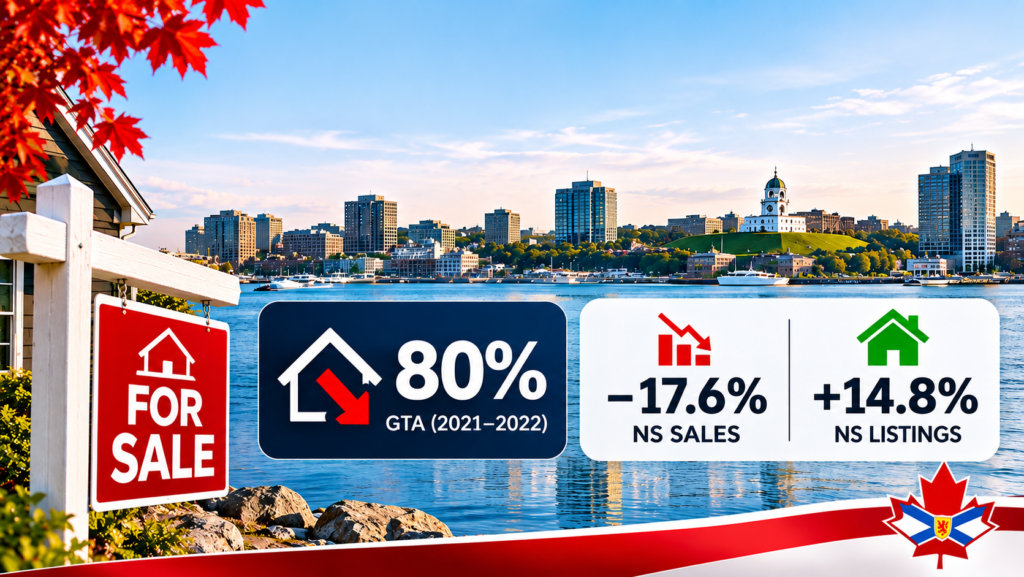
Among sellers who originally purchased their properties in 2021 or 2022, approximately 80% sold below their original purchase prices. Their combined resale shortfall was $581.4 million. Across all purchase years, the combined shortfall for homes sold below their purchase price was $936.6 million.
Across the broader sample, nearly one-quarter of properties sold for less than their previous purchase prices.
For those loss-making transactions, the median decline was 11.1%, representing approximately $100,000.
These figures concern the GTA, not Canada as a whole. They also measure differences between purchase and resale prices, rather than every expense associated with ownership.
Nevertheless, they demonstrate how dramatically market conditions have changed since the pandemic-era property boom.
2. Why Homeowners Refuse to Sell
Daniel Foch, chief real estate officer at Valery, describes a market where homeowners increasingly withdraw listings rather than accept disappointing offers.
The explanation is partly psychological.
Many sellers remain attached to their original purchase price, treating it as the minimum acceptable value.
However, buyers evaluate current financing conditions, competing listings, property quality and future prospects.
The market does not guarantee that yesterday's purchase price will become tomorrow's selling price.
This creates a stalemate: sellers refuse to reduce prices, while buyers remain unwilling to meet their expectations.
A homeowner may avoid realizing a loss by withdrawing a listing, but that decision does not restore the property's market value.
3. Selling Is More Expensive Than It Appears
Real estate differs considerably from financial investments that can be sold quickly.
A property sale involves commissions, legal expenses, moving costs and potentially mortgage penalties. Purchasing another property introduces additional expenses, including applicable transfer taxes.
These costs can substantially increase the financial consequences of selling.
A homeowner who sells for $100,000 below the purchase price may therefore experience a greater total financial loss after accounting for transaction expenses.
However, continuing to own the property also has costs.
Mortgage interest, property taxes, insurance, maintenance and repairs continue regardless of market conditions.
The correct comparison is not simply today's selling price against yesterday's purchase price. It is the financial cost of selling now against the cost and risk of continuing to hold.
4. Homeowners and Investors Face Different Decisions
Anthony Scilipoti, chief executive of Investment Research, draws an important distinction between owner-occupied homes and investment properties.
For someone living comfortably in a home, a decline in its market value may have little immediate consequence.
If mortgage payments remain affordable and the property meets the household's needs, selling may be unnecessary.
For investors, the calculation is different.
A rental property must be evaluated according to its current value, operating expenses, rental income, financing costs and future prospects.
An investment that no longer produces an acceptable return should not automatically be retained simply because its owner hopes to recover the original purchase price.
Waiting for a recovery is not an investment strategy unless there is a credible financial reason to expect one.
5. Will Canadian Housing Prices Recover?
The Financial Post cites RBC economist Robert Hogue, who describes Canada's housing recovery as fragile.
Weak sales activity, affordability pressures and mortgage renewals continue to influence market conditions.
However, rising mortgage delinquencies and forced sales have not become the dominant forces driving the national market.
Many homeowners can continue holding their properties as long as they meet their financial obligations.
That means a widespread collapse is not inevitable.
Equally, there is no guarantee that prices will return quickly to their previous peaks.
The central lesson is that accepting a loss can sometimes be rational. Holding can also be rational. What matters is the financial evidence, not the emotional attachment to a past valuation.
Nova Scotia: Is Halifax Heading Toward the Same Reality?
Nova Scotia has not experienced the same broad resale losses documented among recent GTA buyers, but its housing market is showing clear signs of cooling.
According to the Nova Scotia Association of REALTORS®, 885 homes sold across the province in October 2026, a decline of 17.6% from October 2025.
Active listings reached 5,354 properties, increasing 14.8% year over year.
The province had six months of inventory, compared with 4.3 months one year earlier.
These figures indicate greater buyer choice and increased competition among sellers.
However, prices have remained comparatively resilient.
Nova Scotia's benchmark home price was $426,000 in October, just 0.5% below the previous year.
The average sale price was $450,887, down 2.9%.
Halifax: Slower Sales, More Negotiation
The Halifax-Dartmouth market is experiencing similar changes.
According to October market data from Homeworks Realty, sales declined 22.2% year over year, while active listings increased 17.9%.
The median selling time increased to 41 days, compared with 31 days in October 2025.
Meanwhile, the Teranet–National Bank House Price Index recorded a 4.0% annual decline in Halifax resale prices in September 2026.
This index differs from average transaction prices and should not be interpreted as evidence that every Halifax property has lost 4% of its value.
The picture is therefore mixed: fewer transactions and softer prices in some measures, but no evidence of GTA-style losses across the entire Halifax market.
What Should Nova Scotia Homeowners Do?
Homeowners who purchased before the pandemic may still hold substantial equity.
Those who bought near recent price peaks, particularly with limited down payments, may face greater financial exposure.
For investors, the decision should depend on rental income, financing costs, maintenance obligations and realistic resale valuations.
For homeowners, affordability and long-term housing needs remain central.
Nova Scotia's market is changing, but a slower market is not automatically a collapsing market.
The danger is assuming that every property will recover its previous valuation simply because Canadian real estate has historically appreciated.
The question for Halifax homeowners is no longer only how much their property is worth. It is whether keeping it remains the best financial decision.
#CedarWhispers #CanadianRealEstate #HousingMarket #HousingCorrection #HousingAffordability #NovaScotia #Halifax #HalifaxRealEstate #NovaScotiaRealEstate #RealEstateInvestment #PropertyInvestment #RentalHousing #Landlords #Homeowners #HousingPrices #RealEstateDevelopment #MultifamilyHousing #PropertyManagement #HousingTrends #RealEstateMarket #CanadianHousing #CMHC