
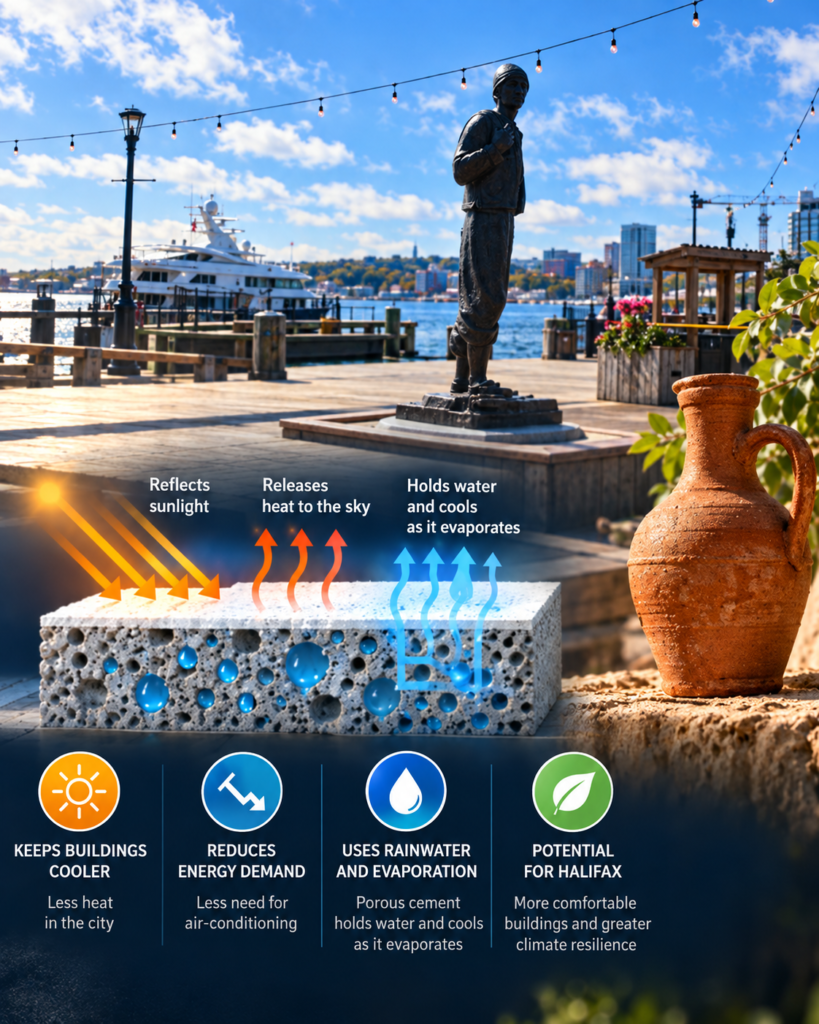


New coatings can reflect sunlight, radiate heat and even store rainwater to cool buildings without conventional air-conditioning. The science sounds futuristic. Yet part of the principle would have been immediately familiar to anyone who grew up drinking cool water from a traditional Lebanese terracotta water pitcher.
Cooling Buildings Without Paying to Cool Them
Air-conditioning solves one problem by creating several others. It consumes electricity, puts additional pressure on power grids during the hottest periods and, by moving heat from inside buildings to the outdoors, can contribute to hotter urban environments.
A recent Economist article, “How to cool buildings on the cheap,” examines a very different approach: instead of mechanically removing heat after it has entered a building, stop much of that heat from entering in the first place and help the building release the heat it already has.
The simplest version is surprisingly familiar: make surfaces whiter.
Researchers at University College London have developed a highly reflective coating that reportedly reflects about 93% of incoming sunlight, compared with roughly 84% for conventional white paint. In tests cited by The Economist, surfaces treated with the new material stayed as much as 8°C cooler than those covered with standard white paint.
But reflection is only half the story.
Modern radiative-cooling coatings are engineered to reflect most incoming solar energy while allowing the surface to emit its own heat as infrared radiation. In the right conditions, this can let a surface shed more heat than it absorbs from sunlight, without compressors, fans or electricity.
Early versions were expensive and complicated. The newer generation is moving toward ordinary materials and conventional construction methods.
One particularly interesting development takes the idea beyond paint.
Researchers led by Jipeng Fei developed a cement-based passive-cooling coating that combines solar reflection with evaporative cooling. The material has a carefully engineered porous structure that can hold water. The published research reports solar reflectance of roughly 88–92%, high infrared emissivity and water retention of about 30%. Field testing in Singapore showed better cooling performance than ordinary commercial white coatings.
When rainwater or moisture enters those tiny pores, it is retained. As the water later evaporates, it takes heat with it.
The principle is remarkably simple: the building effectively sweats.
According to the account in The Economist, the material can also draw moisture from humid air, while its porous cement structure scatters sunlight. In tests, the approach produced lower temperatures than conventional radiative coatings and reduced cooling-energy demand. Because cement is inexpensive, researchers see a possible route toward passive cooling that does not depend on costly exotic materials.
The attraction is obvious.
Instead of continually spending energy to fight heat after it enters a building, the envelope itself begins doing part of the work.
That could matter most in hot countries.
But it may also have lessons for places that we do not normally associate with extreme heat.
Could This Make Sense in Halifax Construction?
Halifax is certainly not Singapore, Madrid or the Middle East.
For most of the year, our bigger concern is keeping buildings warm rather than keeping them cool. Nova Scotia’s building regulations place buildings under requirements associated with Climate Zone 6, reflecting a substantial heating demand.
That might seem to make cooling coatings irrelevant.
It doesn’t.
Halifax already experiences periods of extreme summer heat, particularly in apartments and taller buildings, and the municipality specifically warns that indoor temperatures can become dangerous during heat events. Climate projections for Nova Scotia point toward hotter summers and substantially more very hot days in coming decades. Under one high-emissions projection, days above 29°C rise from an historical average of about two per year to 14 by the 2050s and 32 by the 2080s.
HRM is already looking at urban heat islands and building resilience as part of its climate work.
So, there is a potential Halifax application, but we should not simply copy a technology developed for tropical climates and cover every roof with it.
The obvious first candidates would be buildings particularly vulnerable to summer overheating: large flat-roofed commercial buildings, warehouses, schools, community facilities, apartment buildings with significant solar exposure and perhaps rooftop structures and hard urban surfaces.
A coating that reflects a large share of summer solar radiation could lower roof temperatures before that heat reaches the occupied space. Passive cooling could therefore reduce peak cooling demand and make upper-floor apartments more comfortable during heat waves.
The water-retaining cement idea is also intriguing for a rainy coastal city. A surface capable of retaining some rainfall and later using evaporation to remove heat creates an interesting connection between stormwater, building envelopes and thermal management.
It might be tempting to think that if this material controls heat in summer, we could somehow use the same coating in winter to keep heat from escaping.
Not exactly.
A conventional radiative-cooling coating is designed to release heat, which is precisely what a Halifax building does not want during a cold January night. Research has identified this winter “overcooling penalty” as a real issue in colder climates.
The more interesting future may therefore be adaptive envelopes: materials that behave one way in July and another way in January.
That work is already happening. Researchers are developing temperature-responsive and switchable roof coatings that become highly reflective and heat-emitting when conditions are hot but reduce heat loss when temperatures fall. Canadian research has also examined thermochromic coatings specifically to reduce summer cooling while limiting the winter heating penalty.
And yet the most fascinating part of all this sophisticated materials science may be how old the underlying idea really is.
In my hometown in northern Lebanon, nobody needed a laboratory to explain why water from the traditional terracotta clay water pitcher, could stay pleasantly cool even on a hot day.
Different material. Different scale. Much more sophisticated engineering.
But the physics is remarkably familiar.
As science moves forward, it sometimes discovers that old wisdom was already waiting for it.
#Halifax #NovaScotia #ConstructionInnovation #SustainableConstruction #BuildingScience #PassiveCooling #EnergyEfficiency #ClimateResilience #GreenBuilding #Architecture #UrbanDesign #ConcreteInnovation #RadiativeCooling #EvaporativeCooling #LebaneseHeritage #LebaneseCanadian #ImmigrantStories #HalifaxWaterfront #CedarWhispers