


A recent Washington Post article, “Once banished to trailer parks, manufactured homes are moving to suburbia,” describes a quiet change in American housing. Factory-built homes, long associated with trailer parks, rural lots and lower-income households, are beginning to appear in conventional suburban neighbourhoods.
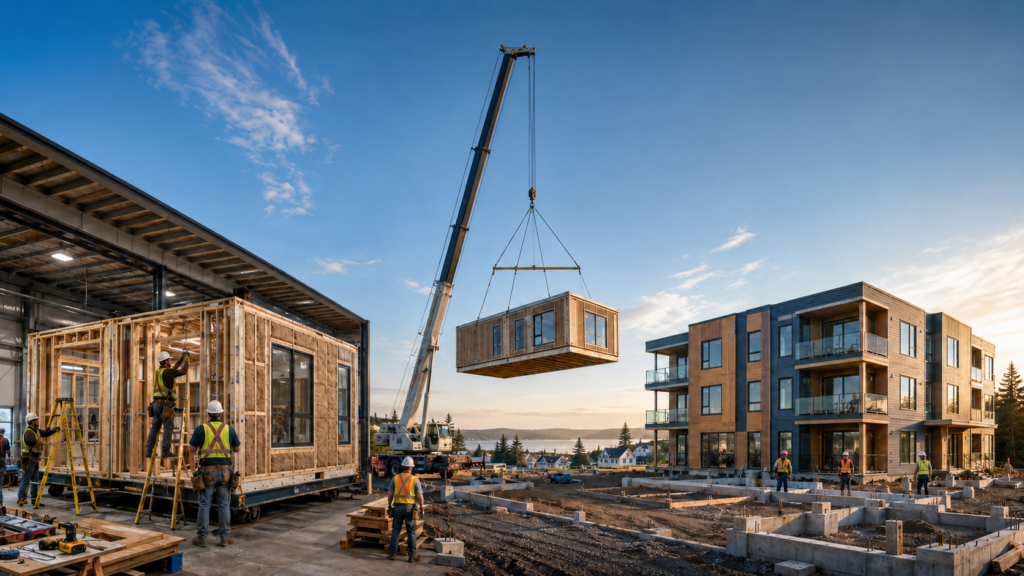
The article opens in Acacia Village in Santa Rosa, California. From the street, its new houses resemble the surrounding homes, with Craftsman styling, plank siding, porches and landscaped yards. The difference is how they arrived. Each house was built in a factory, transported in sections and placed on its foundation by crane.
This is more than a change in construction technique. It is an attempt to overcome decades of stigma. Manufactured housing was often viewed as unsafe, unattractive or likely to depreciate. Many municipalities restricted or excluded it through zoning. The Washington Post notes that even the industry acknowledges that some of this reputation was earned by older products. Modern manufacturers are now trying to prove that factory-built homes can meet higher expectations for design, durability and neighbourhood compatibility.
Yet the Post does not present factory construction as an effortless solution. Financing remains difficult because some manufactured homes are treated as movable personal property rather than real estate. Municipal rules can block them directly or impose design requirements that are difficult to satisfy when a house must be transported.
Land ownership also matters. A house may be affordable while the buyer leases the land beneath it, creating long-term cost and security questions. A lower purchase price does not necessarily mean secure or affordable ownership over the life of the home.
The most sobering argument comes from researchers at Groundwork Collaborative. They contend that private demand alone may not justify the factories and scale needed for a major expansion. American manufactured-home production has remained near 100,000 units annually. Their conclusion is that large and dependable purchasing commitments may be necessary before producers invest in greater capacity.
Why the comparison matters in Canada
First, the terminology must be clear. The Washington Post discusses American manufactured housing and hybrid CrossMod homes. Nova Scotia defines a modular building as factory-built modules transported and assembled on-site, with certification under CSA A277. These are related forms of off-site construction, but they are not legally or technically identical.
Under the Nova Scotia Building Code Regulations, certified modular buildings and closed factory panels can be deemed compliant for components that cannot be inspected after arriving on-site. Modular construction therefore does not mean escaping the building code. It means moving part of the inspection and quality-control process into the factory.
Canada’s housing shortage demands more than marginal improvement. CMHC estimates that restoring affordability to 2019 levels would require between 430,000 and 480,000 housing starts annually by 2035, compared with a projected 245,000 to 250,000. CMHC explicitly says this is an estimate of the scale of the challenge, not an official government target.
Either way, conventional construction alone is unlikely to close that gap without major increases in labour, productivity and investment.
Modular construction can help because factory production and site preparation can proceed simultaneously. Controlled conditions reduce weather interruptions. Repeated designs can improve quality, simplify training, support bulk purchasing and reduce material waste. Completing buildings sooner can also reduce financing costs and allow owners to begin receiving rent earlier.
But faster and cheaper must not become a slogan detached from evidence. A one-off modular prototype may cost as much as, or more than, a conventional building. Savings depend on standardized designs, repeat orders, efficient transportation, suitable sites and a steady production pipeline. A factory without reliable demand becomes overhead, not innovation.
Canadian policy is beginning to address one of the largest obstacles: financing. In May 2026, CMHC expanded mortgage-insurance support for prefabricated homes and multi-unit modular projects, including MLI Select. Its earlier pilot supported more than 800 rental homes in five provinces.
CMHC also cited an 84-unit Calgary modular project that was built and occupied in under one year, compared with nearly two years for a similar conventional development in the same community. That is strong evidence of a schedule advantage, although it does not prove that every modular project will achieve the same result.
Nova Scotia is already gaining experience
In Lower Sackville, 75 modules manufactured in Trenton were shipped to the site and craned onto the foundation for a 22-unit public-housing development.
In Amherst, the Groves at Hillsdale will provide 47 modular homes. Twenty-eight will be sold through a shared-ownership model, while 19 will be offered as affordable rentals.
These projects show that modular construction is no longer a theoretical discussion in Nova Scotia. The province is already manufacturing, transporting, assembling and financing factory-built housing.
The Amherst manufacturing opportunity
The next step may be local production. Mikhial Mansour, President of Casey Realty Ltd. in Amherst, has established a factory that prefabricates modular apartment units. The initial product line will include studio, one-bedroom and two-bedroom units that can be assembled into multi-unit buildings, currently up to three storeys.

This project could matter far beyond one company. A factory in Amherst could create skilled jobs, shorten supply chains and retain more construction spending in Cumberland County. It could serve smaller communities where conventional builders may struggle to mobilize labour for modest projects.
Reusable unit designs could also allow developers, municipalities and non-profit organizations to stop redesigning every project from the beginning. Proven units could be adapted to different sites while preserving repeatability inside the factory.
The weak link is not the ability to manufacture a box. It is the system surrounding the box. Municipalities must approve suitable sites. Lenders must finance work completed away from the site. Most importantly, public and private buyers must provide a credible pipeline of projects. Without volume and continuity, the promised economies of factory production will not materialize.
Modular construction will not replace conventional construction, nor should it. It should become an additional delivery system, particularly for repeatable apartments, seniors’ housing, workforce housing and affordable projects.
Nova Scotia cannot solve a housing production shortage through announcements alone. It needs homes moving from drawings to factories, from factories to foundations, and from foundations to occupancy.
If local modular manufacturing can deliver code-compliant homes faster, at a lower total project cost and with greater schedule certainty, it deserves a serious place at the centre of Nova Scotia’s housing strategy.
#ModularConstruction #ModularHousing #PrefabConstruction #OffsiteConstruction #HousingInnovation #AffordableHousing #HousingSupply #NovaScotia#LocalManufacturing #SkilledTrades #EconomicDevelopment #CanadianConstruction #CedarWhispers