
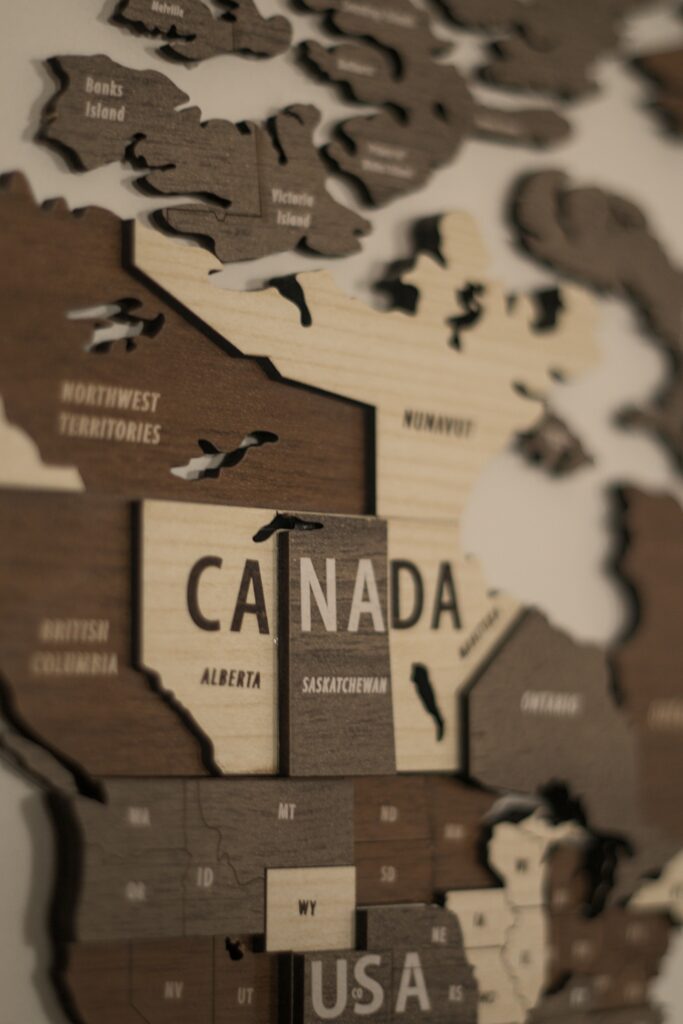


Canada Before Canada: How British North America Reached the Federal Bargain of 1864
On July 1, 1867, Britain united three colonies in North America into a single political entity. That moment became known as Confederation. The colonies were New Brunswick, Nova Scotia, and the Province of Canada. The new country took the name of the largest colony, but with a deliberate upgrade in status: the Dominion of Canada. It also arrived with a new architecture of government: a federal system with one central government and four provincial governments, because the Province of Canada was split into Ontario and Quebec.
That description sounds neat and almost inevitable. It was not. Confederation was the outcome of failure, fear, compromise, and ambition. It was the product of societies that did not fully trust one another, leaders who wanted different futures, and a constitutional mess that stopped ordinary government from functioning. In other parts of the world, nations were being forged through blood and civil war. In British North America, the political class chose debate, negotiation, and votes. This did not make the process pure, peaceful, or inclusive. It did make it different.
To understand how Canada came to be governed through federalism, you have to start earlier than 1867. You have to begin with a French Catholic society along the St. Lawrence, the arrival of British rule, the shockwave of the American Revolution, and the long political paralysis that followed. You also have to understand something that still defines Canada today: federalism is not just a set of rules. It is a permanent negotiation about power.
Confederation Was Two Things at Once
Confederation meant two developments at the same time. First, it meant union: separate British colonies were brought together in a larger structure. Second, it meant federalism: the new structure divided government into two orders, a central government and provincial governments, each with its own authority.
The plan was ambitious. The Dominion adopted a motto that captured a dream of scale: “from sea to sea.” British Columbia was expected to join, and it did four years later. The new Dominion also acquired Rupert’s Land, a massive territory draining into the Arctic Ocean and spanning a geography that, by sheer size, made Canada one of the largest political entities on earth.
Scale, however, does not solve politics. In some ways, it makes politics harder. A big country with multiple regions, multiple economies, and multiple cultural identities needs a system that can absorb disagreement without collapsing. Federalism was selected because it offered exactly that. It allowed unity without forcing uniformity.
But federalism is not an easy system to run. It creates rival governments. It makes conflict normal. It guarantees disputes over responsibility, money, and legitimacy. The division of powers is never perfectly defined, and even when written down it changes through how governments use it. The balance between Ottawa and the provinces shifts over time. What looks like a clear rule in a constitution becomes, in practice, a moving line negotiated again and again.
That is not a flaw. That is the design.
Why Federalism Entered the Conversation
The idea of federalism was not new in the nineteenth century, but it was rare. British colonies were normally run through more centralized frameworks. Yet in the Province of Canada, by the 1850s, debate about federalism became unavoidable because the colony had become ungovernable. Four previous British constitutions had failed. Politics could not produce stable governments. Elections did not solve the deadlock. Basic decisions on defense, trade, transport, and development were being delayed or mishandled because leaders could not assemble majorities and could not keep them.
By 1864, many accepted that federalism was the only workable option. What remained unclear was the shape federalism should take. There were not many models. The United States offered a federal example, but it was not necessarily one British North America wanted to copy. Britain offered another model through its empire, where London handled trade, defense, and foreign affairs while colonies controlled local matters. British parliamentary government had its own traditions, largely unwritten, built on precedent. The challenge was to combine a written federal constitution with the British cabinet system.
The eventual constitutional outcome, the British North America Act of 1867, turned out to be successful. It remained in effect, amended formally and informally over time. Its survival does not mean it resolved conflict. It means it created a framework where conflict could be managed.
A World of Violence, and a Canadian Contrast
Confederation also needs to be seen in the context of the wider world. Italy and Germany were being unified through war. The United States held itself together through a civil war that cost hundreds of thousands of lives. Expansion in the American South and West involved conquest and forced submission of Indigenous peoples. Against that backdrop, British North America’s path stands out. The core political bargain was achieved through speeches, bargaining, committee work, conferences, and votes.
This does not mean the process was gentle or morally clean. It was not. It does mean that political leaders built a habit of settling major structural conflicts through negotiation rather than through civil war. That habit continued in later struggles, including prairie expansion, negotiations with First Nations, the entry of new provinces, threats of secession, divisions created by world wars, Quebec separatism, and Western alienation. Some lives were lost across these chapters of history, and not everything was handled well. Yet the political tradition leaned toward bargaining, not force, and that became part of Canada’s identity.
The Foundation: New France and the Meaning of Survivance
The deepest reason Canada needed federalism existed before the British conquest of New France in 1763. New France was a French Catholic colony concentrated along the St. Lawrence, with a relatively homogeneous population. Those Canadiens developed an identity distinct from European French and distinct from French Acadians in the Maritimes. They saw themselves as a people with shared religion, language, customs, and history.
After 1763, that population was isolated from France and dominated by English Protestants. In that new situation, preservation became a political mission. The determination to maintain identity, resist assimilation, and protect a way of life became a defining feature of French Canadian nationalism. It became known as la survivance.
This is not just a historical slogan. It shaped institutions. It shaped constitutional demands. It shaped how French Canadians approached every debate about governance: what protects our language, our religion, our civil law, our schools, our land, our community life?
A small phrase printed on Quebec license plates captures the emotional core of survivance: Je me souviens, “I remember.” It is not merely romantic. It is political memory. It signals that identity is tied to struggle, not just culture.
Britain’s First Attempt: The Proclamation Act of 1763
Britain’s first constitution for Quebec, the Proclamation Act of 1763, tried to govern Quebec similarly to British colonies along the Atlantic seaboard, the world that would become the United States. In those colonies, English Protestants were the majority and Catholics were excluded from political life. Quebec was the opposite. English Protestants were few. The population was overwhelmingly French and Catholic. The model was impractical.
After a decade of confusion, Britain changed course.
The Quebec Act of 1774: A Constitutional Anchor
The Quebec Act of 1774 granted Canadiens what they valued most: the right to live their lives according to their religion, language, culture, civil law, education, health, welfare, and land ownership traditions. In practice, it recognized that stability in Quebec required cultural autonomy.
The Quebec Act became a bedrock of Canadien political culture. Survival as a distinct group was seen as tied to the maintenance of those rights. That belief never faded. One of the core achievements of Confederation, later on, would be that it preserved Quebec’s distinctiveness within a larger union, rather than erasing it.
The Loyalists and the Constitutional Act of 1791
Ten years after the conquest, the American Revolution produced a wave of English-speaking refugees: the Loyalists. Many settled in the Maritimes or west of Montreal. That changed the political map. To accommodate this new English-speaking population, the Constitutional Act of 1791 replaced the Quebec Act and introduced another major shift. It divided Quebec into two colonies:
- Lower Canada, where Canadiens were the majority
- Upper Canada, where English-speaking Protestants were the majority
Both colonies gained elected assemblies and representatives called Members of the Legislative Assembly. But real power still rested with governors appointed by Britain. The elected bodies existed, yet control remained limited.
Even within that constrained system, political styles diverged. French Canadian politicians became skilled at electoral politics with survivance as their core objective. Many English-speaking politicians focused more on economic development.
The Atlantic Colonies: Similar Empire, Different World
Loyalist settlement also reshaped the Maritimes. New Brunswick separated from Nova Scotia in 1784. Prince Edward Island had already been separated in 1769. By 1800, there were six British North American colonies: Newfoundland, Nova Scotia, New Brunswick, Prince Edward Island, Lower Canada, and Upper Canada.
Britain had little difficulty governing Newfoundland and the Maritime colonies. The Canadas were different. Their political and cultural structure created deeper tension, and eventually dysfunction.
There was also a glaring exclusion that shaped Canada’s story from the beginning. First Nations had no role in government. They were not part of the discussions. They did not vote until 1960. They did not gain a role in First Ministers’ conferences until decades after that. Confederation was built without Indigenous participation in its political design, even while its consequences would directly affect Indigenous peoples.
The Rebellions of 1837 and Durham’s Remedy
In the early 1800s, French and English communities had relatively limited contact. Upper Canada had few Canadiens. Lower Canada’s English-speaking minority was privileged as part of the British colonial order. Yet both colonies faced political problems driven by small elites and the abuse of power.
Rebellions broke out in 1837. Britain responded by appointing a new governor, Lord Durham, to recommend reforms. Durham’s recommendations included two linked ideas: assimilate the Canadiens into British culture, and combine Upper and Lower Canada into one colony, the Province of Canada.
The merger happened. But because some matters required separate governance, including education and civil law, the united colony was divided administratively into Canada East and Canada West. People continued using the old terms Upper and Lower Canada, and many still do even today when discussing cultural and historical divides.
Durham also wanted to prevent the French majority from dominating the assembly. So he proposed equal representation for Canada East and Canada West, even though Canada East had a larger population. He also recommended overrepresenting English-speaking minorities in Canada East. These were undemocratic moves meant to produce a political outcome: control without majority rule.
Ironically, Durham misjudged the political dynamics. English-speaking members remained divided over economic and regional priorities. Canadiens were united on the question of preventing assimilation. The attempt to silence French in the new assembly became a symbolic test. Canadien MLAs spoke French on the first day. The protest was ignored, and French continued. In 1848, French gained official recognition in the Assembly and courts. Assimilation suffered a major defeat.
Responsible Government Arrives, and Paralysis Follows
After 1848, Britain granted democratic control over local matters to Nova Scotia and Canada. Power shifted from the British governor to executives who depended on legislative majorities.
Yet rather than producing stability, this period produced chaos in the Province of Canada. English-speaking politicians were divided into loose factions: Reformers, Conservatives, and independents. French Canadian politics included conservative Bleus and more radical Rouges. Parties were unstable and undisciplined. Coalitions were hard to form and easy to break.
Because governments needed Canadien participation, and because Canadiens were more united than English-speaking factions, Canadien politicians gained influence inside governing coalitions. This was the opposite of Durham’s dream. The system now made French Canadian support essential, not marginal.
During the 1850s, the colony faced major issues it could not handle effectively: defense concerns tied to the United States, uncertainty over British military support, the likely cancellation of a major trade agreement with the United States, and the need for transportation links to the Maritimes. On top of that, English and French communities differed in their visions of the future. Many French Canadians focused on protecting their homeland and community life along the St. Lawrence. Many English-speaking Canadians focused on development and expansion into western territories.
Britain’s own interests were shifting. It wanted to reduce costs of defense and administration. The American Civil War created strategic anxiety, including fear of invasion. British investors wanted stability and preferred dealing with a single government rather than a cluster of fragile colonies. Gradually, Britain moved toward favoring union.
The Maritimes: Proud, Loyal, and Not Impressed by Canada
Newfoundland, Nova Scotia, New Brunswick, and Prince Edward Island developed differently from one another and differently from the Province of Canada. They shared Atlantic geography and British identity, but their political priorities were local. By the 1850s, these colonies guarded their autonomy and were loyal to Great Britain. Municipal government was weak, so local MLAs held strong influence over roads, forests, property, and contracts. Their outward gaze turned first to Britain, then to New England, then sometimes to one another.
To many in the Maritimes, the Province of Canada looked messy and unreliable. It seemed unable to govern itself, unstable in negotiations, and oddly self-satisfied.
That skepticism mattered, because Canada could not form a larger union without Maritime participation, especially Nova Scotia and New Brunswick.
The Key Players and Their Conflicting Goals
By the late 1850s, major leaders in the Province of Canada confronted the deadlock:
- George Brown, leader of the Reformers
- John A. Macdonald, Conservative leader from Upper Canada
- George-Étienne Cartier, leader of the Bleu Conservatives from Lower Canada
- Alexander T. Galt, a key advocate of federalism
- A.A. Dorion, leader associated with the Rouges
Their goals overlapped just enough to enable a compromise, but their visions were not identical.
In 1858, a Conservative-Bleu government fell. A Reform-Rouge government lasted only two days. In the aftermath, Cartier and Macdonald formed a coalition and brought in Galt. Galt believed federalism was the only solution to Canada’s political paralysis and wanted to include the Atlantic colonies in a broader scheme. He made this a condition for joining. Cartier and Macdonald were not enthusiastic, but they accepted, believing it harmless. Federalism remained a platform plank.
Brown’s Reformers wanted “rep by pop,” representation by population. Upper Canada’s population was rising beyond Lower Canada’s, and Brown wanted political power to follow that demographic reality. Rep by pop would give English Protestants a growing majority and could reopen the goal of assimilation. But federalism also offered Reformers a separate Upper Canadian government free from French Canadien influence. Brown eventually abandoned the unitary dream and accepted federalism as necessary. In 1859, Reformers endorsed it, though his proposal was defeated in the Assembly.
Cartier initially liked the status quo because it gave his group strong influence. But he recognized rep by pop was likely inevitable. If that happened inside a unitary system, French Canadians risked losing control of their daily-life institutions. Cartier needed a new protection mechanism. Federalism could restore a French Canadian province with full control over the areas essential to survivance.
Macdonald, for his part, wanted a strong unified state and never truly embraced federalism. Even when he accepted it tactically, he aimed to make the central government so strong that the system would behave like a unitary state.
This produced the foundational bargain of Canadian federalism: Brown accepted federalism to get rep by pop in the central government; Cartier accepted federalism to secure provincial autonomy for French Canada; Macdonald accepted federalism to achieve union and then fought to centralize it.
The 1864 Committee and the End of the Old System
By 1863 to 1864, stalemate was exhausting everyone. On March 14, 1864, Brown proposed a committee to find a replacement for the dysfunctional constitution. A committee of twenty MLAs formed, including Brown, Cartier, Macdonald, Dorion, and influential ministers like Galt.
They reviewed multiple options: reform the unitary system, return to separate colonies with shared administrative bodies (a confederal approach), adopt federalism with an American-style model, adopt a British Empire style division of responsibilities, or build on the existing reality that law and education already functioned separately in Canada East and West.
Over eight meetings in two months, pragmatism finally appeared. A unitary reform based on rep by pop was unacceptable to the Canadiens, which made it politically impossible. Confederal schemes lacked support. By elimination, only one workable option remained: a federal system with a central government and two provincial governments.
On June 14, Brown tabled the recommendation. It passed 59 to 48. That same day, the Taché-Macdonald government fell by 60 to 58, the fourth government to fall in three years. The Act of Union system was finished.
Monck’s Push and the Grand Coalition
Governor General Sir Charles Stanley, Viscount Monck, urged Brown and Macdonald to negotiate, believing union of all colonies was necessary. Brown recognized the committee’s recommendation could only be implemented through a coalition government. Cartier agreed with federalism. The remaining question was whether Macdonald would join. He did, at least for the moment.
On June 22, 1864, the Grand Coalition took office. It included Conservative leaders (Taché, Cartier, Macdonald, Galt) and Reformers (Brown, Oliver Mowat). Their purpose was to negotiate a union of British North American colonies based on federalism.
The compromises were historic. Cartier accepted rep by pop in the central government. Brown and Macdonald accepted an autonomous Lower Canada with control over essential aspects of French Canadian life. Brown also accepted Macdonald’s push to include the Maritimes from the start.
By the end of August, the coalition drafted a detailed federal plan. Next, it needed Maritime buy-in.
The Charlottetown Conference: From Maritime Union to Something Bigger
In the Maritimes, Britain wanted the three colonies to unite, partly because they had “too much government for too few people.” Discussions about Maritime union existed, pushed by figures like Arthur Hamilton Gordon in New Brunswick and Charles Tupper in Nova Scotia. Delegates were appointed, but politicians delayed.
Canada, however, saw an opportunity. It wanted a larger union for economic stability, borrowing power in London, defense coordination, and to offset the loss of American trade if the Reciprocity Treaty ended. Governor General Monck asked if Canadian representatives could attend the Maritime meeting. They were invited as observers. The meeting was set for Charlottetown on September 1, 1864.
The Canadians arrived with advantages: a larger, disciplined delegation of ministers aligned under cabinet solidarity; years of debate behind them; and a unified strategy. The Maritime delegates were divided, with government and opposition represented. The Canadians did not need to “divide and conquer.” The divisions already existed.
The Maritime delegates did not initially care much about union. But they wanted rail connections, economic cooperation, and political relevance. The Canadians brought not just arguments, but spectacle: a huge delegation touring the region, led by D’Arcy McGee, an Irish Catholic from Quebec with charisma and oratory that could make a constitutional plan feel like destiny.
Maritime union was quickly shelved. The Canadians became full delegates. The focus shifted to a broader federation.
Macdonald presented the promise of union. Cartier reassured Maritime delegates that Upper Canada would not dominate unchecked. Brown explained how British cabinet government could work inside a federal system. The Canadians insisted the lower house would be based on rep by pop. That was not negotiable.
Brown proposed an upper house with equal representation by region, not by province: Upper Canada, Lower Canada, and the Maritimes would each have twenty-four senators. Central Canada would outnumber the Maritimes two to one. For Maritime delegates, this raised the core fear: would they be permanently dominated in both houses?
The plan also included a division of powers. The central government would handle trade and commerce, money and banking, navigation, post office, criminal law, weights and measures, Aboriginal affairs, defense, and overall economic development. Provinces would handle property, natural resources, civil law, education, health, welfare, and municipal government. Galt explained the financial plan.
The unitary versus federal debate resurfaced. Many English-speaking delegates, including Macdonald, still preferred a unitary government. The four Canadien delegates were mostly opposed, as were many Maritime delegates determined to retain meaningful local legislatures. Unitary advocates may have been a majority, but they could not win without the Canadiens and key Maritime allies. No minutes were kept, preserving flexibility and limiting political ammunition for opponents.
Prince Edward Island was uneasy. Rail benefits favored Nova Scotia and New Brunswick. PEI feared irrelevance with only a few MPs and senators. Yet for Canada, what mattered most was securing Nova Scotia and New Brunswick, and the conference succeeded in building momentum.
Delegates left Charlottetown energized, even intoxicated by the speed of agreement, the social celebrations, and the dream of creating something larger than a cluster of colonies. The next step was to write the details.
The Quebec Conference and the Quebec Resolutions
Delegates agreed to meet again in Quebec City one month later. They toured Nova Scotia and New Brunswick, building elite support through lavish hospitality, but without explaining details to the public. This created two problems. Delegates grew out of touch with their constituents. And the public sensed something huge was happening without understanding what it was, setting the stage for backlash.
A vague summary appeared in the Montreal Gazette on September 26, but it did not clarify much.
On October 9, 1864, thirty-three delegates from five colonies met in Quebec City. Newfoundland joined discussions to see whether union might solve its problems. Canada was represented by twelve delegates, the majority of whom were conservatives.
By now, Macdonald dominated the drafting. The unitary debate returned, but unitary advocates could not prevail. The French Canadiens demanded provincial control over areas essential to survivance. The federal government would get everything else.
A critical issue was residual power: who would control new matters not assigned in the constitution? Some wanted residual power for provinces. Others wanted it for the central government. The compromise granted provinces residual power over local matters and Ottawa residual power over everything else.
Macdonald attempted another centralizing move: he proposed that only the central government be democratic, returning provincial authority to lieutenant governors. Since lieutenant governors would be appointed by the central government, provinces would become subordinate. New Brunswick’s Charles Fisher introduced a motion making both orders of government democratic. It passed without opposition. Another centralizing effort failed.
The main controversy became the Senate. The regional model was retained, with twenty-four senators each for Upper Canada, Lower Canada, and the Maritimes, and Maritime seats divided among provinces. Senators would be appointed, not elected, by the federal government, not provinces. This ensured the Senate would echo the House of Commons rather than become a strong provincial shield.
Financial provisions followed Galt’s plan. Customs duties, the main revenue source for colonies, would be centralized under the federal government because separate customs collection was impractical in a union. Ottawa would then transfer funds back to provinces to finance their responsibilities. Ottawa would also take on expensive responsibilities and could tax broadly. Provinces would rely on transfers, direct taxes, and natural resource royalties.
Delegates addressed institutional roles for governor general, lieutenant governors, and courts. They did not define cabinets, prime ministers, or premiers in detail because British parliamentary practice relied on precedent rather than written constitutional description.
They agreed that the new federation would buy Rupert’s Land from the Hudson’s Bay Company, with British financial support, and that Britain would support construction of the Intercolonial Railway linking Lower Canada and the Maritimes. Rail to the West was understood as essential, even if not fully spelled out in constitutional clauses. The new entity would be called Canada.
On November 4, delegates completed the Quebec Resolutions, seventy-two clauses describing the proposed federation. It was a remarkable achievement, but delegates overestimated how accepted it would be. Nova Scotia and New Brunswick delegates were out of touch with their own assemblies. PEI and Newfoundland had serious reservations. The Rouges remained excluded.
Still, the Resolutions were published on November 8, and delegates moved to sell the plan.
Britain’s Sovereignty and the Next Fight
Throughout the process, no one questioned that Britain remained sovereign. The colonial governments were expected to agree on their plan and then submit it to London for approval, modification, and drafting into British law.
Approval was to come from the five assemblies, not from direct elections on the issue. Elections involved many topics, and no colony got everything it wanted. That decision, however, meant that the real political fight was only beginning. Debate, elections, crises, and British intervention would be needed to produce sufficient support.
Yet by December 1864, the direction was clear. Only ten months earlier, the Canadian Assembly was paralyzed. Governments were falling. Decisions could not be made. Maritime colonies faced growing problems and uncertain futures. Both Canada and the Maritimes faced the possibility of being absorbed into the United States, whether through economic gravity or political pressure. The transformation from chaos to a workable federal blueprint was dramatic.
And it came from one idea that still explains Canada today: when different regions and identities cannot be safely forced into one mold, the only stable path is a negotiated balance of power. Federalism made that balance possible. It did not end rivalry. It made rivalry governable.
That was the bargain of 1864. The rest of Canada’s story is how that bargain kept being tested.
Next Tuesday: Federalism Under Fire: How Three Colonies Became Canada