
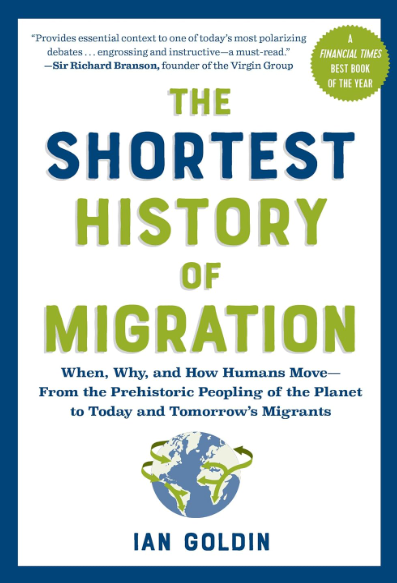


Migration is one of the most widely discussed topics of our time. Many public conversations present human movement as a crisis or a source of instability. Ian Goldin’s book, The Shortest History of Migration, takes a very different approach. It argues that migration is a normal part of human life and a powerful force that has shaped societies for thousands of years.
This article introduces the main ideas of the book in a way that helps readers prepare for discussion, reflection, and shared interpretation.
- Migration is a basic feature of human history
Goldin opens the book with a simple and important point. Human beings have always moved. Early humans moved in search of food, safety, and better climates. Later societies moved for trade, exploration, education, conflict, and opportunity. Movement has been part of how communities survived and adapted.
This perspective helps the reader understand why modern debates often feel disconnected from history. Many societies treat migration as if it is unusual or disruptive. Goldin shows that this view is historically inaccurate. Movement has shaped every era, every continent, and every major cultural shift.
For book club readers, this idea invites a useful question. If migration has always existed, why are modern societies so unsure about how to talk about it?
- Movement often leads to creativity and progress
Goldin spends a significant portion of the book showing how migration has supported innovation and growth. When people move, they bring ideas, skills, technologies, and new ways of thinking. This process has helped create vibrant cities, strong trade networks, and periods of scientific and artistic expansion.
Examples include the growth of Mediterranean trading ports, the cultural exchanges along the Silk Road, and the scientific developments of the Renaissance. In all of these cases, newcomers contributed knowledge that enriched the societies they joined.
This theme offers a second question for book club discussion. If history shows that migration brings creativity and development, why do some societies fear it today?
- Modern borders are new, and our attitudes toward them are even newer
Goldin explains that strict border systems are not ancient traditions. They are recent political creations. Modern passport and visa controls developed mainly in the early twentieth century, especially during wartime. Before that period, movement across regions was much more fluid.
Understanding this history is important because many people assume that strong borders have always existed. Goldin encourages readers to recognize that current policies reflect new political attitudes and not long standing human customs.
A valuable discussion point here is the contrast between the long history of free movement and the short history of strict border control. Why did these systems develop when they did, and what do they represent?
- Goldin challenges common myths about migration
One of the strengths of the book is its clear explanation of what migration looks like today, based on real data.
Goldin highlights four key facts.
- Global migration is not as large as many believe. Only a small share of the world’s population lives outside its country of birth.
• Most migrants move to nearby countries rather than across continents.
• Migrants generally contribute more economically than they receive in public services.
• Many societies exaggerate the scale of irregular migration, while ignoring how much they depend on migrant labor in essential sectors.
These points help readers separate emotional reactions from actual demographic reality. They also create space for thoughtful group discussion about how myths influence public opinion.
- Climate change will reshape migration patterns
Goldin dedicates a section of the book to the future. Environmental pressures will influence movement in new ways. Rising temperatures, water scarcity, storms, and sea level rise will push some communities to relocate. These shifts will not happen all at once. They will appear gradually in multiple regions and for different reasons.
Goldin argues that the question is not whether people will move, but how societies will prepare for that movement. This part of the book invites readers to think about long term planning, adaptation, and responsibility.
A book club would certainly discuss the following. How should societies prepare for climate driven mobility, and what ethical questions arise from this challenge?
- Relevance for diaspora communities
Goldin’s ideas speak strongly to communities with long histories of migration, including Lebanese communities worldwide. Lebanese mobility has often been shaped by opportunity, conflict, and global networks. Goldin’s argument that migration is normal and historically common might feel familiar to readers who come from families with their own stories of movement.
The book also highlights the importance of networks, community support, and shared knowledge. These elements are central to the success of any diaspora, and they are part of what Cedar Whispers aims to cultivate. Goldin’s work supports the idea that communities thrive when they maintain bonds across countries and generations.
This idea aligns with comments made by Lena Metlege Diab, who has stated publicly that immigrant communities strengthen Canada by contributing skills, culture, and long term civic engagement. “Immigrants enrich our social fabric and help sustain our economic future”, a sentiment that reflects Goldin’s thesis.
The Shortest History of Migration provides a balanced and evidence-based overview of one of the most misunderstood subjects in public debate. Goldin shows that movement is not an interruption of normal life. It has always been part of human development and remains essential to the future.
For book club readers, the text offers a foundation for thoughtful discussion. It encourages questions about history, identity, public perception, and the role of migration in shaping both individual experiences and entire societies.

1 Comment
Ahmad
March 11, 2026, at 11:59 amHye