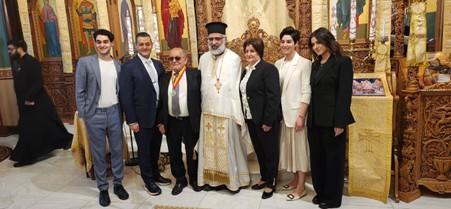



On May 24, 2025, under the radiant skies of Halifax, something sacred and unforgettable unfolded. It wasn’t a concert or a parade, but it drew hundreds. It wasn’t a political rally, yet it gathered dignitaries. It wasn’t a museum opening, and yet—a masterpiece was unveiled. The Lebanese Orthodox community of Halifax gathered, not simply to witness a moment, but to live one: the consecration of St. Antonios Antiochian Orthodox Church.
From Roots to Revival: A Legacy in Halifax
The story of St. Antonios Antiochian Orthodox Church begins long before the oil touched the altar in 2025. Lebanese and Syrian immigration to Canada began before 1900, with many continuing onward to the United States. Those who stayed in Halifax attended Saint George’s Greek Orthodox Church, but language barriers led to the hope for a parish where Arabic, English, and French could be used in the Divine Liturgy.
In 1980, that hope became a mission. With the blessing of Metropolitan of the Antiochian Orthodox Christian Archdiocese of North America, the parish was founded under the patronage of St. Anthony the Great.
Later that same year, Archbishop Saliba visited Halifax to witness firsthand the devotion of this growing community. His visit marked the spiritual endorsement of what would become a decades-long labor of love, culminating in the consecration of the magnificent Second Temple in 2025.
The Altar: A Living Heart
More Than a Church — A Mosaic of Orthodoxy in Canada
An Icon of Unity: Lebanese Dignitaries and Churches Stand Together
Wadih Fares, Honorary Consul of Lebanon in Halifax, stood with the faithful not as an observer, but as a devoted pillar of the community. His support throughout the years, and his visible presence during the consecration, reminded everyone that Lebanon beats proudly in Nova Scotia. For his service, he was awarded the Archdiocesan Medal of St. Raphael. He returned the honor by presenting a thoroughly handcrafted miniature of the church, a gift prepared by the team of his company W.M. Fares.
So too was the presence of The Honourable Lena Metlege Diab, Canada’s Minister of Immigration, Refugees, and Citizenship—a daughter of this community whose presence connected faith and public service.
Even more powerful was the solidarity from the Maronite community of Our Lady of Lebanon Church. Among the many Maronite faithful in attendance was Father Eid, who stood side by side with Orthodox clergy, a witness to the unity of Lebanon’s Christian heart.
A Legacy Remembered, a Legacy Renewed

At the heart of it all stood Archpriest Maximos Saikali, who has faithfully led the parish since 1991. It was deeply moving to witness generations of families—the Lawens, the Haddads, and many others—recognized for the love and labor they poured into making this vision a reality.
Echoes of Thjodhilde’s Church: A Sacred Parallel
In many ways, the consecration of St. Antonios calls to mind Thjodhilde’s Church in Greenland—the first Christian church built in the Western Hemisphere and, symbolically, the last parish established before the Great Schism of 1054. Just as that remote church was planted at the edge of the known world, so too does St. Antonios rise at the Atlantic edge of Canada.
We Were There
On that Saturday, Halifax was not just a city. It was a cathedral. From the oil poured on the altar to the incense that clouded the air, from the solemn chanting to the laughter of children, St. Antonios was reborn.
We were there.
We saw the Lebanese community as one family. We saw the past, present, and future kneeling side by side.
And in that moment, we knew this was more than the consecration of a church.
It was the consecration of a people.